Copy of 7.) Transcription Models (5/28/2026)
star
star
star
star
star
Last updated 3 months ago
9 Nsɛmmisa
Untitled Section 1
2
Processing of mRNA Questions
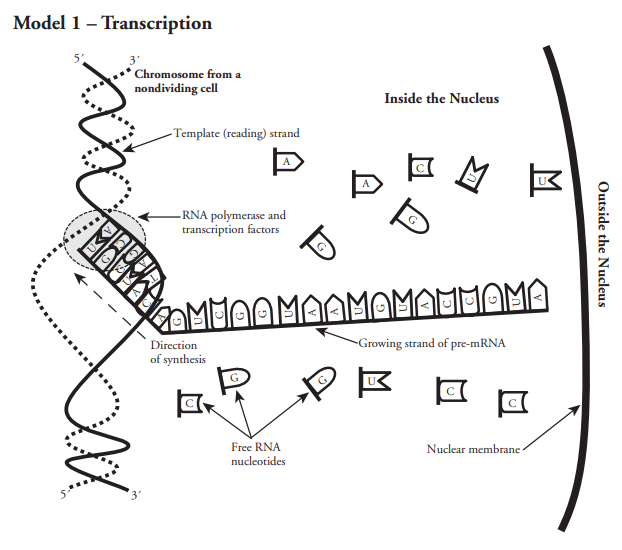
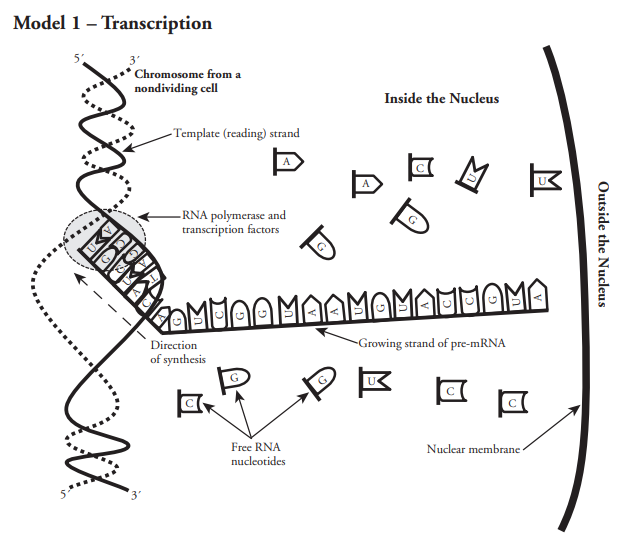
This model displays a piece of mRNA being copied from a segment of DNA; this process is called transcription.
a.) Where in the cell is the DNA found (examine the model)?
b.) Where in the cell is transcription taking place (examine the model)?
a.) What is being synthesized during transcription?
b.) What monomers are used to construct this molecule?
According to this model, what enzyme is used during transcription?
In the are where RNA polymerase is, a small section of RNA and DNA are paired up. Notice the based of the DNA and RNA pair up in a similar manner that DNA bases pair up.
a.) What is the name of the rule that describes how bases pair up?
b.) According to the model, using the provided DNA nucleotides, what RNA nucleotides would pair with each?
DNA — RNA
A —
T —
C —
G —
c.) According to the model, which strand of DNA is used to make the mRNA strand?
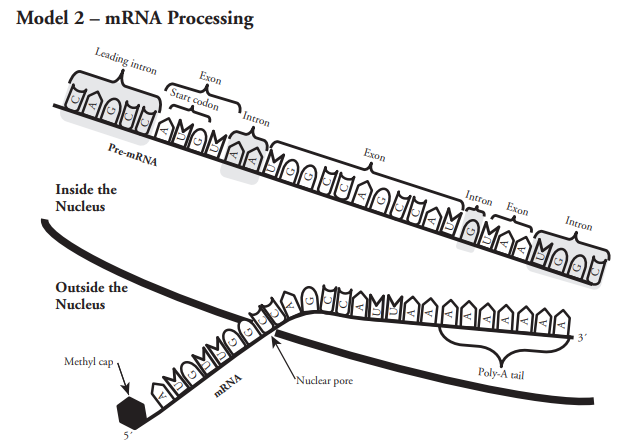
Contrast the mRNA at the top of the model with the mRNA at the bottom of the model.
a.) What was removed from the pre-mRNA to form the mRNA?
b.) What was added to the mRNA that was not present in the pre-mRNA?
Which molecule leaves the nucleus?
During translation, the mRNA will be read from 5' to 3' to make a protein. Examine the sequence of RNA nucleotides at the 5' end in the mRNA and the pre-mRNA; look at the labels of each section of nucleotides on the pre-mRNA.
a.) What do you think is the name of the area on the mRNA that is read first during translation?
b.) What is the sequence of RNA nucleotides of the area read first during translation?
What end of the mRNA is the methyl cap?
Introns are segments of pre-mRNA that do not code for proteins. In other words, they don’t contain information needed for making the polypeptide being synthesized. Research shows that introns can allow certain regions of DNA to produce different polypeptides by removing different sections of genetic material. Many, to most or all, of these introns are removed during the processing. This removal process is triggered by specific signaling responses within the cell. The parts of the pre-mRNA that remain after this editing are called exons.
The methyl-G cap—also known as the GTP cap or 5ʹ cap—helps the mRNA move through the nuclear pore and attach to a ribosome, where protein synthesis happens. mRNA is a short-lived or transient molecule; once it’s in the cytoplasm, enzymes called exonucleases quickly begin breaking it down by removing nucleotides from the 3ʹ end. These released nucleotides are then recycled and used again later during transcription to build new mRNA molecules.
a.) Introns are segments of
b.) When different sections of pre-mRNA are removed in response to cell signals, certain regions of DNA can produce different
c.) The parts of the pre-mRNA that stay after specific segments are removed are
d.) The
e.) In the cytoplasm, enzymes called