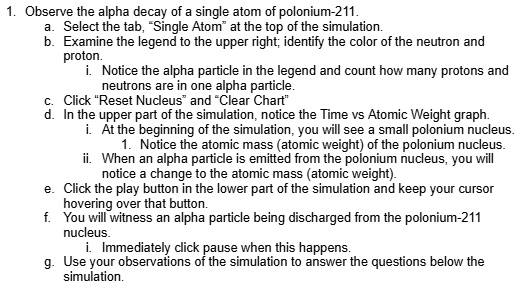
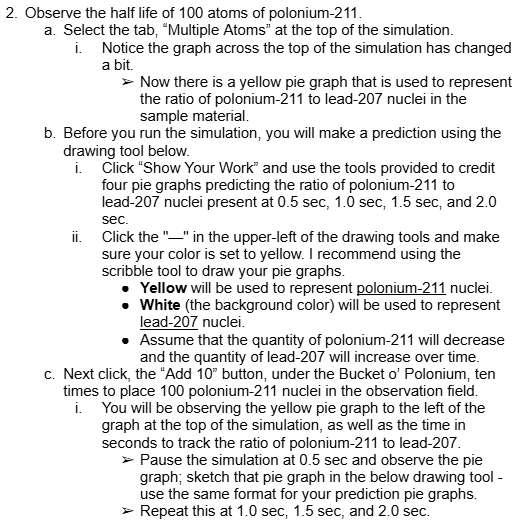
Copy of 3.) Alpha Decay Lab (5/28/2026)
star
star
star
star
star
Last updated 3 months ago
6 Nsɛmmisa
Alpha Decay Lab
Post-Lab Independent Work
In the alpha particle how many of each are there:
Protons
Neutrons
What element nucleus is formed from polonium-211 after the alpha particle is emitted?
What is its atomic mass (atomic weight)?
If polonium-211 has 84 protons and 127 neutrons, how many protons and neutrons would be in the nucleus of the atom formed (answer to the above blank) from the alpha decay of polonium-211?
Protons
Neutrons
Use the drawing/scribble tool to help you with this.
Create a nuclear equation for the alpha decay of polonium-211.
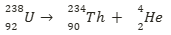
Here is the nuclear equation for the alpha decay of uranium-238, use it as a guide to write the nuclear equation for polonium-211.
Decay in chemistry refers to changes in the nuclei of certain atoms.
Radioactive elements and isotopes have unstable nuclei. To become more stable, the nuclei undergo radioactive decay. In radioactive decay, the nuclei give off, or emit, radiation in the form of energy and often particles as well. There are several types of radioactive decay, including alpha, beta, and gamma decay. Energy is emitted in all three types of decay, but only alpha and beta decay also emit particles.
Alpha decay occurs when a nucleus is unstable because it has too many protons. The Figure below shows what happens during alpha decay. The nucleus emits an alpha particle and energy. An alpha particle consists of two protons and two neutrons, which is actually a helium nucleus. Losing the protons and neutrons makes the nucleus more stable.
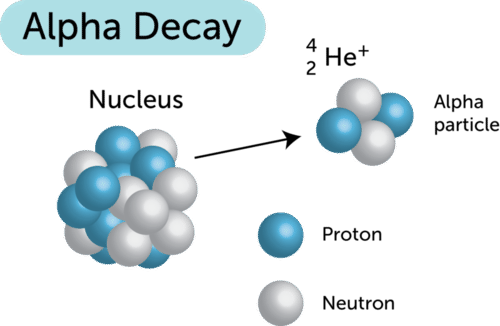
[Figure 2]
Radioactive nuclei and particles are represented by nuclear symbols that indicate their numbers of protons and neutrons. For example, an alpha particle (helium nucleus) is represented by the symbol , where He is the chemical symbol for helium, the subscript 2 is the number of protons, and the superscript 4 is the mass number (2 protons + 2 neutrons).
Nuclear symbols are used to write nuclear equations for radioactive decay. Let’s consider an example. Uranium-238 undergoes alpha decay to become thorium-234. (The numbers following the chemical names refer to the number of protons plus neutrons.) In this reaction, uranium-238 loses two protons and two neutrons to become the element thorium-234. The reaction can be represented by this nuclear equation:

Total Mass Number
Left Side = 238
Right Side = 234 + 4 = 238
If you count the number of protons (subscripts) as well as the number of protons plus neutrons (superscripts), you’ll see that the total numbers are the same on both sides of the arrow. This means that the equation is balanced. The thorium-234 produced in this reaction is also unstable, so it will undergo radioactive decay as well. The alpha particle (helium nucleus) that is produced in the reaction can join with two free electrons to form the element helium. This is how most of Earth’s helium formed.
All types of radioactive decay pose risks to living things, but alpha decay is the least dangerous. That’s because alpha particles are relatively heavy, so they can travel only a few centimeters through the air. They also are not very penetrating. For example, they can’t pass through a sheet of paper or thin layer of clothing. They may burn the skin, but they can’t penetrate to the tissues underneath the skin. However, if alpha particles are emitted inside the body, they can do more damage. One way this can happen is by inhaling cigarette smoke. People who smoke actually inhale the radioactive element polonium-210. It undergoes alpha decay in the lungs. Over time, exposure to alpha particles may cause lung cancer.
a.) Alpha decay occurs because the nucleus has too many
b.) During alpha decay, the nucleus emits two things:
c.) An alpha particle consists of two things:
d.) An alpha particle is the same thing as a
e.) In the nuclear symbol for an alpha particle, the subscript 2 represents the number of
f.) In the nuclear symbol for an alpha particle, the superscript 4 represents the
g.) In alpha decay of uranium-238, the nucleus loses two protons and two neutrons to become
h.) Alpha particles are not very penetrating, so they can’t pass through a sheet of
Predictions Instructions:
Click “Show Your Work” and use the tools provided to credit four pie graphs predicting the ratio of polonium-211 to lead-207 nuclei present at 0.5 sec, 1.0 sec, 1.5 sec, and 2.0 sec.
Click the "—" in the upper-left of the drawing tools and make sure your color is set to yellow. I recommend using the scribble tool to draw your pie graphs.
Yellow will be used to represent polonium-211 nuclei.
White (the background color) will be used to represent lead-207 nuclei.
Assume that the quantity of polonium-211 will decrease and the quantity of lead-207 will increase over time.
Observation Instructions:
Record the pie graph in the simulation at 0.5, 1.0, 1.5, and 2.0 seconds.
Use the same format used to make your predictions.
Is it reasonable to assume that if you start with 10 atoms of Polonium, that 0.5s later only 5 will remain undecayed? What if you start with 500 atoms? Explain.
Alpha particles cannot penetrate skin, therefore, they cannot cause disease.