Log in
Sign up for FREE
arrow_back
Library

Copy of Energy Flow in Ecosystems - Models (5/28/2026)

star
star
star
star
star
Last updated about 3 hours ago
11 questions
4
1
1
1
Every organism in an ecosystem is either eating or being eaten. When cows eat grass, they obtain some of the energy that the grass transferred from the sunlight it absorbed. If cows could carry out photosynthesis, would they have access to more energy than they get as herbivores? Which organisms in an ecosystem require the most energy to sustain life?
The unit of energy used to measure energy is kcal (kilocalorie).
2
Question 1
1.
Question 2
2.
Other Answer Choices:
3
Question 3
3.
3
Question 4
4.
6
Question 5
5.
Question 6
6.

Using your answers from the above questions, why would energy pyramids in an ecosystem typically be limited to four or five levels.

Question 7
7.

Propose an explanation for why populations of top carnivores, such as hawks, are always smaller than the populations of herbivores, such as caterpillars.

Question 8
8.
Read This!
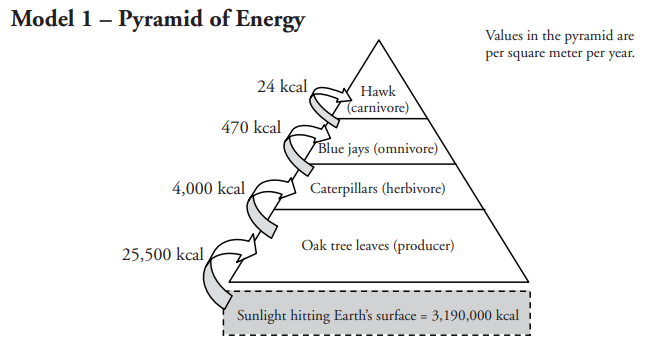
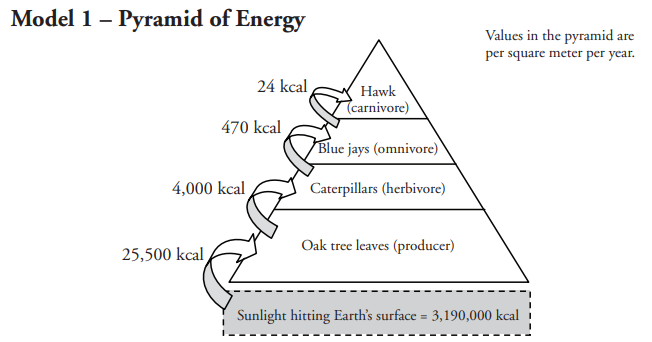
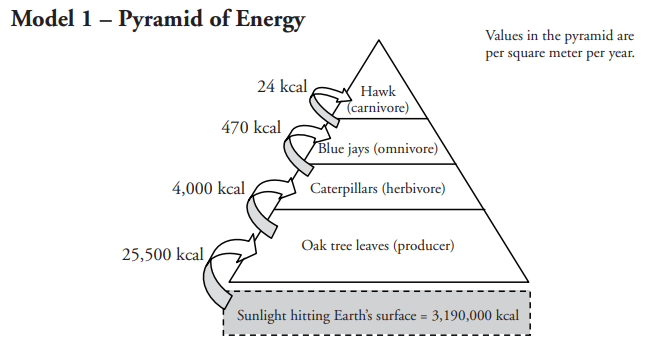
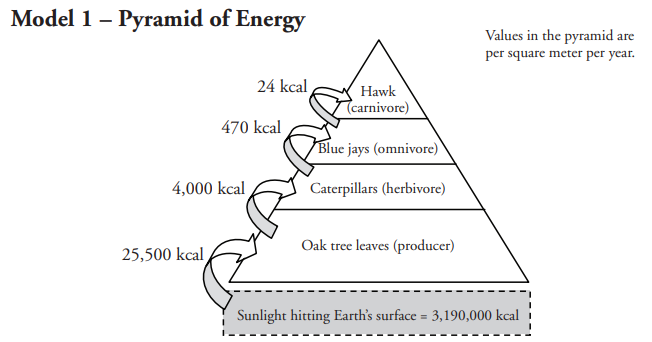
Each level in the pyramid in Model 1 is a trophic level. The word “trophic” refers to feeding or nutrition. Model 1 shows one example of one organism that would be included in each level, but each level in an ecosystem includes many species of organisms.

What is the overall name given to each level of an energy pyramid? _______
7
Question 9
9.
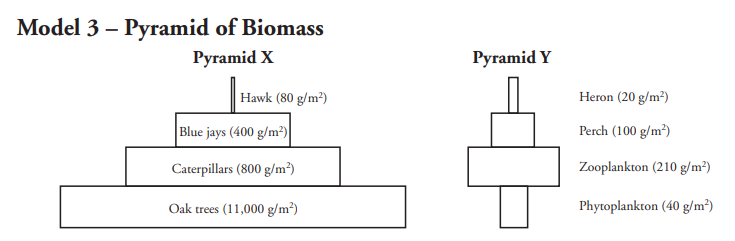
The units for biomass in the above two pyramids are g/m2 (grams per square meter).
4
Question 10
10.
Read This!

Phytoplankton are microscopic aquatic organisms that are quickly consumed by microscopic animals (zooplankton). Because they are eaten so quickly there is a need for the phytoplankton to reproduce rapidly for survival.
2
Question 11
11.

a.) What is the source of all energy in the pyramid in Model 1? _______

b.) How much energy does this source provide to a square meter of the Earth per year? (Be sure your answer includes units.) _______
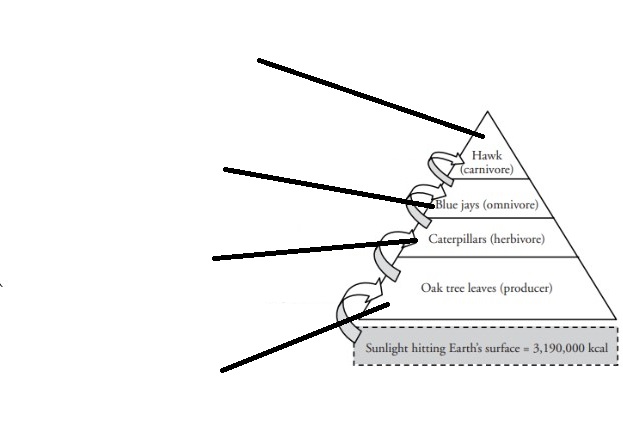
Identify which level would be:
  • primary producers
  • primary consumers
  • secondary consumers
  • tertiary consumers
tertiary consumers
secondary consumers
primary consumers
primary producers
The arrows in Model 1 represent the energy available to the next level of the pyramid (use a calculator for this part - see the tip for the formula/calculator).

a.) What percentage of energy is absorbed by the oak leaves (round to the nearest 10th)? _______

b.) What process will the oak leaves use to harness this energy? _______

c.) How do the consumers at one level obtain energy from the organisms in the previous level? _______
Refer to Model 1:
a.) How much energy per year do the caterpillars obtain from eating the leaves in a square meter of the oak tree (don't forget the units)? _______

b.) What percentage of the energy that was originally absorbed by the oak leaves is passed on to the caterpillars (round to the nearest 10th)? _______

c.) What percentage of the energy absorbed by the oak leaves is not passed on to the caterpillars? _______
Calculate the percentage of energy that is transferred from one level of the pyramid in Model 1 to another for all of the levels (round to the nearest 10th).

a.) Oak leaves to caterpillars _______
b.) Caterpillars to Blue Jays _______
c.) Blue Jays to Hawk _______

Calculate the average percentage of energy that is transferred from one level to another using the above answers (round to the nearest 10th)

d.) Average energy transferred _______

e.) What percentage of the caterpillars' original energy is available to the hawk (round to the nearest 100th)? _______

f.) What percentage of the oak leaves' original energy is available to the hawk (round to the nearest 100th)? _______
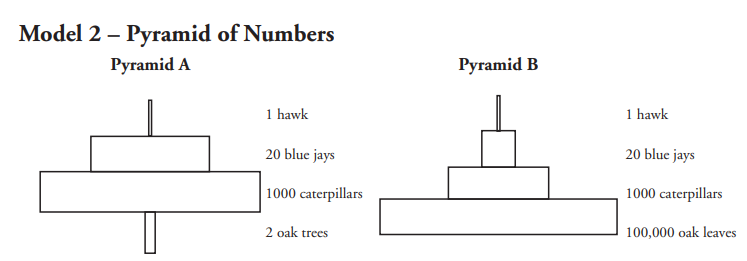
Compare and contrast the two pyramids in Model 2. Provide two similarities and one difference.

a.) Similarities: _______ and _______
b.) Differences: _______

Examine the 2nd, 3rd, and 4th trophic levels of both pyramids.

c.) Do the number of organisms differ at each trophic level when you compare each pyramid? _______

Examine the 1st trophic level - the primary producers.

d.) Are the two pyramids discussing the same or a different organism? _______

e.) Which of the two pyramids provides a more accurate account of what occurs in this ecosystem? _______

f.) Briefly explain your answer to the above question (e). _______
Biomass refers to the mass of living organisms at each trophic level.

a.) What is the mass of the oak trees in Pyramid X of Model 3? _______ g/m2

b.) What is the mass of the phytoplankton in Pyramid Y of Model 3? _______ g/m2

c.) Identify the overall trend in biomass as you move up the trophic levels in pyramid X (I have to regrade this one): _______

d.) Is the trend in biomass in pyramids X and Y the same? _______
Propose an explanation for why the Pyramid Y ecosystem can exist with a smaller biomass at the primary producer level.