Log in
Sign up for FREE
arrow_back
Library

Copy of Electrons and Orbitals Intro (Videos) (5/28/2026)

star
star
star
star
star
Last updated about 2 hours ago
11 questions
Note from the author:
Untitled Section
Exit Ticket
Required
0
Required
0
HS-PS1-1 Use the periodic table as a model to predict the relative properties of elements based on the patterns of electrons in the outermost energy level of atoms.

Learning Goals (I can...):
1. explain the relationship between the periodic table and electron orbitals.
2. explain why electrons have orbitals.
3. explain the concept of valence and where the valence electrons are in an atom.
4. explain the difference between a long-hand and a short-hand notation for electron configurations.
HS-PS1-1 Use the periodic table as a model to predict the relative properties of elements based on the patterns of electrons in the outermost energy level of atoms.

Learning Goals (I can...):
1. explain the relationship between the periodic table and electron orbitals.
2. explain why electrons have orbitals.
3. explain the concept of valence and where the valence electrons are in an atom.
4. explain the difference between a long-hand and a short-hand notation for electron configurations.
Questions 1 & 2
00:00
keyboard_arrow_down
1
13
Questions 3 & 4
00:01
keyboard_arrow_down
1
1
1
Question 5
5.
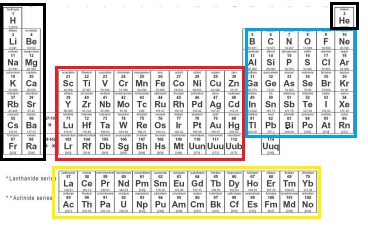
What type of orbital would be found in this section of the periodic table? _______
1
1
1
Text, Question 9
00:00
keyboard_arrow_down
Use the video to help you answer the following questions - the video will not pause.
10
Question 10
10.

Describe one or two concepts or ideas from this activity that you learned.

Question 11
11.

Describe one thing (other than hybridization of orbitals) that you would like to know more about or would like Mr. Poe to explain during this unit.

Question 1
1.

Question 2
2.
a.) Before quantum mechanics, electrons seemed to just be particles _______ around the nucleus.

b.) The energy given off by electrons is referred to as _______

c.) Electrons don’t really behave like particles. They are more like _______.

d.) Electrons exist in _______, they also exist in shells.
i.) The first shell, the _______ orbital, has only _______ orbital which can only fit _______ electrons.
ii.) The second shell, the _______ orbital, has _______ configurations and can fit _______ electrons per part (configuration) for a total of _______ electrons. The electrons of the p and s orbitals are the 8 electrons referred to in the _______ rule, which refers to how many electrons atoms want to have in their outer shell.
iii.) The third shell has a third kind of orbital, the _______ orbital.
Question 3
3.

Question 4
4.
The amount of energy need to remove an electron from an atom is called the _______ energy.
Question 6
6.
What type of orbital would be found in this section of the periodic table? _______
Question 7
7.
What type of orbital would be found in this section of the periodic table? _______
Question 8
8.
What type of orbital would be found in this section of the periodic table? _______
Question 9
9.
Use the video (above) to help you answer these questions.

a.) In an atom, electrons exist around _______.
b.) Bonds form from _______ electron clouds or shells.
c.) Electrons exist as both _______ and _______.
d.) Wave functions are mathematical probabilities that an _______ is in a certain place at any given moment.
e.) The simplest wave function is the _______ which can contain _______ electrons and has a _______ shape.
f.) Other than the s orbital, other types of orbitals that exist include the:
  • _______ which can contain up to _______ electrons.
  • d orbitals which can contain up to 10 electrons.
  • f orbital which can contain up to 14 electrons.
We will not concern ourselves with orbital hybridization in this course.
Today, many people understand electrons.
True
False
The d orbital doesn’t have as strong a need to be filled as the p and s orbitals.
True
False