Log in
Sign up for FREE
arrow_back
Library

Copy of Ionic Bonding 3 - Polyatomic Ions (5/28/2026)

star
star
star
star
star
Last updated about 2 hours ago
8 questions
3
3
3
2
2
2
2
3

Review of Ionic Bonding

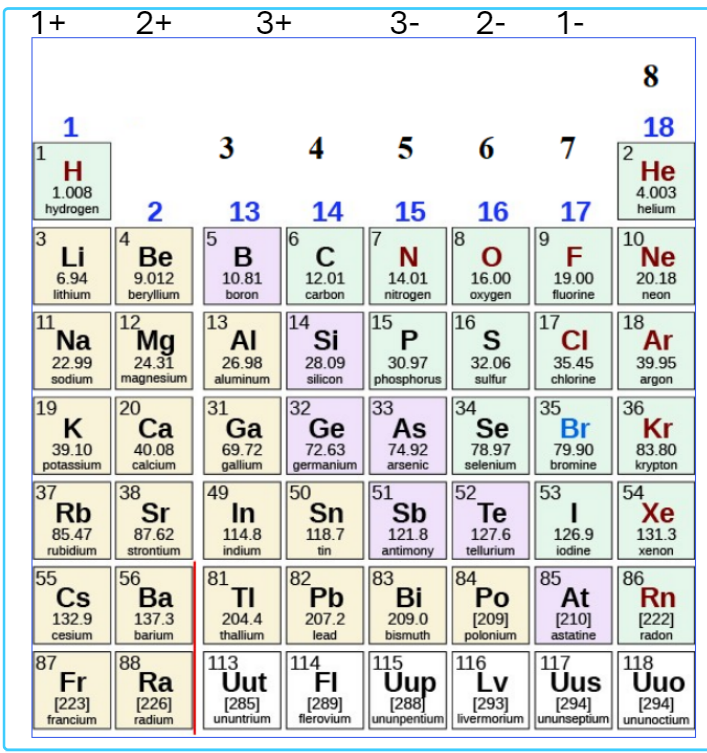
  • Occurs to satisfy the rule of octet - so that all atoms involved have full valence energy levels.
  • Electrons are transferred - from the metal to the non-metal.
  • Forms two ions (cations - positively charged; anions - negatively charged) that bond via electrostatic attraction.
  • The overall charge of the compound must be neutral (0 charge) - the charge of the cation and the anion must balance each other out.
  • Subscripts (numbers to the bottom-right of each element abbreviation) are used to increase the amount of the metal and/or the non-metal to balance out the charges of the cation and anion in the compound.
  • When subscripts are added, it multiplies the charge of each ion.
  • To name a compound, the name of the metal is not changed; the last syllable of the non-metal is replaced with "ide" - unless the compound has a polyatomic ion.

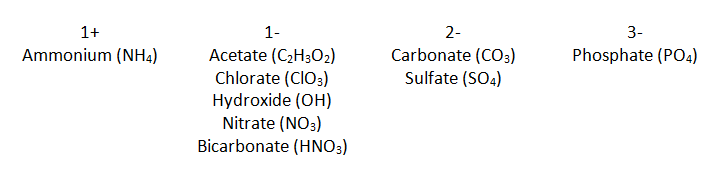
Polyatomic Ions:

  • A single ion is constructed of multiple atoms.
  • It could be a cation or an anion.
  • Do not alter the name of a polyatomic when naming an ionic compound.
  • Examples:


Question 1
1.
Calcium + Nitrogen → Ca + N → (ions) _______ and _______.
Which is the Cation or Anion? Ca ion: _______; N ion: _______
Compound Formula: _______
Name: _______
Question 2
2.
Strontium + Bromine → Sr + Br → (ions) _______ and _______.
Which is the Cation or Anion? Br ion: _______; Sr ion: _______
Compound Formula: _______
Name: _______


Question 3
3.
Potassium + Selenium → K + Se → (ions) _______ and _______.
Which is the Cation or Anion? K ion: _______; Se ion: _______
Compound Formula: _______
Name: _______
Question 4
4.
Sodium + Phosphate → Na + PO4 → (ions) _______ and _______.
Compound Formula: _______
Name: _______


Question 5
5.
Ammonium + Hydroxide → NH4 + OH → (ions) _______ and _______.
Compound Formula: _______
Name: _______
Question 6
6.
Potassium + Acetate → K + C2H3O2 → (ions) _______ and _______.
Compound Formula: _______
Name: _______


Question 7
7.
Lithium + Phosphate → Li + PO4 → (ions) _______ and _______.
Compound Formula: _______
Name: _______
Question 8
8.
Write the name of the following ionic formulae:
a. Mg(PO4)2 _______
b. Ca(OH)2 _______
c. H3PO4 _______