La lectura en Español - https://docs.google.com/document/d/1-dRyuk530ZqGgi776OPAD5n7qoE_jG7GepuZMo5f5y0/copy
Covalent Bonding
Sharing Electrons
A covalent bond is the force of attraction that holds together two atoms that share a pair of valence electrons. The shared electrons are attracted to the nuclei of both atoms. This forms a molecule consisting of two or more atoms. Covalent bonds form only between atoms of nonmetals.
Covalent Compounds and Diatomic Elements
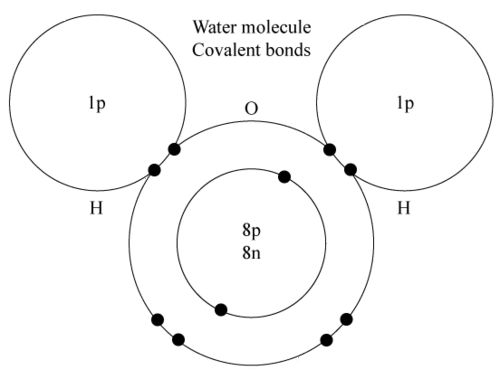
The two atoms that are held together by a covalent bond may be atoms of the same element or different elements. When atoms of different elements form covalent bonds, a new substance, called a covalent compound, results. Water is an example of a covalent compound. A water molecule is modeled in the Figure below. A molecule is the smallest particle of a covalent compound that still has the properties of the compound.
9
Q: How many valence electrons does the oxygen atom (O) share with each hydrogen atom (H)? How many covalent bonds hold the water molecule together?
A: The oxygen atom shares one pair of valence electrons with each hydrogen atom. Each pair of shared electrons represents one covalent bond, so two covalent bonds hold the water molecule together.
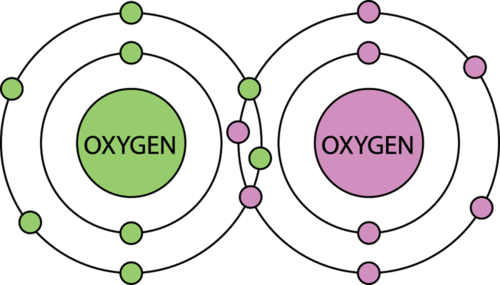
The diagram in the Figure below shows an example of covalent bonds between two atoms of the same element, in this case two atoms of oxygen. The diagram represents an oxygen molecule, so it’s not a new compound. Oxygen normally occurs in diatomic (“two-atom”) molecules. Several other elements also occur as diatomic molecules: hydrogen, nitrogen, and all but one of the halogens (fluorine, chlorine, bromine, and iodine).
Q: How many electrons do these two oxygen atoms share? How many covalent bonds hold the oxygen molecule together?
A: The two oxygen atoms share two pairs of electrons, so two covalent bonds hold the oxygen molecule together.
5
Why Covalent Bonds Form
Covalent bonds form because they give atoms a more stable arrangement of electrons. Look at the oxygen atoms in the Figure above. Alone, each oxygen atom has six valence electrons. By sharing two pairs of valence electrons, each oxygen atom has a total of eight valence electrons. This fills its outer energy level, giving it the most stable arrangement of electrons. In the diatomic oxygen molecule, the shared electrons are attracted to both oxygen nuclei, and this force of attraction holds the two atoms together in the oxygen molecule.
4
Question 3
3.
11
Question 4
4.
8
Question 5
5.
5
Question 6
6.
Question 1
1.
Sharing Electrons
A _______ is an attractive force that holds two atoms together by the sharing of _______. Covalent bonds form between atoms of _______.
Covalent Compounds and Diatomic Elements
The atoms that are held together by a covalent bond may be atoms of the _______ or _______. When atoms of different elements form covalent bonds a _______ forms (a new substance). An example of this is a molecule of _______.
In a molecule of water, the oxygen atom shares _______ electrons with each hydrogen atom. Since the oxygen atom shares electrons with two hydrogen atoms, _______ covalent bonds are in a molecule of water.
Question 2
2.
Oxygen gas normally occurs as a _______ molecule, meaning that it is constructed of two of the same atom. There are a total of seven diatomic molecules - chlorine, _______, fluorine, _______, bromine, _______, and nitrogen. These seven are often listed as an acronym - ClIF H BrON.
Oxygen, and the other diatomic molecules, share _______ of electrons.
Why Covalent Bonds Form
Covalent bonds are formed because they give atoms a _______ arrangement of electrons. This occurs by filling the _______. In the diatomic oxygen molecule (as well as other covalently bonded molecules), the shared electrons are _______ to both _______ .
Energy and Covalent Bond Formation
Why do BeCl2 and LiCl bond differently?
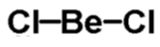
We have learned that halide salts of elements in group 1 are typically ionic compounds. We would expect LiCl to exist as Li+ cations and Cl- anions (and it does). However, if we move one column to the right, lithium’s neighbor beryllium forms a different type of bond altogether. This bond consists of shared electrons between the Be and Cl atoms, not electrostatic attraction among ions.
Energy and Covalent Bond Formation
Molecular compounds are those that take the form of an individual molecule. Molecular compounds are generally comprised of two or more nonmetal atoms. Familiar examples include water (H2O), carbon dioxide (CO2) and ammonia (NH3). Recall that the molecular formula shows the number of each atom that occurs in a molecule of that compound. One molecule of water contains two hydrogen atoms and one oxygen atom. Hydrogen (H2) is an example of an element that exists naturally as a diatomic molecule. A diatomic molecule is a molecule containing two of the same atom (i.e. F2, H2, Cl2).
Most atoms attain a lower potential energy when they are bonded to other atoms than when they are separated. Consider two isolated hydrogen atoms that are separated by a distance large enough to prevent any interaction between them. At this distance, the potential energy of the system is said to be equal to zero (see Figure below).
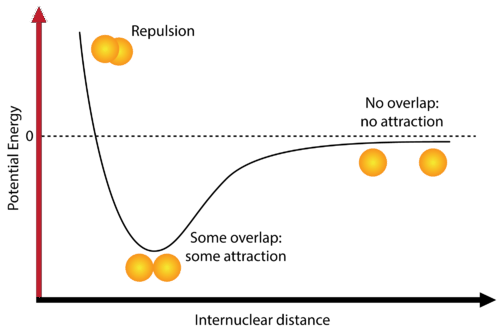
The graph, above, shows how the potential energy of two hydroben atoms changes as a function of their separation distance.
As the atoms approach one another, their electron clouds gradually begin to overlap. Now there are several interactions which begin to occur. One is that the single electrons that each hydrogen atom possesses (which are the valence electrons for hydrogen) begin to repel each other. This repulsive force would tend to make the potential energy of the system increase. However, the electron of each atom begins to be attracted to the nucleus of the other atom. This attractive force tends to make the potential energy of the system decrease.
As the atoms first begin to interact, the attractive force is stronger than the repulsive force and so the potential energy of the system decreases, as seen in the diagram, above. Remember that as potential energy decreases this causes the stability of the system (interacting atoms) to increase. As the two hydrogen atoms move closer and closer together, the potential energy continues to decrease. Eventually, a position is reached where the potential energy is at its lowest possible point. If the hydrogen atoms move any closer together, a third interaction begins to dominate and that is the repulsive force between the two positively-charged nuclei. This repulsive force is very strong as can be seen by the sharp rise in energy at the far left of the diagram.
The point at which the potential energy has reached its lowest point represents the ideal distance between hydrogen atoms for a stable chemical bond to occur. This type of chemical bond is called a covalent bond. A covalent bond is a bond in which two atoms share one or more pairs of electrons. The single electrons from each of the two hydrogen atoms are shared when the atoms come together to form a hydrogen molecule (H2).
Energy and Covalent Bond Formation
_______ are those that take the form of an individual molecule. They are typically comprised of two or more _______ . A diatomic molecule is one containing two of the _______ .
Most atoms have a _______ when they are bonded to other atoms than when they are separated.
There are several interactions that occur when the electron clouds of two atoms, like two H atoms, overlap. First, the valence electrons begin to _______. Second the electrons of one atom are _______ of the other atom.
The lower the potential energy the higher the _______ of the atoms that are interacting. The third interaction that occurs when two electron clouds overlap is the _______ between the two positively-charged nuclei of each atom as they become closer to each other.
The point at which the potential energy reaches its lowest point represents the _______ between hydrogen atoms for the greatest amount of stability to occur in the H2 diatomic molecule. The type of chemical bond that forms is a _______. In this type of bond, two atoms _______ one or more pairs of electrons.
Single Covalent Bonds
A covalent bond forms when two orbitals with one electron each overlap each other, causing the electrons to be shared. In the diagram, below, the electrons are respresented by arrows, they point in opposite directions because they repel each other due to the fact that they are negatively-charged and like charges tend to repel. For two hydrogen molecules, orbital overlap and shared valence electrons can be shown as:
Upon formation of the H2 molecule, the shared electrons must have opposite spin (due to repulsive forces between the electrons), so they are shown with opposite spin in the atomic 1s orbital.
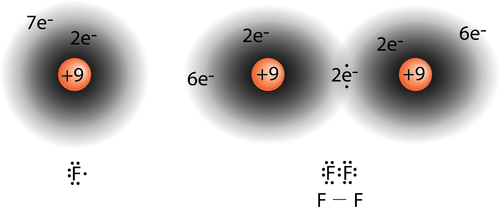
The halogens (group 17 elements and group 7 representative elements) also form single covalent bonds in their diatomic molecules. An atom of any halogen, such as fluorine, has seven valence electrons, which gives them one unpaired electron that could be involved in a single covalent bond. Its unpaired electron is located in the 2p orbital.
The single electrons in the third 2p orbital combine to form the covalent bond:
Figure 4: On the left is a fluorine atom with seven valence electrons. On the right is the F2 molecule (diatomic).
The diatomic fluorine molecule (F2) contains a single shared pair of electrons. Each fluorine atom also has three pairs of electrons that are not shared with the other atom. A lone pair is a pair of electrons in a Lewis dot structure that is not shared between atoms. The oxygen atom in the water molecule shown below has two lone pair sets of electrons. Each fluorine atom has three lone pairs. Combined with the two shared electrons in the covalent bond, each fluorine atom achieves the octet rule of having a full valence energy level.
Single Covalent Bonds
A covalent bond forms when _______ with one electron each _______, causing the electrons to be shared.
Halogens also form _______ in their diatomic molecules. All halogens have _______ valence electrons, this means that they have one _______ that could take part in a single covalent bond.
Flourine atoms also have three pairs of electrons that are _______ with the other atom. A _______ is a pair of electrons in a Lewis dot structure that is not shared with other atoms. When you combine these unshared electrons with the two shared electrons in the covalent bond, each fluorine atom now has a full _______
.
Lewis Dot Structures and Covalent Bonds
Draw the Lewis electron dot structure for water.
Step 1: List the known quantities of valence electrons in atom.
Known
molecular formula of water = H2O
1 O atom = 6 valence electrons
2 H atoms = 2 × 1 = 2 valence electrons
total number of valence electrons = 8
Use the periodic table to determine the number of valence electrons for each atom and the total number of valence electrons. When you draw the Lewis dot structures, arrange the atoms and distribute the electrons so that each atom follows the octet rule. The oxygen atom will have 8 electrons, while the hydrogen atoms will each have 2.
Step 2: Form covalent bonds between unpaired electrons in each atom.
Lewis dot structures for each atom are:
Each hydrogen atom with its single electron will form a covalent bond with the oxygen atom where it has a single electron. The resulting Lewis electron dot structure is:
Step 3: Examine the molecule the ensure that the octet rule is satisfied.
The oxygen atom follows the octet rule with two pairs of bonding electrons and two lone pairs. Each hydrogen atom follows the octet rule with one bonding pair of electrons.
Lewis Dot Structures and Covalent Bonds
Covalent bonds can be demonstrated by drawing Lewis dot structures. There are three steps in this process.
Step 1 - List the known _______ in each atom. Use the _______ to determine this. Draw each Lewis dot structure so that the electrons on each atom follows the _______ .
Step 2 - form covalent bonds between _______ in each atom.
Step 3 - examine the molcule to ensure that the _______ is satisfied. All atoms must have a full valence energy level and all electrons should be in pairs.