The Kinetic-Molecular Theory
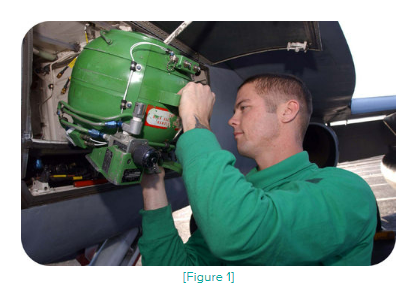
Approximately 20% of the atmosphere is oxygen. This gas is essential for life. In environments where oxygen is in low supply, it can be provided from a tank. Since gases are very compressible, a large amount of oxygen can be stored in a relatively small container. When it is released, the volume expands and the pressure decreases. The gas is then available for breathing under normal pressure.
The kinetic-molecular theory is a theory that explains the states of matter and is based on the idea that matter is composed of tiny particles that are always in motion. The theory helps explain observable properties and behaviors of solids, liquids, and gases. However, the theory is most easily understood as it applies to gases and it is with gases that we will begin our detailed study. The theory applies specifically to a model of a gas called an ideal gas. An ideal gas is an imaginary gas whose behavior perfectly fits all the assumptions of the kinetic-molecular theory. In reality, gases are not ideal, but are very close to being so under most everyday conditions.
The kinetic-molecular theory as it applies to gases has five basic assumptions.
Gases consist of very large numbers of tiny spherical particles that are far apart from one another compared to their size. The particles of a gas may be either atoms or molecules. The distance between the particles of a gas is much, much greater than the distances between the particles of a liquid or a solid. Most of the volume of a gas, therefore, is composed of the empty space between the particles. In fact, the volume of the particles themselves is considered to be insignificant compared to the volume of the empty space.
Gas particles are in constant rapid motion in random directions. The fast motion of gas particles gives them a relatively large amount of kinetic energy. Recall that kinetic energy is the energy that an object possesses because of its motion. The particles of a gas move in straight-line motion until they collide with another particle or with one of the walls of its container.
Collisions between gas particles and between particles and the container walls are elastic collisions. An elastic collision is one in which there is no overall loss of kinetic energy. Kinetic energy may be transferred from one particle to another during an elastic collision, but there is no change in the total energy of the colliding particles.
There are no forces of attraction or repulsion between gas particles. Attractive forces are responsible for particles of a real gas condensing together to form a liquid. It is assumed that the particles of an ideal gas have no such attractive forces. The motion of each particle is completely independent of the motion of all other particles.
The average kinetic energy of gas particles is dependent upon the temperature of the gas. As the temperature of a sample of gas is increased, the speeds of the particles are increased. This results in an increase in the kinetic energy of the particles. Not all particles of gas in a sample have the same speed and so they do not have the same kinetic energy. The temperature of a gas is proportional to the average kinetic energy of the gas particles.
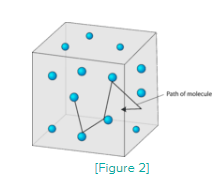
Assumptions of the kinetic-molecular theory:
Gases consist of very large numbers of tiny spherical particles that are far apart from one another compared to their size.
Gas particles are in constant rapid motion in random directions.
Collisions between gas particles and between particles and the container walls are elastic collisions.
There are no forces of attraction or repulsion between gas particles.
The average kinetic energy of gas particles is dependent upon the temperature of the gas.
In what state of matter would molecules be moving the most?
The average kinetic energy of gas particles depend(s) on the
A gas that completely obeys all of the assumptions of the kinetic-molecular theory is called a(n)
Collisions between gas particles and between particles and teh container wall are
The average speed and kinetic energy of the particles in a gas are proportional to the measured
The actual volume of molecule of gas is negligible as compared to the total volume of gas since:
Which best describes the kinetic energy of two gas particles before and after a collision?
What is the relationship between the temperature of a sample of gas and the kinetic energy of the particles of that gas?
What best describes the path of the gas particles in a given sample of gas?
If the attractive forces in a substance is much less than the molecular motion, then the substance will be in
According to the kinetic molecular theory of gas, molecules are in a state of motion that can be described as:
The average kinetic energy of gas molecules is
The constant random motion of gas molecules causes them to
Gas Pressure
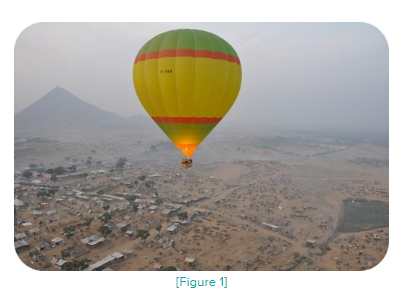
Many people enjoy riding in hot air balloons. Some use them for romantic picnics and marriage proposals. Others race in competitions. Being above the earth gives a whole new perspective on the world around us. As the beginning of a hot air balloon ride, the balloon is flat because the pressure inside the balloon equals the pressure outside. When the air inside the balloon is heated, the speed of movement of those air molecules increases and the pressure goes up. After a while the balloon is completely expanded and the flight is ready to take off.
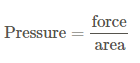
Pressure is defined as the force per unit area on a surface.
When a person stands on the floor, his feet exert pressure on the surface. That pressure is related to both the mass of the person and the surface area of his feet. If the person were holding a heavy object, the pressure would increase because of a greater force. Alternatively, if the person stands on his toes, the pressure also increases because of a decrease in the surface area.
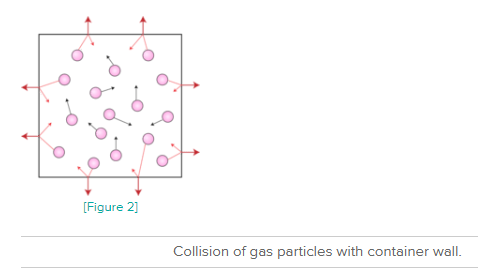
Gas molecules also exert pressure. Earth’s atmosphere exerts pressure because gravity acts on the huge number of gas particles contained in the atmosphere, holding it in place. Pressure is also exerted by a small sample of gas, such as that which is contained in a balloon. Gas pressure is the pressure that results from collisions of gas particles with an object. Inside the balloon, the gas particles collide with the balloon’s inner walls. It is those collisions which keep the balloon inflated. If the gas particles were to suddenly stop moving, the balloon would instantly deflate. Figure below is an illustration of gas particles exerting pressure inside a container.
The pressure inside the hot air balloon is affected by temperature. As the molecules heat up, they move faster and strike the inside wall of the balloon harder. This increased motion of the gas particles increases the force on an area of the balloon, producing a rise in the pressure.
Formula from this section: (P - pressure; f - force; A - area)
P = f/A
f = P(A)
A = f/P or
Pressure is defined as
If some of the gas inside a container is permitted to escape, the pressure of that gas will
A truck has a mass of 7280 pounds. If the pressure exerted by its tires on the ground is 87.5 pounds per square centimeter, what is the area of one tire that's in contact with the road?
Tip - how many tires does the truck have and how many are you trying to solve for?
A marble statue stands on a square pedestal whose side lengths are 2.30 m. Together, the statue and pedestal weigh 3450 N. What is the pressure the statue exerts on the floor in Pa? (Round to the nearest whole number.)
P =
P =
F =