Twa kɔ nsɛm atitiriw so
Log in
Sign up for FREE
arrow_back
Laabri

Copy of Energy - Reading and Questions (5/28/2026)

star
star
star
star
star
Last updated about 1 month ago
13 Nsɛmmisa
1
1
1
1
5
5

Energy

Energy is defined in science as the ability to move matter or change matter in some other way. Energy can also be defined as the ability to do work, which means using force to move an object over a distance. When work is done, energy is transferred from one object to another. For example, when the boy in the Figure below uses force to swing the racket, he transfers some of his energy to the racket.

A boy on a tennis court holding a racket, preparing to hit a tennis ball.

[Figure 2]

Q: It takes energy to play tennis. Where does this boy get his energy?

A: He gets energy from the food he eats.

SI Unit for Energy

Because energy is the ability to do work, it is expressed in the same unit that is used for work. The SI unit for both work and energy is the joule (J), or newton ∙ meter (N ∙ m). One joule is the amount of energy needed to apply a force of 1 newton over a distance of 1 meter. For example, suppose the boy in the Figure above applies 20 newtons of force to his tennis racket over a distance of 1 meter. The energy needed to do this work is 20 N ∙ m, or 20 J.

1
Asemmisa {{asɛmmisaAhyɛnsode}}
1a.

According to the reading, how is energy defined?

1
Asemmisa {{asɛmmisaAhyɛnsode}}
1b.

What is the SI unit for both work and energy?

Energy Has Many Forms

If you think about different sources of energy—such as batteries and the sun—you probably realize that energy can take different forms. For example, when the boy swings his tennis racket, the energy of the moving racket is an example of mechanical energy. To move his racket, the boy needs energy stored in food, which is an example of chemical energy. Other forms of energy include electrical, thermal, light, and sound energy. The different forms of energy can also be classified as kinetic energy, potential energy, or a combination of the two. Kinetic energy is the energy of moving matter. Potential energy is energy that is stored in matter. 

Q: Is the chemical energy in food kinetic energy or potential energy?

A: The chemical energy in food is potential energy. It is stored in the chemical bonds that make up food molecules. The stored energy is released when we digest food. Then we can use it for many purposes, such as raising our arms (mechanical energy) or staying warm (thermal energy).

1
Asemmisa {{asɛmmisaAhyɛnsode}}
2a.

How is chemical energy defined in the context of the boy swinging his racket?

1
Asemmisa {{asɛmmisaAhyɛnsode}}
2b.

What type of energy is exhibited by a moving a golf club?

Asemmisa {{asɛmmisaAhyɛnsode}}
3.

A ball flying through the air toward a soccer goal has what kind of energy?

Asemmisa {{asɛmmisaAhyɛnsode}}
4.

______ energy is stored energy that is related to mass.

Asemmisa {{asɛmmisaAhyɛnsode}}
5.

Which of the following are forms of energy?

Asemmisa {{asɛmmisaAhyɛnsode}}
6.

What is the SI unit of energy?

Potential Energy

A diver poised on a diving board above a pool, preparing to jump.This diver has just jumped up from the end of the diving board. After he dives and is falling toward the water, he’ll have kinetic energy, also known as the energy of moving matter. But even as he momentarily pauses before jumping high above the water, he has energy. Do you know why?

Stored Energy

The diver has energy because of his position high above the pool. The type of energy he has is called potential energy. Potential energy is energy that is stored in a person or object. The person or object often has potential energy because of its position compared to something else or shape.

Q: What is it about the diver’s position that gives her potential energy?

A: Because the diver is high above the water, he has the potential to fall toward Earth because of gravity. This gives him potential energy.

1
Asemmisa {{asɛmmisaAhyɛnsode}}
7a.

What type of energy does the diver have while he is falling toward the water?

1
Asemmisa {{asɛmmisaAhyɛnsode}}
7b.

What is potential energy?

Gravitational Potential Energy

Potential energy due to the position of an object above Earth’s surface is called gravitational potential energy. Like the diver on the diving board, anything that is raised up above Earth’s surface has the potential to fall because of gravity. You can see another example of people with gravitational potential energy in the Figure below. 

A gymnast on a balance beam and a child sledding down a snowy hill.

[Figure 2]

Gravitational potential energy depends on an object’s weight and its height above the ground. It can be calculated with the equation:

Gravitational potential energy (GPE) = weight × height

Consider the little child on the sled, pictured in the Figure above. They weigh 140 newtons, and the top of the hill is 4 meters higher than the bottom. As they sit at the top of the hill, the child’s gravitational potential energy is:

GPE = 140 N × 4 m = 560 N • m or 560 J

Notice that the answer is given in newton meters (N • m), which is the SI unit for energy. A newton meter is the energy needed to move a weight of 1 newton over a distance of 1 meter. A newton meter is also called a joule (J).

Q: The gymnast on the balance beam pictured in the Figure above weighs 360 newtons. What is the gymnast's gravitational potential energy if the balance beam is 1.2 meters above the ground?

A: Her gravitational potential energy is:

GPE = 360 N × 1.2 m = 432 N • m, or 432 J

Asemmisa {{asɛmmisaAhyɛnsode}}
8.

a.) A rock weighs 50 newtons and is placed on a ledge 3 meters high. What is the gravitational potential energy of the rock?

b.) A weightlifter is holding a barbell that weighs 800 newtons 1.5 meters above the ground. What is the gravitational potential energy of the barbell?

c.) A diver weighs 600 newtons on a diving platform that is 5 meters above the water. What is the gravitational potential energy of the diver?

d.) A tree branch weighs 200 newtons and is 6 meters off the ground. What is the gravitational potential energy of the branch?

e.) An elevator carries a load that weighs 400 newtons to a height of 10 meters. What is the gravitational potential energy of the load?

Elastic Potential Energy

Potential energy due to an object’s shape is called elastic potential energy. This energy results when an elastic object is stretched or compressed by a force. The farther the object is stretched or compressed, the greater its potential energy is. A point will be reached when the object can’t be stretched or compressed anymore. When the external force is removed, it will forcefully return to its original shape.

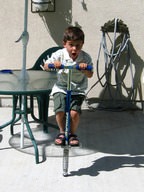
Look at the pogo stick in the Figure below. Its spring gains elastic potential energy when it is pressed down by the boy's weight. Moments after the boy jumps, his weight is no longer compressing the spring and it will spring back to its original shape. The energy it releases will push the pogo stick—and the boy—off the ground.

A boy on a pogo stick compresses the spring, demonstrating elastic potential energy.

[Figure 3]

Q: The girl in the Figure below is giving the elastic band of her slingshot potential energy by stretching it. She’s holding a small stone against the stretched band. What will happen when she releases the band?

A: The elastic band will spring back to its original shape. When that happens, watch out! Some of the band’s elastic potential energy will be transferred to the stone, which will go flying through the air.

Other Forms of Potential Energy

All of the examples of potential energy described above involve movement or the potential to move. The form of energy that involves movement is called mechanical energy. Other forms of energy also involve potential energy, including chemical energy and nuclear energy. Chemical energy is stored in the bonds between the atoms of compounds. For example, food and batteries both contain chemical energy. Nuclear energy is stored in the nuclei of atoms because of the strong forces that hold the nucleus together. Nuclei of radioactive elements such as uranium are unstable, so they break apart and release the stored energy.

1
Asemmisa {{asɛmmisaAhyɛnsode}}
9a.

What is elastic potential energy, and how does it relate to an object's shape and the forces acting upon it?

Kinetic Energy

Kinetic energy is the energy of moving matter. Anything that is moving has kinetic energy—from atoms in matter to stars in outer space. Things with kinetic energy can do work. For example, the spinning saw blade in the photo above is doing the work of cutting through a piece of metal.

Calculating Kinetic Energy

The amount of kinetic energy in a moving object depends directly on its mass and velocity. An object with greater mass or greater velocity has more kinetic energy. You can calculate the kinetic energy of a moving object with this equation:

Let’s consider an example. The Figure below shows Juan running on the beach with his dad. Juan has a mass of 40 kg and is running at a velocity of 1 m/s. How much kinetic energy does he have?

A father and son running on the beach during a sunny day.

Substitute these values for mass and velocity into the equation for kinetic energy:

Q: What is Juan’s kinetic energy if he speeds up to 2 m/s from 1 m/s?

A: By doubling his velocity, Juan increases his kinetic energy by a factor of four:

Asemmisa {{asɛmmisaAhyɛnsode}}
10.

We will do 10 in class on Friday.

a.) Maria has a mass of 60 kg and is cycling at a velocity of 3 m/s. How much kinetic energy does she have?

b.) Alex has a mass of 75 kg and is sprinting at a velocity of 5 m/s. What is his kinetic energy?

c.) An athlete with a mass of 55 kg is running at a velocity of 4 m/s. How much kinetic energy does the athlete possess?

d.) A car has a mass of 1200 kg and is moving at a velocity of 10 m/s. What is its kinetic energy?

e.) A ball with a weight of 0.5 N is thrown at a velocity of 20 m/s. What is the kinetic energy of the ball?