Use the reading, and only the reading, to help you answer the questions after each section.
La lectura en Español - https://docs.google.com/document/d/1J3vI4ckEwDALGNUocC5W3LsL0Iy58Zisd6pHyCz2fQs/edit?usp=sharing
Use the reading, and only the reading, to help you answer the questions after each section.
La lectura en Español - https://docs.google.com/document/d/1J3vI4ckEwDALGNUocC5W3LsL0Iy58Zisd6pHyCz2fQs/edit?usp=sharing
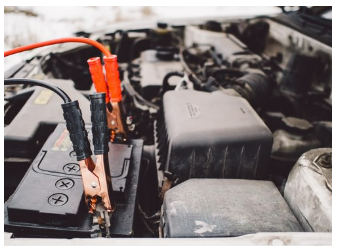
The car battery in the picture is being given a “jump” because the battery “died” overnight. Jumper cables have been attached to the terminals of the car battery and the terminals on the other end of the cables have been connected to the terminals of a “live” battery. The cables will carry electric current to the dead battery, providing the energy needed for the car to start.
Electric current is a continuous flow of electric charges (electrons). Current is measured as the amount of charge that flows past a given point in a certain amount of time. The unit for electric current is the ampere (A), or amp. Electric current may flow in just one direction (direct current), or it may keep reversing direction (alternating current).
Charges flow in an electric current when they have electric potential energy. Potential energy is stored energy that an object has due to its position or shape.
a.) What measures the quantity of charge passing a specific point over a defined time period?
b.) What unit is used for electric current?
c.) What kind of stored energy enables charges to move in an electric current?
d.) What type of current continuously alternates its direction?
Electric potential energy comes from the position of a charged particle in an electric field. For example, when two negative charges are close together, they have potential energy because they repel each other and have the potential to push apart. If the charges actually move apart, their potential energy decreases. Electric charges always move spontaneously from a position where they have higher potential energy to a position where they have lower potential energy. This is like water falling over a dam from an area of higher to lower potential energy due to gravity.
What causes a charged particle to possess electric potential energy?
In what direction do electric charges naturally move regarding their potential energy?
What happens to the potential energy of charges when they move apart?
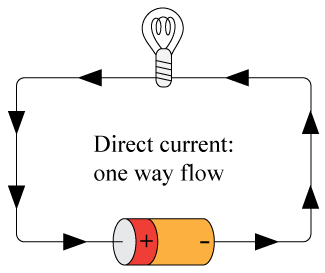
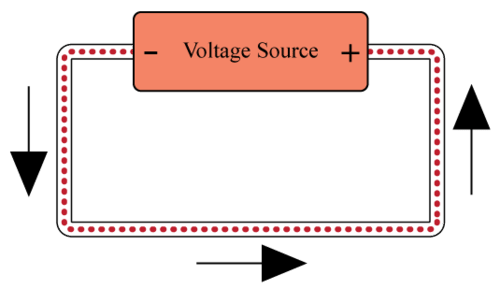
For an electric charge to move from one position to another, there must be a difference in electric potential energy between the two positions. A difference in electric potential energy is called voltage. The SI unit for voltage is the volt (V). Look at the figure below. It shows a simple circuit. The source of voltage in the circuit is a 1.5-volt battery. The difference of 1.5 volts between the two battery terminals results in a spontaneous flow of charges, or electric current, between them. Notice that the electrons flow from the negative terminal to the positive terminal because electrons are negatively charged and are repelled by the negative terminal.
Q: You might put a 1.5-volt battery in a TV remote. The battery in a car is a 12-volt battery. How do you think the current of a 12-volt battery compares to the current of a 1.5-volt battery?
A: Greater voltage means a greater difference in potential energy, so the 12-volt battery can produce more current than the 1.5-volt battery.
What is required for an electric charge to shift from one location to another?
Why do electrons move from the negative terminal to the positive terminal in a battery circuit?
a.) What is the term used to describe the difference in electric potential energy?
b.) What is the unit for measuring voltage?

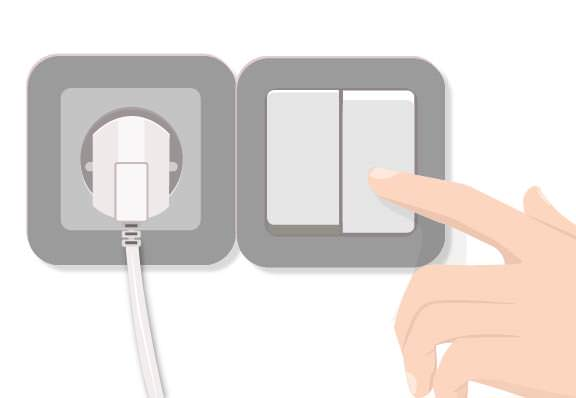
To use an electric appliance, you have to plug it into an outlet unless it has batteries. This may be all you need to know in order to use electric current. But did you ever wonder what electric current is or how it flows through wires inside the walls of your home? Electric current is a continuous flow of electric charges. The charges may flow in just one direction, or they may keep reversing direction.
When current flows in just one direction, it is called direct current (DC). The diagram below shows how direct current flows through a simple circuit. An example of direct current is the current that flows through a battery-powered flashlight. In addition to batteries, solar cells and fuel cells can also provide direct current.

a.) What describes a current that only moves in a single direction?
b.) Name one source other than a battery that uses the answer to the above question's type of current.
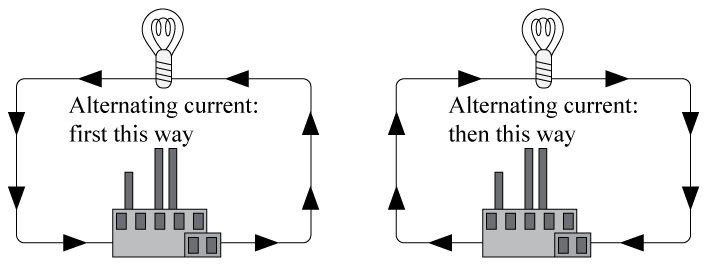
When current keeps reversing direction, it is called alternating current (AC). You can see how it works in the two diagrams below. The current that comes from a power plant and supplies electricity to homes and businesses is alternating current. The current changes direction 60 times per second. It happens so quickly that the light bulb doesn’t have a chance to stop glowing when the reversals occur.

Q: Which type of current flows through the wires in your home?
A: Alternating current from a power plant flows through the wires in a home.
a.) What describes a current that continuously changes directions?
b.) How often does the current in a house reverse its direction?

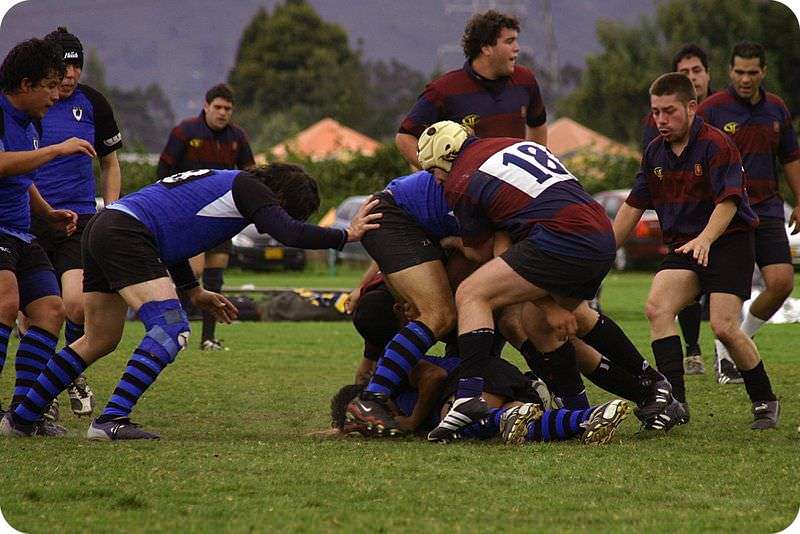
These athletes are playing rugby, a game that is similar to American football. The players in red and blue are trying to stop the player in blue and black from running across the field with the ball. They are resisting his forward motion. This example of resistance in rugby is a little like resistance in physics.
In physics, resistance is opposition to the flow of electric charges in an electric current as it travels through matter. The unit for resistance is the ohm. Resistance occurs because moving electrons in current bump into atoms of matter. Resistance reduces the amount of electrical energy that is transferred through matter. That’s because some of the electrical energy is absorbed by the atoms and changed to other forms of energy, such as heat.
Q: In the rugby analogy to resistance in physics, what do the players on each team represent?
A: The player on the blue and black team represents a moving electron in an electric current. The players on the red and blue team represent particles of matter through which the current is flowing.
a.) What describes the opposition to the flow of a charge in a current?
b.) What unit is used to measure the answer to the above question?
What happens to electrical energy when electrons collide with atoms during current flow?
How much resistance a material has depends on several factors: the type of material, its width, its length, and its temperature.
All materials have some resistance, but certain materials resist the flow of electric current more or less than other materials do. Materials such as plastics have high resistance to electric current. They are called electric insulators. Materials such as metals have low resistance to electric current. They are called electric conductors.
A wide wire has less resistance than a narrow wire of the same material. Electricity flowing through a wire is like water flowing through a hose. More water can flow through a wide hose than a narrow hose. In a similar way, more current can flow through a wide wire than a narrow wire.
A longer wire has more resistance than a shorter wire. Current must travel farther through a longer wire, so there are more chances for it to collide with particles of matter.
A cooler wire has less resistance than a warmer wire. Cooler particles have less kinetic energy, so they move more slowly. Therefore, they are less likely to collide with moving electrons in current. Materials called superconductors have virtually no resistance when they are cooled to extremely low temperatures.
What elements determine the level of resistance in a material?
Why does a cooler wire exhibit lower resistance than a warmer one?
What are the two categories of materials are based on their ability to resist electric current?
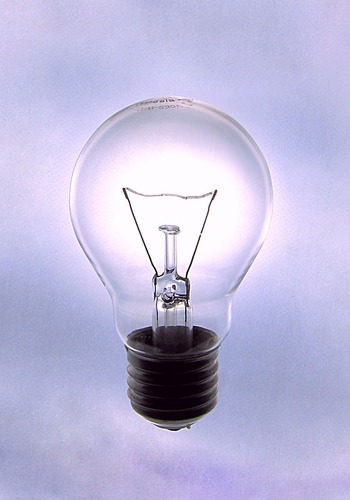
Resistance can be helpful or just a drain on electrical energy. If the aim is to transmit electric current through a wire from one place to another, then resistance is a drawback. It reduces the amount of electrical energy that is transmitted because some of the current is absorbed by particles of matter. On the other hand, if the aim is to use electricity to produce heat or light, then resistance is useful. When particles of matter absorb electrical energy, they change it to heat or light. For example, when electric current flows through the tungsten wire inside an incandescent light bulb like the one in the figure below, the tungsten resists the flow of electric charge. It absorbs electrical energy and converts some of it to light and heat.

What’s wrong with this picture? (Hint: How does current get to the light bulb?)
Q: The tungsten wire inside a light bulb is extremely thin. How does this help it do its job?
A: The extremely thin wire has more resistance than a wider wire would. This helps the wire resist electric current and change it to light.
In what situation is resistance considered a disadvantage in transmitting electric current?
How does resistance prove to be beneficial when using electricity?