Log in
Sign up for FREE
arrow_back
Library

Copy of Autotrophs, Heterotrophs, Food Chains and Webs Reading w/Questions (5/28/2026)

star
star
star
star
star
Last updated about 2 hours ago
7 questions
"Reading"
Required
5
Exit Ticket
Required
5
Question 1
1.

What is happening inside each leaf and blade of grass?

Photosynthesis. Maybe the most important biochemical reaction of Earth. As sunlight shines down on this forest, the sunlight is absorbed, and the energy from that sunlight is transformed into chemical energy. That chemical energy is then distributed to all other living organisms in the ecosystem.

Flow of Energy

To survive, ecosystems need a constant influx of energy. Energy enters ecosystems in the form of sunlight or chemical compounds. Some organisms use this energy to make food. Other organisms get energy by eating food.

Producers

Producers are organisms that produce food for themselves and other organisms. They use energy and simple inorganic molecules to make organic compounds. The stability of producers is vital to ecosystems because all organisms need organic molecules. Producers are also called autotrophs. There are two basic types of autotrophs: photoautotrophs and chemoautotrophs.
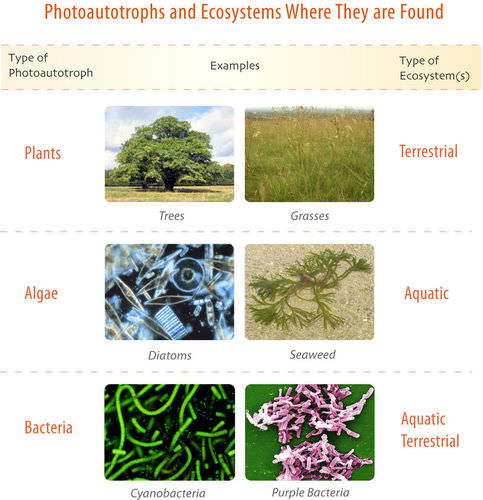
  1. Photoautotrophs use energy from sunlight to make food by photosynthesis. They include plants, algae, and certain bacteria (see the figure below).
  2. Chemoautotrophs use energy from chemical compounds to make food by chemosynthesis. They include some bacteria and also archaea. Archaea are bacteria known as extremophiles because they often live in extreme environments (hot springs, thermal vents) or can perform extreme functions (break down radiation or toxic chemicals as a food source).

5

Consumers

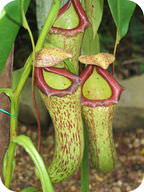
Consumers are organisms that depend on other organisms for food. They take in organic molecules by essentially “eating” other living things. They include all animals and fungi (fungi don't really “eat”; they absorb nutrients from other organisms). They also include many bacteria and even a few plants, such as the pitcher plant shown in the figure below. Consumers are also called heterotrophs and are classified by what they eat:
  • Herbivores consume producers such as plants or algae. They are a necessary link between producers and other consumers. Examples include deer, rabbits, and mice.
  • Carnivores consume animals. Examples include lions, polar bears, hawks, frogs, salmon, and spiders. Carnivores that are unable to digest plants and must eat only animals are called obligate carnivores. Other carnivores can digest plants but do not commonly eat them.
  • Omnivores consume both plants and animals. They include humans, pigs, brown bears, gulls, crows, and some species of fish.

The Pitcher Plant
Virtually all plants are producers. This pitcher plant is an exception. It consumes insects. It traps them in a sticky substance in its “pitcher.” Then it secretes enzymes that break down the insects and release nutrients. Which type of consumer is a pitcher plant?
4

Decomposers

When organisms die, they leave behind energy and matter in their remains. Decomposers break down the remains and other wastes and release simple inorganic molecules back to the environment. Producers can then use the molecules to make new organic compounds. The stability of decomposers is essential to every ecosystem. Decomposers are classified by the type of organic matter they break down:
  • Scavengers consume the soft tissues of dead animals. Examples of scavengers include vultures, raccoons, and blowflies.
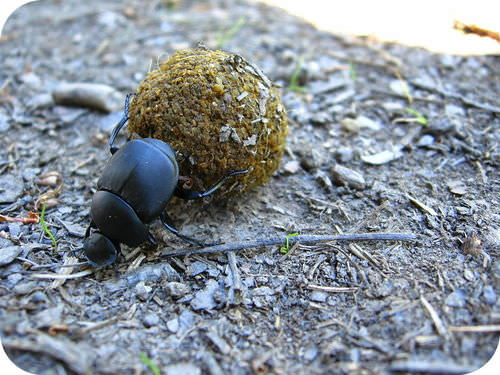
  • Detrivores consume detritus—the dead leaves, animal feces, and other organic debris that collects on the soil or at the bottom of a body of water. On land, detrivores include earthworms, millipedes, and dung beetles (see the figure below). In water, detritivores include “bottom feeders” such as sea cucumbers and catfish.
  • Saprotrophs are the final step in decomposition. They feed on any remaining organic matter that is left after other decomposers do their work. Saprotrophs include fungi, bacteria, and single-celled protozoa. Fungi are the only organisms that can decompose wood.

2
2

Who eats whom?

Describing the flow of energy within an ecosystem essentially answers this question. To survive, one must eat. Why? To get energy. Food chains and webs describe the transfer of energy within an ecosystem, from one organism to another. In other words, they show who eats whom.

Food Chains and Food Webs

Food chains and food webs are diagrams that represent feeding relationships. Essentially, they show who eats whom. In this way, they model how energy and matter move through ecosystems.

Food Chains

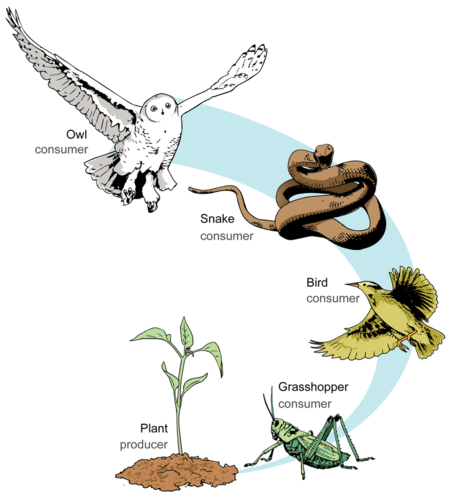
A food chain represents a single pathway by which energy and matter flow in a single direction through an ecosystem. An example is shown in the figure below. Food chains are generally simpler than what really happens in nature. Most organisms consume—and are consumed by—more than one species. When examining a food chain, we often describe the first organism that is consumed as being on the bottom of the food chain, while the last organism to eat is at the top of the food chain. In most ecosystems, a type of autotroph will be located at the bottom of all of the food chains.


Food Webs

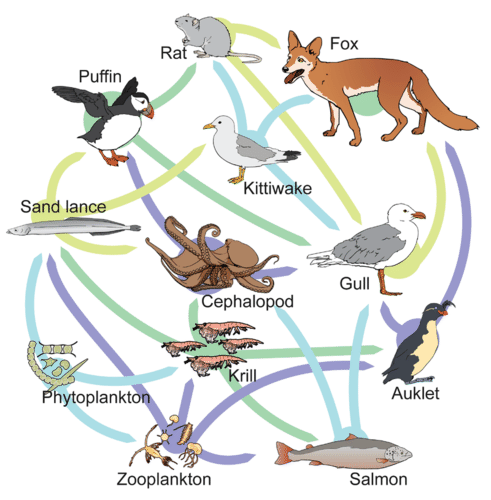
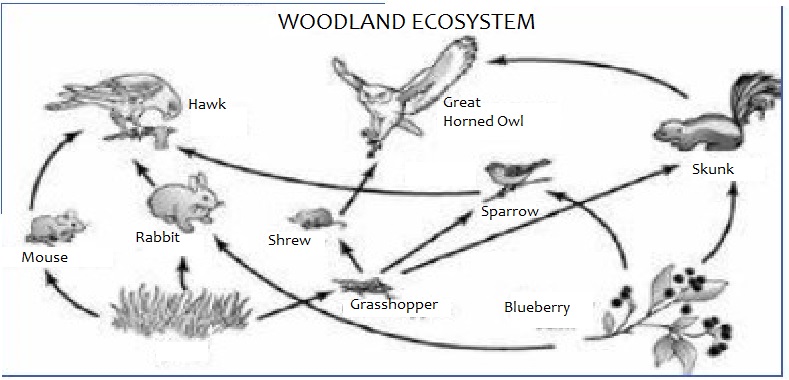
A food web represents multiple pathways through which energy and matter flow through an ecosystem. It includes many intersecting food chains. It demonstrates that most organisms eat, and are eaten, by more than one species. Examples are shown in the figure below. The discussion about organisms being at the top and bottom of food chains can be carried over to food webs, while there is often more than one organism at the top of a food chain, there is still a top level. Depending upon the ecosystem, many food webs will have one or multiple types of autotrophs that will occupy the lowest level.


2
Question 7
7.


a) What kind of organism is at the bottom of this simple food web? _______
b) If this food web displayed the body of a deceased hawk, what type of organism would eat/consume it? _______
c) What will the grass use to drive the processes within it to make its food? _______
d) Use the above food web to make a food chain, beginning with the grass and ending with the owl: grass → _______ → _______ → great horned owl
(Do this now) I have "read" this.
True
False
Question 2
2.
a) Energy enters ecosystems in the form of _______ or _______ .

b) Producers are also called _______ , and they use energy and simple inorganic molecules to make _______ compounds.

c) The two basic types of autotrophs are _______ and _______ .

d) Photoautotrophs use energy from _______ to make food by _______ .

e) Chemoautotrophs use energy from _______ compounds to make food by _______ .
Question 3
3.
a) Consumers depend on _______ for food.

b) Which organisms absorb nutrients from other organisms instead of eating them? _______

c) In general, what do herbivores consume? _______

d) Consumers are also known as _______.

e) Organisms that consume other animals are _______; organisms that consume animals and plants are _______; organisms that consume only plants are _______ .

f) Humans would be classified as _______.
Question 4
4.
When organisms die and decay, they leave _______ and _______ in their remains. Decomposers break down the dead and decaying organisms and other waste, then they release _______ back into the environment. Producers will be able to use what the decomposers release to create new _______ compounds.
Question 5
5.
a) Organisms that use detritus as their energy source are _______. _______ will consume what is left over when decomposition is complete. Organisms that eat tissue from dead organisms are _______.

b) Which of the following class of decomposers occupy the final stage of decomposition? _______
Question 6
6.
a) What is used to describe the flow of energy with ecosystems: _______ and _______.

b) What does this statement describe: A one-way, single-directional, flow of energy? _______

c) What does this statement describe: A model that contains many pathways for the flow of energy within an ecosystem, it includes most, or all, of the eating relationships with an ecosystem. _______