Copy of Macromolecules - Reading w/Questions (5/28/2026)
star
star
star
star
star
Last updated about 2 hours ago
20 questions
Carbohydrates
What you will learn
The chemical structure and function of carbohydrates
Examples of carbohydrates and where they are used
1
1
1
1
1
1
1
Proteins
What you will learn
What are proteins
Levels of protein structure
Important functions of proteins
1
1
1
1
1
1
1
1
Lipids
What you will learn
What are lipids
Structure and function of saturated and unsaturated fatty acids
Types of lipids
Role of lipids in the human body
1
1
1
1
1
Sugar. Does this look like biological energy?
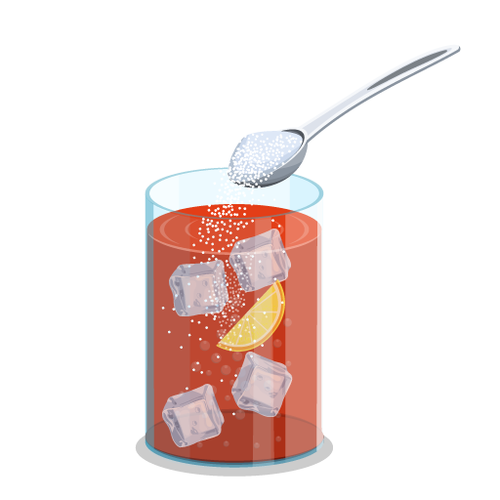
As a child, you may have been told that sugar is bad for you. Well, that's not exactly true. Essentially, carbohydrates are made of sugar, from a single sugar molecule to thousands of sugar molecules attached together. Why? One reason is to store energy. But that does not mean you should eat it by the spoonful.
Carbohydrates
Carbohydrates are the most common type of organic compound. A carbohydrate is an organic compound such as sugar or starch and is used to store energy. Like most organic compounds, carbohydrates are built of small, repeating units that form bonds with each other to make a larger molecule. In the case of carbohydrates, the small repeating units are called monosaccharides. Carbohydrates contain only carbon, hydrogen, and oxygen.
Monosaccharides and Disaccharides
A monosaccharide, the monomer of carbohydrates, is a simple sugar such as fructose or glucose. Fructose is found in fruits, whereas glucose generally results from the digestion of other carbohydrates. Glucose (C6H12O6) is used for energy by the cells of most organisms and is a product of photosynthesis.
Another monosaccharide, fructose, has the same chemical formula as glucose, but the atoms are arranged differently. Molecules with the same chemical formula but with atoms in a different arrangement are called isomers. Compare the glucose and fructose molecules in the Figure below. Can you identify their differences? The only differences are the positions of some of the atoms. These differences affect the properties of the two monosaccharides.
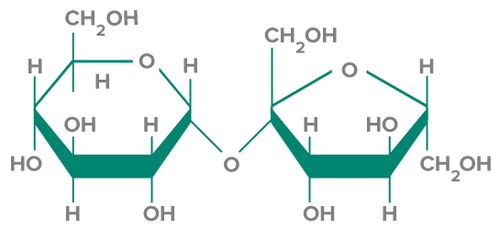
Figure 2: Sucrose Molecule. This sucrose molecule is a disaccharide. It is made up of two monosaccharides: glucose on the left and fructose on the right.
If two monosaccharides bond together, they form a carbohydrate called a disaccharide. An example of a disaccharide is sucrose (table sugar), which consists of the monosaccharides glucose and fructose (Figure above). Monosaccharides and disaccharides are also called simple sugars. They provide the major source of energy to living cells.
Polysaccharides
A polysaccharide is a complex carbohydrate that forms when simple sugars bind together in a chain. Polysaccharides may contain just a few simple sugars or thousands of them. Complex carbohydrates have two main functions: storing energy and forming structures of living things.
Question 1
1.
What are the small repeating units that form bonds to make up carbohydrate molecules called? _______
Question 2
2.
What three elements make up all carbohydrates? _______ _______ _______
Question 3
3.
Name an example of a monosaccharide. _______
Question 4
4.
How does the structure of glucose differ from the structure of fructose, even though they have the same chemical formula?
Question 5
5.
Why is glucose important for most organisms? Describe its role.
Question 6
6.
If two _______ bond together, they form a carbohydrate called a _______ .
Question 7
7.
_______ is a complex carbohydrate that forms when simple sugars bind together in a chain.
Proteins have many important roles, from transporting, signaling, receiving, and catalyzing to storing, defending, and allowing for movement. Where do you get the amino acids needed so your cells can make their own proteins? If you cannot make it, you must eat it.
Proteins
A protein is an organic compound made up of small molecules called amino acids, the monomers of proteins. There are 20 different amino acids commonly found in the proteins of living organisms. Small proteins may contain just a few hundred amino acids, whereas large proteins may contain thousands of amino acids. The largest known proteins are titins, found in muscle, which are composed from over 27,000 amino acids.
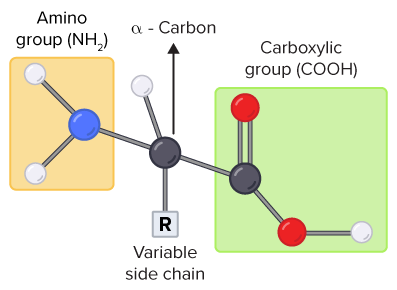
The figure below shows the general structure of all amino acids. Only the side chain, R, varies from one amino acid to another. For example, in the amino acid glycine, the side chain is simply hydrogen (H). In glutamic acid, in contrast, the side chain is CH2CH2COOH. Variable side chains give amino acids different chemical properties. The order of amino acids, together with the properties of the amino acids, determines the shape of the protein, and the shape of the protein determines the function of the protein.
Figure 1: General Structure of Amino Acids. KEY: White = hydrogen (H), Blue = nitrogen (N), Dark Grey = carbon (C), Red = oxygen (O), R = variable side chain
Protein Structure
When amino acids bind together, they form a long chain called a polypeptide. A protein consists of one or more polypeptide chains. A protein may have up to four levels of structure. The lowest and initial level, a protein’s primary structure, is formed from the sequence of amino acids. Higher levels of protein structure include the secondary, tertiary, and quaternary structures. They are all identified by the overall shape of the polypeptide. The complex structures of different proteins give them unique properties, which they need to carry out their various jobs in living organisms.
Functions of Proteins
Proteins play many important roles in living things. Some proteins help cells keep their shape (structural proteins), some, such as connective and motor proteins, make up muscle tissues, and some transport items in and out of cells (transport proteins). Some proteins act as signals, and other proteins receive those signals. Enzymes are proteins that speed up chemical reactions in cells. Other proteins are antibodies, which bind to foreign substances such as bacteria and target them for destruction. Still other proteins carry messages or transport materials. For example, human red blood cells contain a protein called hemoglobin, which binds with oxygen. Hemoglobin allows the blood to carry oxygen from the lungs to cells throughout the body.
Question 8
8.
A protein is an organic compound made up of small molecules called _______ .
Question 9
9.
There are _______ different amino acids commonly found in the proteins of living organisms.
Question 10
10.
Large proteins may contain _______ amino acids.
Question 11
11.
In the amino acid glycine, the side chain is simply _______ .
Question 12
12.
The _______ of amino acids, together with the properties of the amino acids, determines the _______ of the protein, and this determines the _______ of the protein.
Question 13
13.
When amino acids bind together, they form a long chain called a _______ .
Question 14
14.
A protein consists of one or more _______ chains.
Question 15
15.
The _______ of a protein is the initial sequence of amino acids.
Lipids
A lipid is an organic compound such as fat or oil. Organisms use lipids to store energy, but lipids have other important roles as well. Lipids consist of repeating units called fatty acids. Fatty acids are organic compounds that have the general formula CH3(CH2)nCOOH, where n usually ranges from 2 to 28 and is always an even number. There are two types of fatty acids: saturated fatty acids and unsaturated fatty acids.
Saturated Fatty Acids
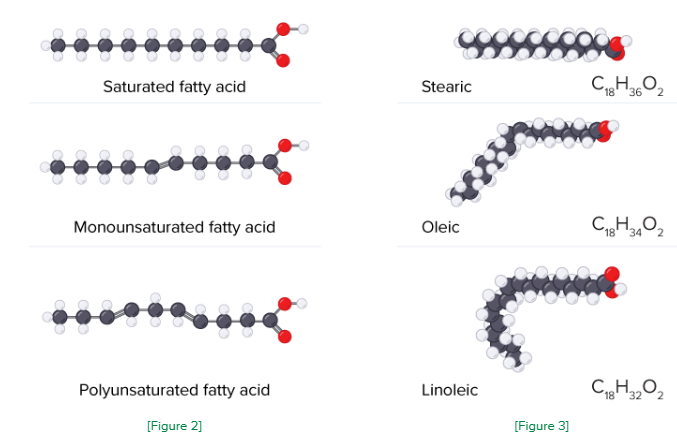
In saturated fatty acids, carbon atoms are bonded to as many hydrogen atoms as possible. This causes the molecules to form straight chains, as shown in the Figure below. The straight chains can be packed together very tightly, allowing them to store energy in a compact form. This explains why saturated fatty acids are solids at room temperature. Animals use saturated fatty acids to store energy.
Figure 2 and 3: Fatty Acids structures and their examples. Saturated fatty acids have straight chains. Unsaturated fatty acids have bent chains.
Unsaturated Fatty Acids
In unsaturated fatty acids, some carbon atoms are not bonded to as many hydrogen atoms as possible. Instead, they are bonded to other groups of atoms. Wherever carbon binds with these other groups of atoms, it causes chains to bend (see the Figure above). The bent chains cannot be packed together very tightly, so unsaturated fatty acids are liquids at room temperature. Plants use unsaturated fatty acids to store energy.
Types of Lipids
Lipids may consist of fatty acids alone, or they may contain other molecules as well. For example, some lipids contain alcohol or phosphate groups. They include:
Triglycerides: the main form of stored energy in animals.
Phospholipids: the major components of cell membranes.
Steroids: serve as chemical messengers and have other roles.
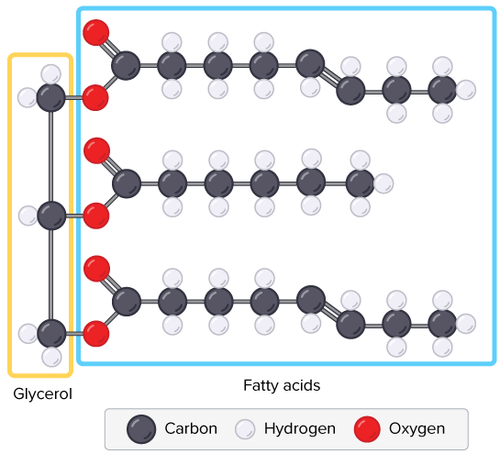
Figure 4: Triglyceride Molecule. The left part of this triglyceride molecule represents glycerol. Each of the three long chains on the right represents a different fatty acid.
Question 16
16.
Lipids consist of repeating units called _______ .
Question 17
17.
The number n in the general formula CH3(CH2)nCOOH for fatty acids usually ranges from _______ to _______ .
Question 18
18.
In _______ fatty acids, carbon atoms are bonded to as many hydrogen atoms as possible.
Question 19
19.
In_______ fatty acids, some carbon atoms are not bonded to as many hydrogen atoms as possible.
Question 20
20.
Triglycerides are the main form of _______ in animals.