Log in
Sign up for FREE
arrow_back
Library

Copy of Eukaryotic Cells Introduction (Oct 2022) (5/28/2026)

star
star
star
star
star
Last updated about 2 hours ago
21 questions
2
Question 1
1.
2
1
1
Question 4
4.
2
1
Ribosomes

Ribosomes are organelles that make proteins (protein synthesis). They are the smallest organelles. A cell has many ribosomes. Some float freely in the cytoplasm. Others are attached to an organelle that surrounds the nucleus - the endoplasmic reticulum. Unlike most organelles, ribosomes are not covered by a membrane. Furthermore, this structure is found in all cell types - prokaryotes and eukaryotes.

Nucleus

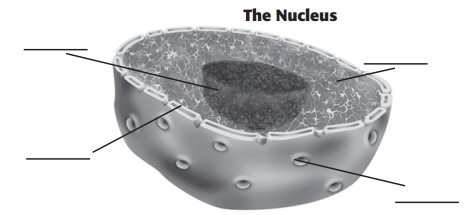
The nucleus is a large organelle in a eukaryotic cell. It contains the cell’s genetic material (DNA). DNA has the instructions that tell a cell how to make proteins. The nucleus is covered by a double-membrane (two membranes). This membrane is referred to as the nuclear membrane, and it separates the inside of the nucleus (nucleoplasm and DNA) from the cytoplasm and the other areas inside of the cell. Certain materials are able to pass through the nuclear membrane through holes that are referred to as nuclear pores. Within the nuclei of many cells there is a dark area called the nucleolus. The nucleolus is responsible for producing ribosomes.
1
3
In the image of the nucleus (below), label the following structures:
  • Nuclear Pore
  • DNA
  • Nucleolus
  • Nuclear Membrane
The description of the nucleus in the reading, above, will assist you in completing this task.
1
Question 9
9.
Identify this structure on the diagram of the nucleus, to the left:
_______
1
1
1
1
1
2
2
Chloroplasts

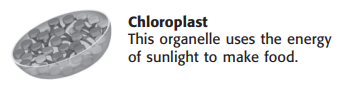
Plants and algae have chloroplasts in some of their cells. Chloroplasts are organelles in which photosynthesis takes place. Photosynthesis is a process by which plants, and other photyosynthetic organisms, use sunlight, carbon dioxide, and water to make sugar and oxygen. Animal cells do not have chloroplasts. Chloroplasts are green because they contain a green pigment called chlorophyll. Chlorophyll is able to absorbe certain wavelengths (energy) of light (natural and artificial). Again, the purpose of chloroplasts is the convert the energy in light into sugars.


Mitochondria

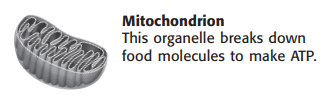
A mitochondrion (plural, mitochondria) is the organelle in which sugar (that is produced via photosynthesis in the chloroplast) is converted into a form of energy that the cell can use (ATP). The mitochondria is often referred to as the powerhouse of the cell because of this. Like the nucleus, a mitochondrion is covered by double-membrane (two membranes). Most of a cell’s usuable energy (ATP) is converted from sugars inside of this organelle. Energy locked within sugars is released by mitochondria is stored in a molecule called ATP. The cell uses ATP to do work.


1
1
1
Question 19
19.
1
1
Learning Goals:
  1. To understand what defines a eukaryotic cell.
  2. To be able to identify the types of eukaryotic cells.
  3. The be able to identify the function of the organelles of eukaryotic cells.

What are Eukaryotic Cells?

In general, eukaryotic cells are cells that have a higher degree of organization and specialization compared to prokaryotic cells. The primary two determining features of eukaryotic cells is the presence of the nucleus and the presence of membrane-bound organelles.

There are four different types of eukaryotic cells - animal cells, plant cells, fungal cells, and protist cells. Animal cells make up the bodies of animals and humans. Plant cells make up plants and fungal cells made up fungi (yeast, mushrooms, molds, etc.). These first three groups of eukaryotes are typically multi-celled organisms (made up of many cells). Protists are a highly diverse group of single-celled organisms that do not fit within the other three groups of eukaryotes. What unites all four of these groups of cell types is that they all have nuclei (some protists can have more than one) and membrane-bound organelles.
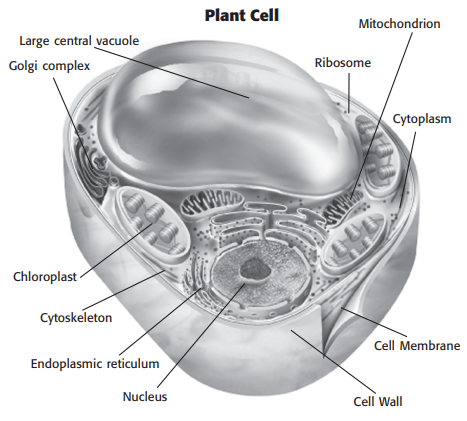
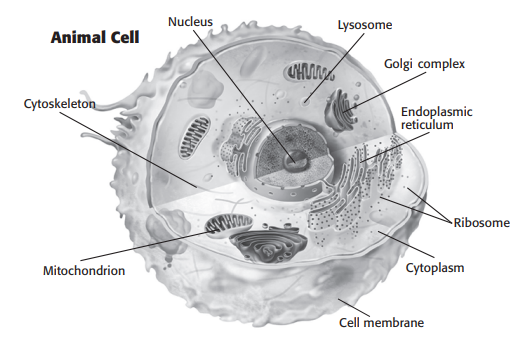

There are two primary features that define a eukaryotic cell. First, is the presence of a _______; second, is the presence of many _______.
Question 2
2.
There are multiple different types of eukaryotic cells - plant cells _______, protist, and _______.
Question 3
3.
_______ are typically single-celled organisms.

What are the Parts of a Eukaryotic Cell?

As you read through each of these features of eukaryotic cells, it is important to realize that while most of these parts can be bound in all eukaryotic cells, not all of them are found in all eukaryotic cells.

Cell Wall

All plant cells have a cell wall. The cell wall is a rigid structure that supports the cell and surrounds the cell membrane. The cell wall of a plant cell is made of a type of sugar called cellulose. Fungi (singular fungus), such as yeasts and mushrooms, also have cell walls. The cell walls of fungi are made of a sugar (carbohydrate) called chitin. Prokaryotic cells such as bacteria and archaea also have cell walls that are often constructed of peptidoglycan. Animal cells and protists do not have this structure.

Cell Membrane

All cells have a cell membrane. The cell membrane is a flexible protective barrier that surrounds all cells. It separates the cell from the outside environment. However, the primary purpose of the cell membrane is to control what substances can enter and leave the cell. In cells that have a cell wall, the cell membrane is found just inside the cell wall.

The cell membrane is made of different materials. It contains proteins, carbohydrates, and phospholipids. Proteins are molecules made by the cell for a variety of functions. Lipids are compounds that do not dissolve in water. They include fats and cholesterol. Phospholipids are lipids that contain the element phosphorous.

The proteins and lipids in the cell membrane control the movement of materials into and out of the cell. A cell needs materials such as nutrients and water to survive and grow. Nutrients and wastes go in and out of the cell through the proteins in the cell membrane. Water can pass through the cell membrane without the help of proteins.
The _______ is a rigid outermost structrue of plant and fungi cells.
Question 5
5.
The flexible outer covering of all cells is the _______. Its primary function is to control _______ the cell.
Question 6
6.
The cell membrane is made-up of proteins, _______, and carbohydrates.
Question 7
7.
The site of protein synthesis is the _______.
Question 8
8.
The nucleus contains _______ and is surrounded in a double-membrane that is known as the _______. The nucleolus is the site in which _______ are made.
Question 10
10.
Identify this structure on the diagram of the nucleus, to the left:
_______
Question 11
11.
Identify this structure on the diagram of the nucleus, to the left:
_______
Question 12
12.
Identify this structure on the diagram of the nucleus, to the left:
_______
Endoplasmic Reticulum

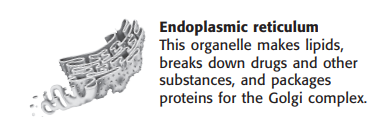
Many chemical reactions take place in the cell. Many of these reactions happen on or inside the endoplasmic reticulum. The endoplasmic reticulum (ER) is a system of membranes with many folds in which proteins, lipids, and other materials are made or modified. The ER is also part of the cell’s delivery system. Its folds have many tubes and passageways. Materials move through the ER to other parts of the cell.

There are two types of ER: rough and smooth. Smooth ER makes lipids and helps breakdown materials (drugs and other toxins) that could damage the cell. Rough ER has ribosomes embedded on the outside surfaces of it. The ribosomes make proteins. These proteins then enter the rough ER to be modified and then delivered to other parts of the cell.


Vesicles

Items are transferred from the rough and smooth ER to other parts of the cell through vesicles that are able to bud off of the membrane that surrounds the ER. This membrane and the vesicles that it can produce are very similar to the cell (plasma) membrane. This means that these vesicles are able to fuse with the cell membrane permitting its contents to leave the cell (exocytosis). All eukaryotic cells have both vesicles and endoplasmic reticula.
Question 13
13.
There are two types of endoplasmic reticulum (ER) - _______ ER and _______ ER.
Question 14
14.
Rough endoplasmic reticulum gets its name due to having many _______ embedded onto its surface.
Question 15
15.
Rough endoplasmic reticulum _______ proteins after they are made by the ribosomes. Smooth endoplasmic reticulum breaksdown toxins and makes _______.
Question 16
16.
Materials that are formed or modified in the ER are transported through the cell or out of the cell in _______. These structures are made out of a similar structure as the _______ which enables it to fuse with it.
Question 17
17.
The _______ converts energy from light into sugars. This process is called _______.
Question 18
18.
Sugars that are formed by the chloroplast are converted into _______ by the mitochondria.
Cytoskeleton

The cytoskeleton is a web of proteins inside the cell. It acts like a skeleton and a muscle (this is merely an analogy, the cytoskeleton is not a skeleton nor muscle). The cytoskeleton helps the cell keep its shape. It also helps some cells, such as bacteria, to move.

Golgi Body (Golgi Complex)

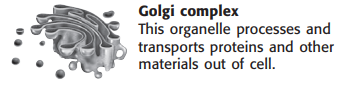
The Golgi body is the organelle that packages and distributes proteins. An analogy that could be used to describe the role of the Golgi body is that it is the “post office” of the cell. The Golgi body looks like the smooth ER. The ER delivers lipids and proteins to the Golgi body. The Golgi body then can modify (alter) the lipids and proteins to do different jobs. The final products are then enclosed in a piece of the Golgi complex’s membrane. This membrane pinches off to form a vesicle. The vesicle transports the materials to other parts of the cell or out of the cell.


Lysosome

Lysosomes are organelles that contain digestive enzymes. This enzyme is able to breakdown worn-out or damaged organelles, wastes, and invading particles. Lysosomes are found mainly in animal cells. The cell wraps itself around a particle and encloses it in a vesicle. Lysosomes fuse with vesicles and pour the enzymes into it. The enzymes will breakdown the particles inside the vesicle. Without lysosomes, old or dangerous materials could build up and damage or kill the cell.

Vacuoles

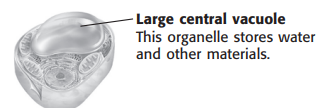
A vacuole is a very large type of vesicle. In plant and fungal cells, some vacuoles act like lysosomes. They contain enzymes that help a cell digest particles. The large central vacuole in plant cells stores water and other liquids. Large vacuoles full of water help support the cell. Some plants wilt when their vacuoles lose too much water. In a plant cell, the vacuole is used for the longterm storage of certain materials, such as proteins, sugars, and other materials.


The _______ can be compared to a post office because it packages and transports different substances around the cell and out of the cell within a _______.
Question 20
20.
The _______ contains enzymes that are used to breakdown _______, as well as wastes and other particles.
Question 21
21.
In a plant cell, the vacuole is used for _______ of certain materials.