Twa kɔ nsɛm atitiriw so
Log in
Sign up for FREE
arrow_back
Laabri

Copy of Animal Cell Organelle Activity - Oct 2022 (5/28/2026)

star
star
star
star
star
Last updated about 1 month ago
17 Nsɛmmisa
Untitled Section

There are two major types of cells on earth - prokaryotic and eukaryotic cells. On the next slide, you will watch a video about these two cells. As you watch, think about the similarities and differences between prokaryotic and eukaryotic cells.

1
10
Untitled Section
Untitled Section
Untitled Section
5
Quiz
1
1
1
2
1
Exit ticket
Ɛhia
0
Ɛhia
0
Question 1
02:39
keyboard_arrow_down
1
Asemmisa {{asɛmmisaAhyɛnsode}}
1.

Continue watching the video and answer the following question.

What are some differences between prokaryotic and eukaryotic cells?

Functions of Animal Cells

Animals and humans are multicellular organisms made up of eukaryotic cells. Animal cells are large and advanced and are specialized for different functions. For example, skin cells, muscle cells, nerve cells, and fat cells make up different types of tissues and play different roles in keeping the organism alive.

Asemmisa {{asɛmmisaAhyɛnsode}}
2.

In your own words, describe why animals are eukaryotic organisms, and why we say their cells are advanced and specialized.

Organelles in an Animal Cell

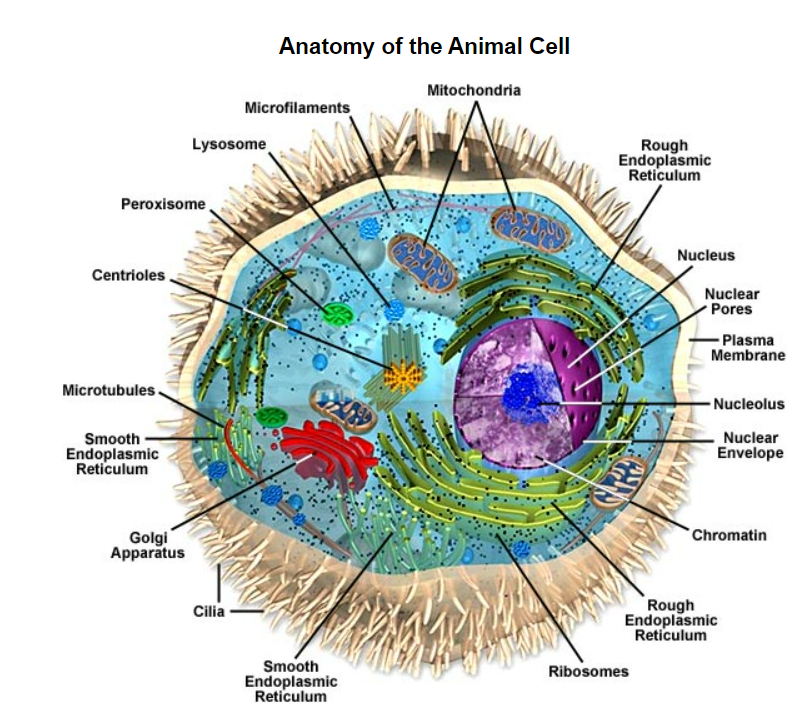
While different animal cells are specialized for different functions, they share the same basic parts. Next, you will watch a video about animal cell orgnelles. As you watch, pay attention to each organelle and its:

  • appearance

  • location

  • function

Question 3
04:55
keyboard_arrow_down
1
Question 4
07:29
keyboard_arrow_down
1
Question 5
09:24
keyboard_arrow_down
1
Question 6
10:36
keyboard_arrow_down
1
Question 7
14:06
keyboard_arrow_down
1
Asemmisa {{asɛmmisaAhyɛnsode}}
8.

Match each organelle with its function(s); if needed, watch the above video, again.

Draggable itemarrow_right_altCorresponding Item

Golgi Body

arrow_right_alt

The organelle that holds the DNA for the cell.

Mitochondria

arrow_right_alt

Has ribosomes embedded on its surface and assists in the production of proteins.

Ribosome

arrow_right_alt

Transports material within the cell.

Vesicle

arrow_right_alt

Stores (packages) proteins for transport

Lysosome

arrow_right_alt

Makes ATP

Cell Membrane

arrow_right_alt

Makes lipids.

Rough Endoplasmic Reticulum (Rough ER)

arrow_right_alt

Makes proteins

Smooth Endoplasmic Reticulum (smooth ER)

arrow_right_alt

A fluid that cushions and contains the organelles.

Cytoplasm

arrow_right_alt

Breaksdown waste and worn out organelles.

Nucleus

arrow_right_alt

Controls what enters and exits the cell.

Location of Organelles

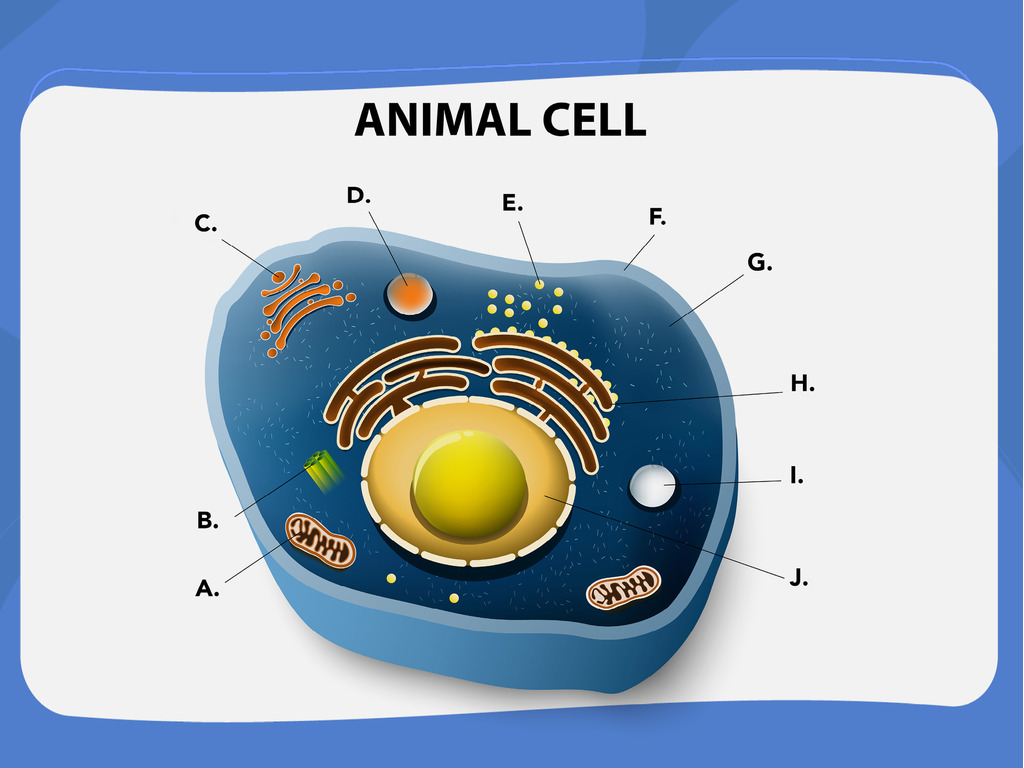
Next, you will review the location of the organelles within an animal cell.

Click on the image to enlarge it.

This will be followed by a set of questions in which you will have to identify the location of certain structures - mitochondria, nucleus, ribosomes, endoplasmic reticulum, vesicles, and the Golgi body.

5
Asemmisa {{asɛmmisaAhyɛnsode}}
9.

Which letter in the image to the left represents each of these:

a.) Mitochondria:

b.) Nuclues:

c.) Ribosome:

d.) Golgi body:

e.) Endoplasmic Reticulum:

Endomembrane System

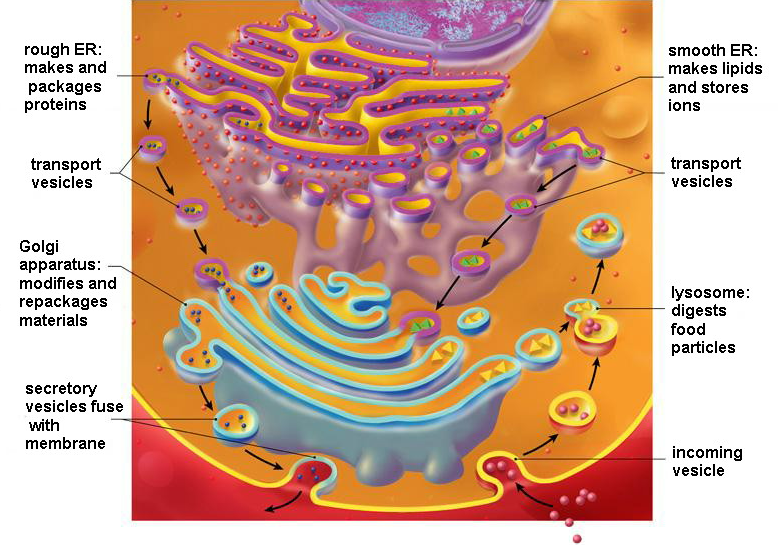
Now, let's see how organelles work together within the cell. You will examine a diagram of the endomembrane system.

Follow the flow of materials through the organelles in the diagram. Note the differences between the smooth ER and the rough ER, what they produce, and where those products go within the cell.

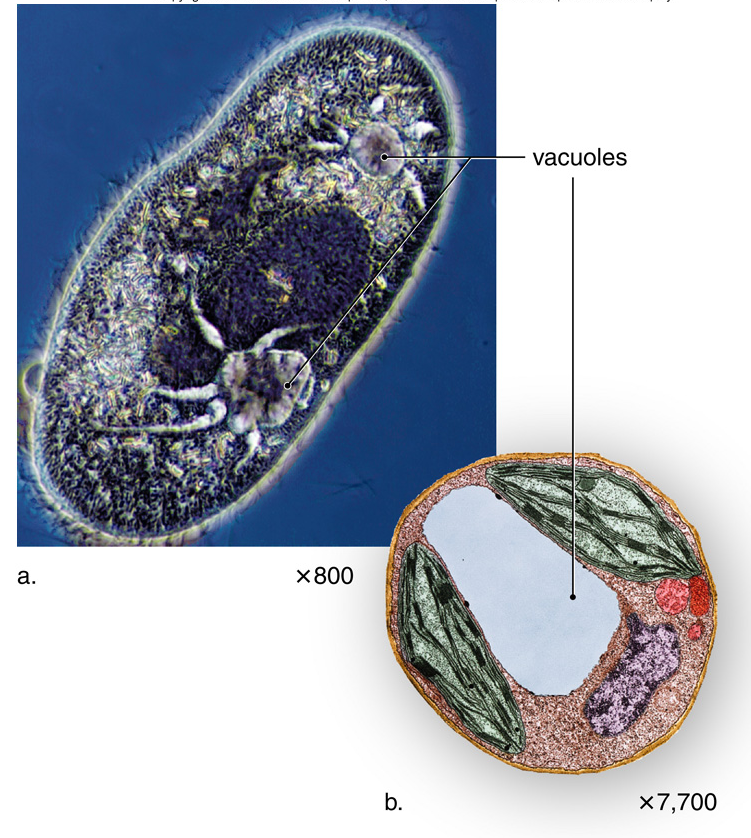
At teh bottom, you will also see a microscopic image of a live cell that is focused upon a vacuole.

The Endomembrane System

The endomembrane system has four components.

1. The nuclear membrane

2. The endoplasmic reticulum (ER)

3. The Golgi apparatus

4. Membranous sacs called vesicles

This system compartmentalizes the cell and carries molecules from one part of the system to another part.
1. Endoplasmic Reticulum

The ER is a complicated system of membranous channels and flattened saccules. It is responsible for making lipids and proteins and it sometimes stores small ions

2. Golgi Apparatus

The Golgi apparatus consists of numerous flattened saccules.

The Golgi apparatus receives protein transport vesicles from the ER, then modifies the molecules and repackages them in new vesicles.

3. Lysosomes

Lysosomes are vesicles from the Golgi apparatus which contain harsh lytic enzymes that digest food molecules or structures within the cell.

Lysosomes also participate in apoptosis, or programmed cell death.  In this process the cell will commit suicide when it "realizes" that is isn't working correctly. It destroys itself by releasing the enzymes from its lysosomes. These enzyme spill out into the cytoplasm and destroy the cell parts.

4. Vacuoles

Vacuoles are membranous storage sacs that are larger than vesicles.

In most organisms, vacuoles can store nutrients, ions, or other molecules.
Asemmisa {{asɛmmisaAhyɛnsode}}
10.

Create a flowchart or diagram of the endomembrane system. Show how lipids and proteins are transported within the cell. Be sure to label the organelles.

Asemmisa {{asɛmmisaAhyɛnsode}}
11.

Which cell type does not have membrane-bound organelles?

Asemmisa {{asɛmmisaAhyɛnsode}}
12.

Which organelle contains enzymes that can digests waste and worn out organelles for the animal cell?

Asemmisa {{asɛmmisaAhyɛnsode}}
13.

After a protein is made, the vesicle transports it to the .

Asemmisa {{asɛmmisaAhyɛnsode}}
14.

Name two structures that are part of the endomembrane system

Asemmisa {{asɛmmisaAhyɛnsode}}
15.

Which organelle provides energy (ATP) for the cell?

Asemmisa {{asɛmmisaAhyɛnsode}}
16.

Name at least one thing that you learned in this lesson, even if you haven't mastered it, yet.

Asemmisa {{asɛmmisaAhyɛnsode}}
17.

How has your confidence regarding this topic changed?

Asemmisa {{asɛmmisaAhyɛnsode}}
3.

All cell types have a cell membrane.

Asemmisa {{asɛmmisaAhyɛnsode}}
4.

Where, inside of the nucleus, are ribosomes assembled?

Asemmisa {{asɛmmisaAhyɛnsode}}
5.

Which organelle is the "shipping part" of the cell?

Asemmisa {{asɛmmisaAhyɛnsode}}
6.

Microtubules are made from a protein called .

Asemmisa {{asɛmmisaAhyɛnsode}}
7.

Provide a list of some of the major organelles found within a cell.