3
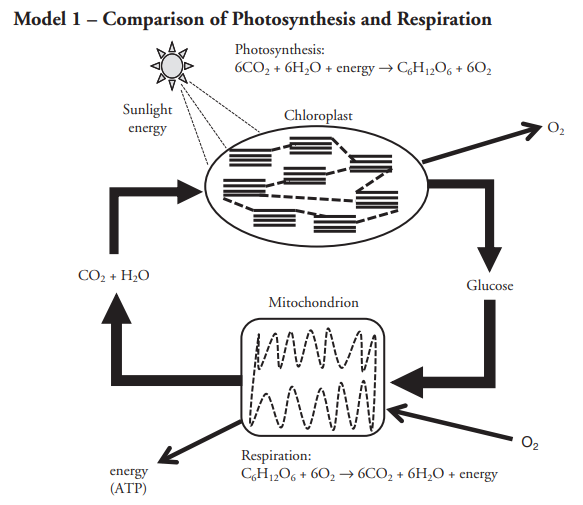
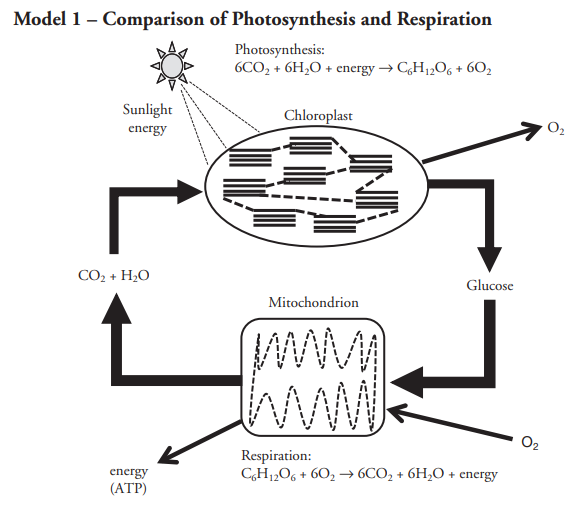
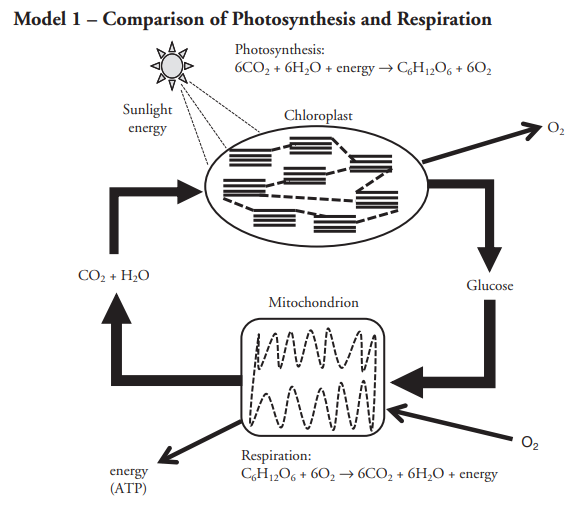
Refer to Model 1.
a. In what cell organelle does photosynthesis occur?
b. What are the three things needed for photosynthesis?
c. What are the two products of photosynthesis?
Use the models to answer all of the questions; spell your answers the same way that the models do.
If it is obvious to me that you are attempting to look up answers on the internet, or using any other source other than the information on this formative, you will not receive any points.
B.2.1 Use a model to illustrate how photosynthesis transforms light energy into stored chemical energy.
B.2.2 Use a model to illustrate that cellular respiration is a chemical process whereby the bonds of food molecules and oxygen molecules are broken and the bonds in new compounds are formed resulting in a net transfer of energy.
B.2.4 Develop a model to illustrate the role of photosynthesis and cellular respiration in the cycling of carbon among the biosphere, atmosphere, hydrosphere, and geosphere.
Learning Goals:
I can use a model to illustrate how photosynthesis can transform light energy into stored chemical energy.
I can use a model to illustrate how cellular respiration uses glucose obtained from food, and oxygen in a series of chemical reactions to produce ATP in a net transfer of energy.
I can use a model to illustrate the role of photosynthesis in the cycling of carbon between the biosphere, atmosphere, hydrosphere and geosphere.
I can use a model to illustrate the role of cellular respiration in the cycling of carbon between the biosphere, atmosphere, hydrosphere and geosphere.
Use the models to answer all of the questions; spell your answers the same way that the models do.
If it is obvious to me that you are attempting to look up answers on the internet, or using any other source other than the information on this formative, you will not receive any points.
B.2.1 Use a model to illustrate how photosynthesis transforms light energy into stored chemical energy.
B.2.2 Use a model to illustrate that cellular respiration is a chemical process whereby the bonds of food molecules and oxygen molecules are broken and the bonds in new compounds are formed resulting in a net transfer of energy.
B.2.4 Develop a model to illustrate the role of photosynthesis and cellular respiration in the cycling of carbon among the biosphere, atmosphere, hydrosphere, and geosphere.
Learning Goals:
I can use a model to illustrate how photosynthesis can transform light energy into stored chemical energy.
I can use a model to illustrate how cellular respiration uses glucose obtained from food, and oxygen in a series of chemical reactions to produce ATP in a net transfer of energy.
I can use a model to illustrate the role of photosynthesis in the cycling of carbon between the biosphere, atmosphere, hydrosphere and geosphere.
I can use a model to illustrate the role of cellular respiration in the cycling of carbon between the biosphere, atmosphere, hydrosphere and geosphere.
Refer to Model 1.
a. In what cell organelle does photosynthesis occur?
b. What are the three things needed for photosynthesis?
c. What are the two products of photosynthesis?
Refer to Model 1.
a. In what cell organelle does cell respiration occur?
b. What are the two things needed for cell respiration to occur?
c. What are the three products of cell respiration?
Refer to Model 1.
a. What four substances are recycled during photosynthesis and respiration?
Refer to Model 1.
What is one component in photosynthesis that is not recycled and must be constantly available?
Are chloroplasts found in most plant cells?
Explain how your answer to the prior question is correct.
Are mitochondria found in most plant cells?
Explain how your answer to the prior question is correct.
Are chloroplasts found in animal cells?
Explain how your answer to the prior question is correct.
Are mitochondria found in animal cells?
Explain how your answer to the prior question is correct.
Write a grammatically correct sentence that compares the reactants and products of photosynthesis with the reactants and products of cell respiration.
Carefully consider and discuss the following statement:
“Plants can survive on their own, because they make their own food. Animals can’t survive on their own but need plants for survival.”
Do you agree with this statement? Why or why not?
Think about the foods that you ate during your last meal. Hypothesize what would happen to the supply of those foods if the sun’s energy was no longer available.
Explain how the energy used by an athlete during a football game comes from the energy of sunlight.
List one or two things that you learned, or confusions that were cleared up, in this activity.
My confidence regarding this activity has: