Copy of Transcription/Translation Interactive (5/28/2026)
star
star
star
star
star
Last updated 3 months ago
13 Nsɛmmisa
Untitled Section
1
1
1
3
5
2
1
2
2
1
2
Exit Ticket
Ɛhia
0
Ɛhia
0
B.4.2 Construct an explanation for how the structure of DNA determines the structure of proteins which carry out the essential functions of life through systems of specialized cells.
Learning Goals:
I can explain how the structure of DNA determines the structure of proteins.
I can explain that proteins carry out the essential functions of life through systems of specialized cells.
Cell Transcription and Translation Interactive
Click "start".
Across the top of the interactive, you will see three tabs - "overview", "transcription", and "translation." Make sure that you do each tab in order.
Begin with "overview."
Read the information and pay attention to the animations that are presented on each slide.
At the bottom right of the screen, you will see a forward and backward arrow that you can use to navigate through the interactive.
Use the information provided to help you answer the questions under the interactive.
According to the overview, why can't DNA leave the nucleus to enter the cytoplasm to make proteins?
According to the overview, after the amino acid chain is complete, it will fold up to form a
slide 1
Every single gene that is used in protein synthesis has three sections - promoter, coding region, and terminator.
The function of the promoter is to
The coding region
The termination sequence
Slides 2 - 4
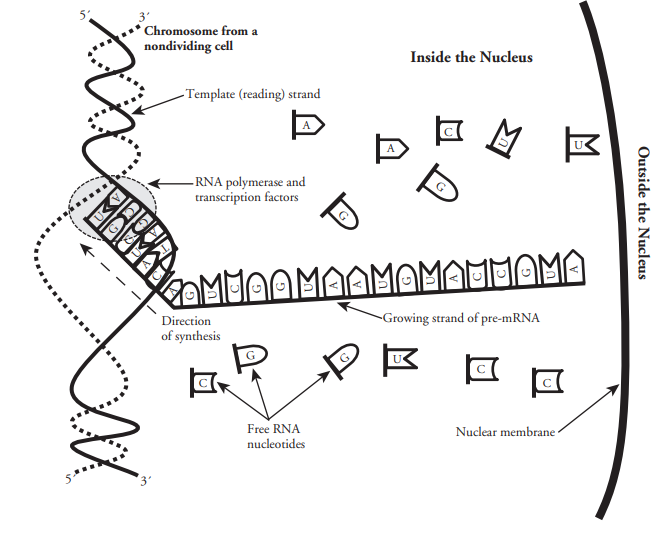
The enzyme that is responsible for making mRNA by reading the gene on the DNA molecule is
RNA polymerase recognizes (and attaches to) the
RNA polymerase will
RNA polymerase will begin to build an mRNA once it reaches the
Slides 5 - 10
The mRNA will
This prevents transcription from continuing which leads to the mRNA to
Slide 11-12
During translation, the ribosome will read
Slide 8
The ribosome is looking for the
Slide 10
tRNA is used to
The part of the tRNA that determines the type of amino acid is the
Slide 11-12
tRNA's have an anticodon that has a three-nucleotide sequence that matches the
Slide 14-15
The process of the tRNA's bringing in amino acids to the ribosome leads to an elongation of the amino acid chain will continue until the ribosome reads the
After the amino acid chain is released, it will
Slide 19 - 22
Provide a list of one - two things that you either learned or confusions that were cleared up in this activity.
After having completed this activity, my confidence regarding this topic has: