Copy of DNA - The Discovery; Its Structure and Replication (5/28/2026)
star
star
star
star
star
Last updated about 2 hours ago
22 questions
Note from the author:
The Discovery of DNA - the Experiments
DNA Structure and Replication
Exit Ticket
Required
0
Required
0
B.4.1 Develop and revise a model that clarifies the relationship between DNA and chromosomes in coding the instructions for characteristic traits passed from parents to offspring.
The Discovery of DNA
Learning Goals:
Important experiments conducted by scientists to determine the nature of genetic material.
Establishment of DNA as the genetic material.
Timeline of the major discoveries related to DNA structure and its function.
What type of organic molecule is this?
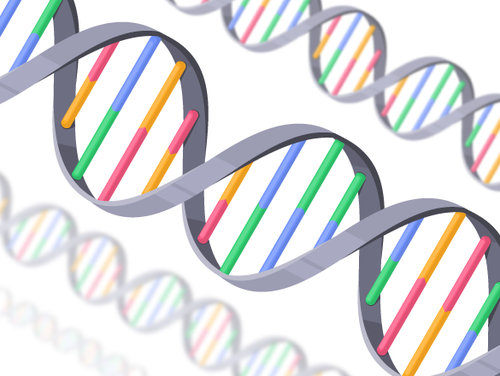
Here’s a hint: molecules like this one determine many physical features about you. They contain genetic information that controls your physical characteristics. They determine your eye color, facial features, and other physical attributes. What molecule is it?
You probably answered "DNA." Today, it is commonly known that DNA is the genetic material. For a long time, scientists knew such molecules existed. They were aware that genetic information was contained within organic molecules. However, they didn’t know which type of molecules play this role. In fact, for many decades, scientists thought that proteins were the molecules that carry genetic information.
1
DNA, the Genetic Material
DNA, deoxyribonucleic acid, is the genetic material in your cells. It was passed on to you from your parents and determines your characteristics. The discovery that DNA is the genetic material was another important milestone in molecular biology.
Griffith Searches for the Genetic Material
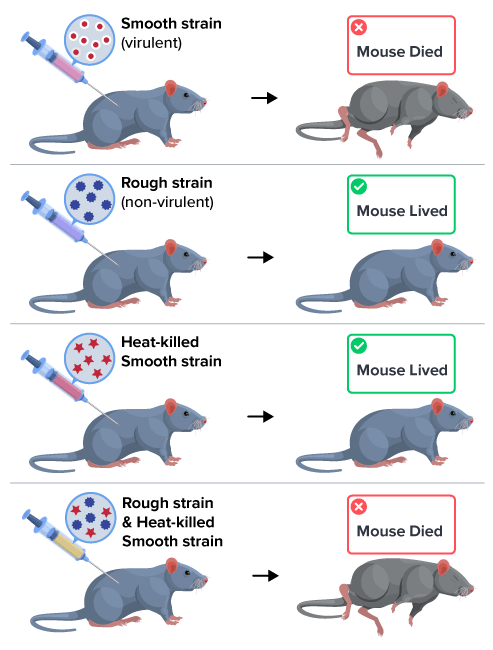
Many scientists contributed to the identification of DNA as the genetic material. In the 1920s, Frederick Griffith made an important discovery. He was studying two different strains of Streptococcus bacteria, called R (rough) strain and S (smooth) strain. He injected the two strains into mice. The S-strain was virulent and killed the mice, but the R-strain was non-virulent and would not kill the mice. Griffith also injected mice with S-strain bacteria that had been killed by heat. As expected, the heat destroyed bacteria did not harm the mice. However, when the dead S-strain bacteria were mixed with live R-strain (non-virulent) bacteria and injected, the mice died.
Based on his observations, Griffith deduced that something in the heat-destroyed S-strain was transferred to the previously harmless R-strain, transforming the R-strain into virulent form of Streptococcus bacteria. He called this process transformation, as something was "transforming" the bacteria from one strain into another strain. What was that something that transformed the non-virulent bacteria into a virulent form? What type of substance could change the characteristics of the organism that received it?
1
1
1
Avery, MacLeod, and McCarty Make a Major Contribution
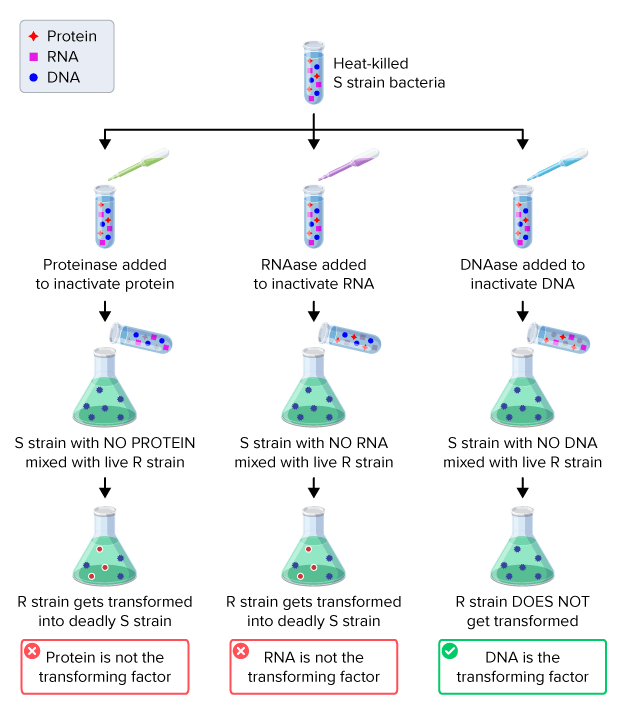
In the early 1940s, a team of scientists led by Oswald Avery tried to answer the question raised by Griffith’s results. Avery, together with his colleagues Colin MacLeod and Maclyn McCarty, inactivated various substances in the heat-destroyed S-strain Streptococcus bacteria. They then mixed the heat-destroyed S-strain bacteria with the harmless R-strain bacteria. When proteins and RNA were inactivated, the R-strain still transformed into the deadly S-strain. This ruled out proteins and RNA as the genetic material. Why? Even without the S-strain proteins or RNA, the R-strain was changed or transformed, into the deadly S-strain. However, when the researchers inactivated DNA in the S-strain, the R-strain did not transform. This led to the conclusion that DNA is the substance that controls the characteristics of organisms. In other words, DNA is the genetic material.
1
1
Hershey and Chase Seal the Deal
The conclusion that DNA is the genetic material was not widely accepted at first. It had to be confirmed with more research. In the 1950s, Alfred Hershey and Martha Chase did experiments with viruses known as bacteriophages, a virus that infects bacteria, and bacteria.
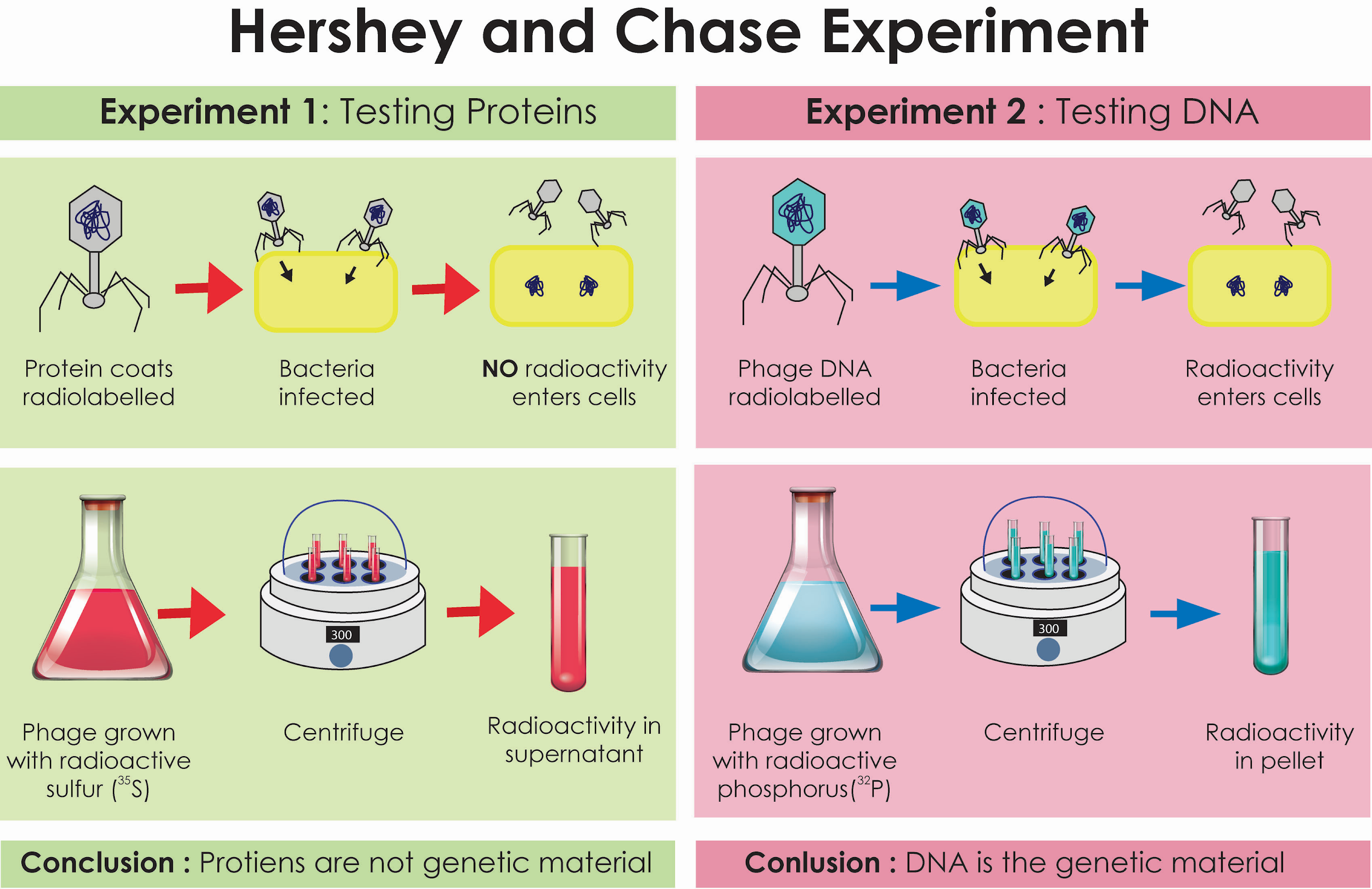
Viruses are not made of cells. Bacteriophages are basically DNA inside a protein coat. To reproduce, a virus must insert its own genetic material into a cell (such as a bacterium). Then it uses the cell’s machinery to make more viruses. The researchers used different radioactive elements to label the DNA and proteins in viruses. The protein was labeled with radioactive sulfur (35S), while the DNA was tagged with radioactive phosphorus (32P) This allowed them to identify which molecule the viruses inserted into bacteria.
When they examined the bacteria that the radioactive-labeled viruses were using to replicate themselves, they failed to discover any 35S but 32P was discovered. Recall that the viral DNA was tagged with 32P at the beginning of their experiment. This meant that DNA was confirmed to be the genetic material.
1
1
1
Timeline of the Discovery of DNA
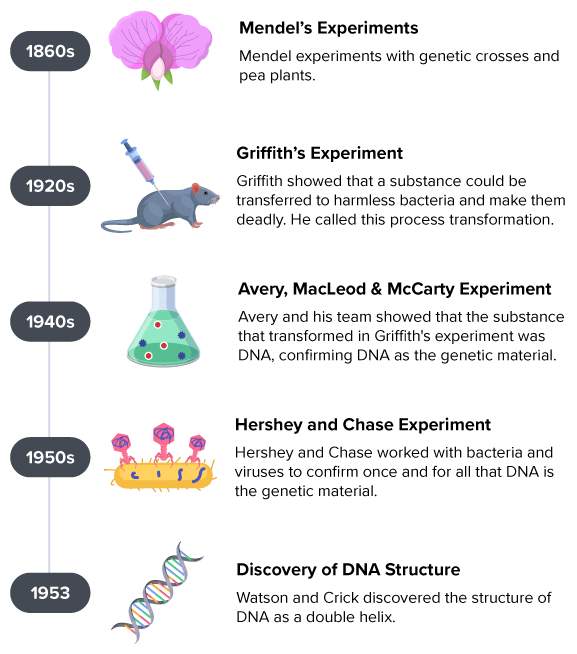
Shown in the figure below is a timeline of the work of several researchers that led to the establishment of DNA as the genetic material followed by the discovery of its structure.
1
Question 10
10.
Summary
DNA, deoxyribonucleic acid, is the genetic material in your cells. It was passed on to you from your biological parents and determines your characteristics.
For many decades, scientists thought that proteins were the molecules that carry genetic information.
The work of several researchers led to the discovery that DNA is the genetic material.
Along the way, Griffith discovered the process of transformation.
DNA Structure and Replication
Learning Goals:
Structure and function of DNA
Chargaff's rules
DNA replication and the role of DNA polymerase
Have you ever seen a ladder? Imagine being able to twist the ladder. The basic shape of DNA is sometimes described as a twisted ladder. Do you see the resemblance? Which parts of the DNA molecule are like the steps of the ladder? What about the railings? There are other ways you can represent or model the structure of DNA in order to better understand its function. The discovery of DNA’s structure actually involved modeling. A model is a very useful tool in science. Models provide a way to explore things that might be too complex or small to investigate directly. So how might you create a model of DNA?
1
Question 11
11.
The basic shape of a DNA molecule can be compared to a _______.
DNA Structure
Chargaff's Rules
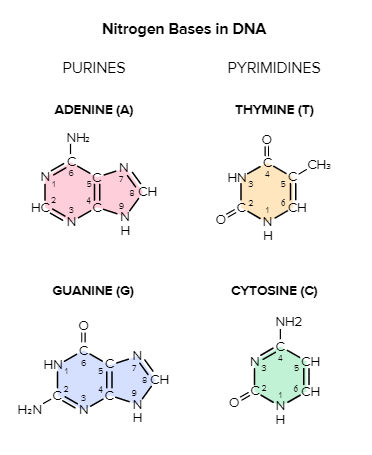
Other important discoveries about DNA were made in the mid-1900s by Erwin Chargaff. He studied DNA from many different species. He was especially interested in the four different nitrogenous bases of DNA: adenine (A), guanine (G), cytosine (C), and thymine (T).
Chargaff found that concentrations of the four bases differed from one species to another. However, within each species, the concentration of adenine was always about the same as the concentration of thymine. The same was true of the concentrations of guanine and cytosine. These observations came to be known as Chargaff’s rules. The significance of the rules would not be revealed until the structure of DNA was discovered.
1
1
The Double Helix
After DNA was found to be the genetic material, scientists wanted to learn more about it. James Watson and Francis Crick are usually given credit for discovering that DNA has a double helix shape, like a twisted ladder.
The discovery was based on the prior work of Rosalind Franklin and other scientists, who had used X-rays to learn more about DNA’s structure. Franklin and these other scientists have not always been given credit for their contributions. With the help of prior work from other scientists, Watson and Crick developed a model of the DNA double helix structure that correctly matched what was observed in Franklin’s X-ray crystallography photos.
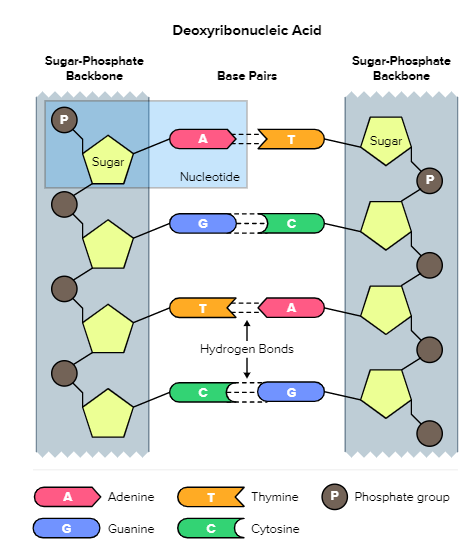
The double helix shape of DNA, together with Chargaff’s rules, led to a better understanding of DNA. DNA, as a nucleic acid, is made from nucleotide monomers, and the DNA double helix consists of two polynucleotide chains. Each nucleotide consists of a sugar (deoxyribose), a phosphate group, and a nitrogenous base (A, C, G, or T).
1
1
Complementarity of Nitrogenous Base Pairs
Scientists concluded that bonds (hydrogen bonds) between complementary bases hold together the two polynucleotide chains of DNA. Adenine always bonds with its complementary base, thymine. Cytosine always bonds with its complementary base, guanine. If you look at the nitrogen bases in the figure above, you will see why. Adenine and guanine have a two-ring structure. Cytosine and thymine have just one ring. If adenine were to bind with guanine and cytosine with thymine, the distance between the two DNA chains would be variable. However, when a one-ring molecule binds with a two-ring molecule, the distance between the two chains is kept constant. This maintains the uniform shape of the DNA double helix. These base pairs (A-T or G-C) stick into the middle of the double helix, forming, in essence, the steps of the twisted ladder.
1
1
DNA Replication
DNA replication begins when an enzyme, DNA helicase, breaks the bonds between complementary bases in DNA. This exposes the bases inside the molecule so they can be “read” by another enzyme, DNA polymerase, and used to build two new DNA strands with complementary bases also DNA polymerase. The two daughter molecules that result each contain one strand from the parent molecule and one new complementary strand. As a result, the two daughter molecules are identical to the parent molecule. DNA polymerase has the remarkable ability to proofread and correct its own mistakes. If it incorporates the wrong base at any point, it corrects itself immediately and only then proceeds with the replication process.
DNA replication is a semi-conservative process because half of the parent DNA molecule is conserved in each of the two daughter DNA molecules.
1
1
1
Summary
Chargaff's rules state that the amount of A is similar to the amount of T, and the amount of G is similar to the amount of C.
Watson and Crick discovered that DNA has a double helix shape, consisting of two polynucleotide chains held together by bonds between complementary bases.
DNA replication is semi-conservative: half of the parent DNA molecule is conserved in each of the two daughter DNA molecules.
Question 21
21.
Provide a list of one or two things that you learned from this activity.
Question 22
22.
Question 1
1.
Before we learned that nucleic acids, such as DNA, were the genetic material in cells, scientists believed that _______ could carry genetic material.
Question 2
2.
The genetic material in our cells, Deoxyribonucleic Acid, is abbreviated as _______.
Question 3
3.
Griffith worked with two types of Streptococcus bacteria, a smooth S-strain, which was _______, and a rough R-strain, which was _______.
Question 4
4.
When Griffith injected the mice with heat-destroyed S-strain Streptococcus bacteria, the mice did not die. However, when he mixed these heat-destroyed S-strain with the non-virulent R-strain bacteria and injected the mice, the mice _______, meaning that something had to transform the R-strain into a _______ form of Streptococcus bacteria.
Question 5
5.
The Avery team inactivated _______ and _______, leaving only the DNA active in the S-strain (virulent).
Question 6
6.
After the Avery team mixed the heat-destroyed S-strain (that only had its DNA remaining active) with the non-virulent R-strain the R-strain was transformed into a virulent form. This meant that _______ from the heat-destroyed S-strain had transformed the R-strain.
This experiment pointed to DNA as being the _______ of the cell.
Question 7
7.
Hershey and Chase worked to confirm the conclusions of the Avery team. To do this, they used _______.
Question 8
8.
Hershey and Chase labeled the protein coats and the DNA of their test subjects with different types of _______ (35S and 32P), which would allow them to identify what was being inserted into bacteria (proteins vs. DNA) during viral replication.
Question 9
9.
When Hershey and Chase examined the bacteria at the end of their experiment, they discovered that radioactive _______ was inside of the bacteria. This confirmed that DNA was the genetic material in cells.
_______ discovered the sequence and structure of DNA in the early 1950's.
Question 12
12.
DNA contains four _______ - adenine, _______, _______, and thymine.
Question 13
13.
According to the Chargaff's rules, if a DNA molecule has 30 units of cytosine, it will have _______ units of guanine.
Question 14
14.
While Watson and Crick are credited for discovering the structure of DNA, much of this discovery was based upon the x-ray crystallography work of _______
Question 15
15.
DNA is made up of many monomers called _______. Each of these is constructed of three things - a sugar, a _______, and a _______.
Question 16
16.
These complementary base pairs are held together by _______.
Question 17
17.
Adenine always binds with _______.
Guanine always bind with _______.
Question 18
18.
_______ breaks the bonds between base pairs in DNA.
Question 19
19.
_______ reads the exposed bases to add complementary bases to build a new DNA strand. This enzyme is also able to proofread the new DNA strands and correct any mistakes that may have been made during DNA replication.
Question 20
20.
The form of replication that used is called _______ because one half of each daughter strand of DNA contains a piece from the parent DNA.
After having completed this activity, how has your confidence regarding this concept changed?