B.4.2 Construct an explanation for how the structure of DNA determines the structure of proteins which carry out the essential functions of life through systems of specialized cells.
B.4.3 Construct a model to explain that the unique shape and function of each protein is determined by the sequence of its amino acids, and thus is determined by the sequence of the DNA that codes for this protein.
Learning Goals:
Explain how the structure of DNA determines the structure of proteins.
Construct a model to explain that the unique shape and function of each protein is determined by the sequence of its amino acids and therefore is determined by the sequence of the DNA that codes for this protein
Helpful Definitions:
Gene - small section of DNA that contains the instructions for one protein.
Gene Expression - when the instructions on one gene are used to make a protein.
Protein Synthesis - the making of a protein; linking together of multiple amino acids at the ribosome.
Codon - three nitrogenous bases that determine the identity of a single amino acid.
Anticodon - sequence of three nitrogenous bases on a tRNA that is complementary to codons on the mRNA.
Complementarity (complement) - relates to how nitrogenous bases pair-up; in DNA (A-T, C-G); in RNA (A-U, C-G).
Scientists were aware that all cells possess DNA (deoxyribonucleic acid), and that DNA is the molecule that contains the instructions for the operation of cellular processes. Scientists were also aware that DNA is in the nuclei of eukaryotic cells (cells with nuclei and membrane-bound organelles; all non-bacterial cells).
However, the mystery was how do the instructions get from the DNA and out of the nuclei so that proteins can be made at the ribosome, which are located outside of the nucleus. In other words, how are genes expressed?
The problem with understanding the whole process of making proteins regarded how DNA sent the instructions out of the
To understand gene expression, biochemists needed to know whether the information in DNA passed directly to an amino acid sequence in a protein, or whether its passage required an intermediary substance. One clue that indicated that there was an intermediary in the process was that the assembly of amino acids takes place in the cytoplasm, while the DNA is confined to the cell's nucleus.
In the 1940's, biochemists reported that cells that are actively undergoing protein synthesis (the making of proteins) contain high amounts of RNA (ribonucleic acid), which is closely related to DNA. Today we know that RNA participates in gene expression in at least three important ways.
A clue that told biochemists that there was an intermediary is that amino acids are assembled in the
Cells that have a high amount of
RNA is involved in gene expression in
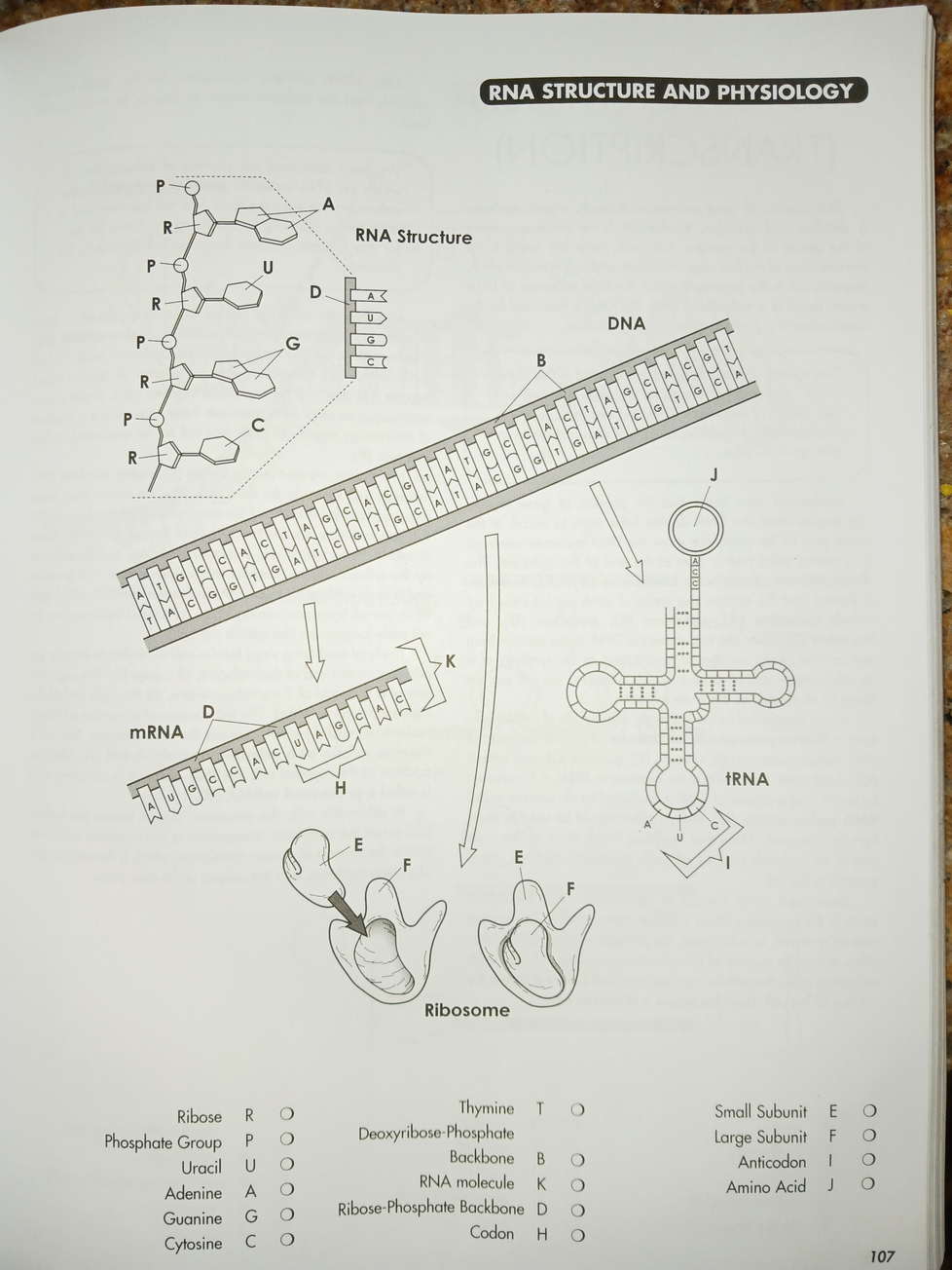
RNA is an important intermediary in gene expression. Although closely related to DNA, RNA differs in three important ways. In the diagram of RNA structure, we see that the sugar is made up of ribose instead of deoxyribose that is found in DNA. Phosphate groups link the ribose molecules in RNA in the same way that they link the deoxyribose molecules in DNA.
The second important difference is the presence of the nitrogenous base uracil (abbreviated 'U'). Uracil does not exist in DNA. Like DNA, RNA contains cytosine (C), guanine (G), and adenine (A); however, in RNA, uracil (U) takes the place of thymine (T) that exists in DNA. Uracil will act in a similar way to thymine in that it can bind to adenine. The four nitrogenous bases of DNA are A, T, C, and G; while in RNA they are A, U, C, and G.
A third important difference is that RNA is single-stranded while DNA is double-stranded. In the diagram, we can see the single molecule of RNA with its ribose-phosphate backbone and the four nitrogenous bases attached to it.
It is because of the many similarities between DNA and RNA that scientists believed that this molecule could receive a genetic message from DNA to use in protein synthesis.
RNA and DNA are different in three ways.
First, the sugar in each is different; DNA has
Second, DNA and RNA share three of the same nitrogenous bases (A, G, C) however, DNA has
Third, DNA is
Go back to the first paragraph. The purpose of the phosphates in DNA is to link
Biochemists soon discovered three types of RNA that participate in the process of protein synthesis. The diagram shows a molecule of DNA with its deoxyribose-phosphate backbone and hydrogen-bonded nitrogenous bases. Note the presence of thymine (T) in DNA and that DNA is double-stranded.
The first type of RNA is messenger RNA (mRNA). This molecule initially copies the code on a single gene from DNA. Notice in the diagram that mRNA is single-stranded and the set of nitrogenous bases on mRNA. Also notice that three of these nitrogenous bases have been bracketed and labeled 'H'. These three bases represent a single codon. The sequence of codons in a strand of mRNA determines the identity of the protein that is created. Notice that the bases of the mRNA complement the lower strand of bases of the DNA molecule just above it on the diagram.
There are
mRNA is copied from the code on a single
The sequence of three consecutive bases is known as a
The second type of RNA that functions in gene expression is ribosomal RNA (rRNA). rRNA make up the ribosomes of the cell. Each ribosome is constructed of two parts - a small subunit and a large subunit. Ribosomes are ultramicroscopic bodies found either on the surface of the rough endoplasmic reticulum (rough ER) or freely "floating" in the cytoplasm of the cell. Ribosomes are often known as the "workbenches" of the cell because they are the location of protein synthesis.
The ribosomes are made up of
Ribosomes are located in two places - the
Protein synthesis takes place at the
The third type of RNA that is involved in gene expression is transfer RNA (tRNA). There are dozens of different types of tRNA floating around the cell's cytoplasm. They link with specific amino acids and carry them to the ribosome so that they can be link with other amino acids during protein synthesis. The tRNA often has the shape of a cloverleaf. In the model, the amino acid is located in the upper end of the tRNA and is labeled with a "J". This specific tRNA is bound to the amino acid serine.
At the bottom of the tRNA molecule in the model, is a three-base sequence (in this case: AUC) that is referred to as an anticodon. This anticodon complements the codon on the mRNA molecule (in this case: UAG). During protein synthesis, the tRNA molecule transports the amino acid serine to the ribosome, where the mRNA molecule will match its codon the tRNA's anticodon. This positions the amino acid at the correct location in the protein.
tRNA's are used to carry
tRNA's contain a three-base sequence that is referred to as the
sequence of three nitrogenous bases on a tRNA that is complementary to codons on the mRNA.
the making of a protein; linking together of multiple amino acids at the ribosome.
small section of DNA that contains the instructions for one protein.
three nitrogenous bases that determine the identity of a single amino acid.
relates to how nitrogenous bases pair-up.
when the instructions on one gene are used to make a protein.