Copy of Energy Levels and Orbitals - draft (5/28/2026)
Energy Levels
What Are Energy Levels?
Energy levels (also called electron shells) are fixed distances from the nucleus of an atom where electrons may be found. Electrons are tiny, negatively charged particles in an atom that move around the positive nucleus at the center. Energy levels are a little like the steps of a staircase. You can stand on one step or another but not in between the steps. The same goes for electrons. They can occupy one energy level or another but not the space between energy levels.
The model in the Figure below shows the first four energy levels of an atom. Electrons in energy level I (also called energy level K) have the least amount of energy. As you go farther from the nucleus, electrons at higher levels have more energy, and their energy increases by a fixed, discrete amount. Electrons can jump from a lower to the next higher energy level if they absorb this amount of energy. Conversely, if electrons jump from a higher to a lower energy level, they give off energy, often in the form of light. This explains the fireworks pictured above. When the fireworks explode, electrons gain energy and jump to higher energy levels. When they jump back to their original energy levels, they release the energy as light. Different atoms have different arrangements of electrons, so they give off light of different colors.

Q: In the atomic model Figure above, where would you find electrons that have the most energy?
A: Electrons with the most energy would be found in energy level IV.
Energy Levels and Orbitals
The smallest atoms are hydrogen atoms. They have just one electron orbiting the nucleus. That one electron is in the first energy level. Bigger atoms have more electrons. Electrons are always added to the lowest energy level first until it has the maximum number of electrons possible. Then electrons are added to the next higher energy level until that level is full, and so on.
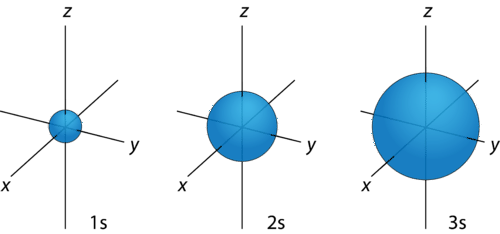
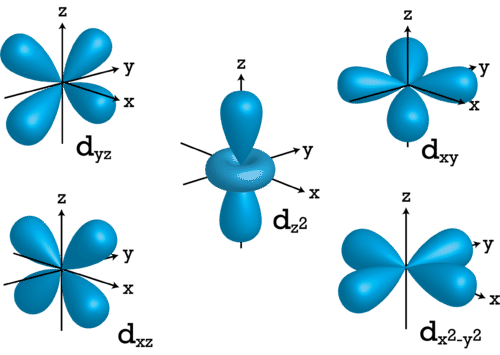
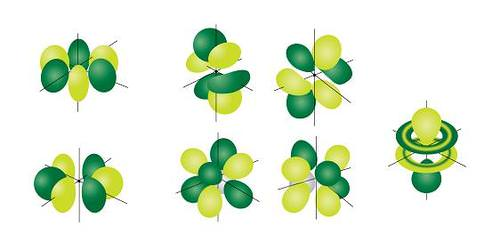
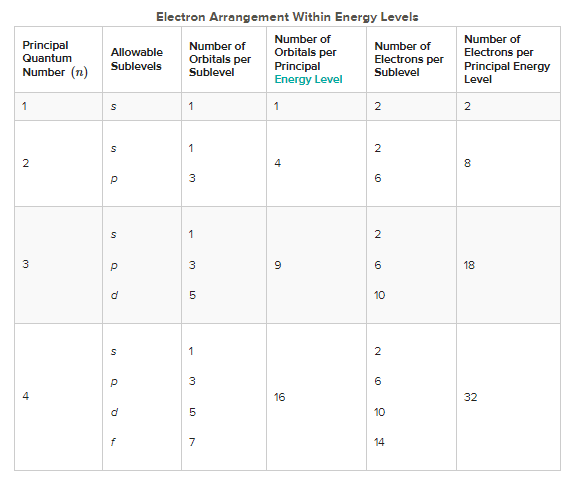
How many electrons can a given energy level hold? The maximum numbers of electrons possible for the first four energy levels are shown in the Figure above. For example, energy level I can hold a maximum of two electrons, and energy level II can hold a maximum of eight electrons. The maximum number depends on the number of orbitals at a given energy level. An orbital is a volume of space within an atom where an electron is most likely to be found. As you can see by the images in the Figure below, some orbitals are shaped like spheres (s orbitals) and some are shaped like dumbbells (p orbitals). There are other types of orbitals as well.
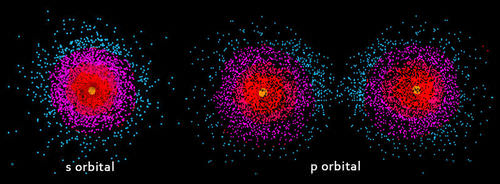
Regardless of its shape, each orbital can hold a maximum of two electrons. Energy level I has just one orbital, so two electrons will fill this energy level. Energy level II has four orbitals, so it takes eight electrons to fill this energy level.
Q: Energy level III can hold a maximum of 18 electrons. How many orbitals does this energy level have?
A: At two electrons per orbital, this energy level must have nine orbitals.
The Periodic Table and Orbital Types