Log in
Sign up for FREE
arrow_back
Library

Copy of Virtual Lab: Properties of Ionic and Covalent Bonds - Sugar and Salt Solutions (5/28/2026)

star
star
star
star
star
Last updated about 2 hours ago
40 questions
Pre-Lab Work
1
Required
1
1
1
Lab - Data Collection
Required
1
Required
1
1
1
Required
1
Required
1
Required
1
Required
1
Required
1
2
Required
1
Required
1
Required
1
Required
1
Required
1
Required
1
Required
1
Required
5
Pre-Lab Questions:

Use the reading, located above, to answer the following pre-lab questions.

Warning - if it is clear to me that you are using using a source other than what has been provided (the above reading) to answer the following questions, you will not receive any points.
Question 1
1.

Define ionic bond:

Question 2
2.

An ionic bond is composed of what types of elements (metals, nonmetals, metalloids)?

Question 3
3.

Define covalent bond.

Question 4
4.

A covalent bond is composed of what type of elements (metals, nonmetals, metalloids)?

Procedure: Part A - Macro


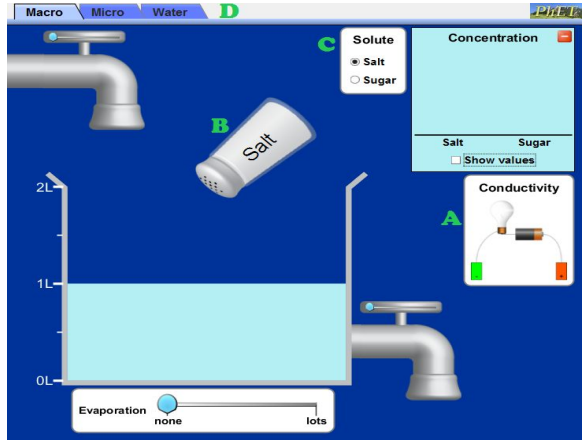
  1. Drag the conductivity tester, labeled A, into the beaker of water. Place the negative and positive electrodes into the water, but not touching the bottom of the beaker. When electricity is conducted by the solution, the light bulb will light up – the stronger the electric current, the brighter the bulb will glow. Record any observations.
  2. Click on the salt shaker, labeled B, and drag your mouse back and forth. This will “shake” the salt into the water. As you add salt, pay attention to the light bulb on the conductivity tester. Continue to add salt until the shaker is empty. Record observations. Then click the “Remove salt” button to reset the simulation.
  3. Click the “sugar” bubble in the solute selector, labeled C, to switch from salt to sugar. Then repeat step 2, this time using the sugar shaker.
  4. Record observations in the space provided, below the lab simulation.
Question 5
5.

Observations (salt):

What happened to the conductivity tester after all of the salt was added to the water?

Question 6
6.

Observations (sugar):

What happened to the conductivity tester after all of the sugar was added to the water?

Question 7
7.

Question 8
8.

Procedure: Part B - Micro


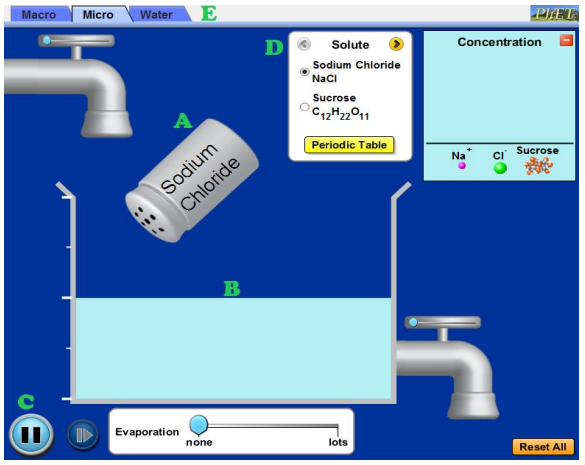
  1. Click on the “Micro” tab at the top of the simulation, labeled E, to switch to a new simulation for the Micro section of this virtual lab.
  2. Click on the salt shaker, labeled A, and drag your mouse back and forth. This will shake the salt into the water. Pressing pause, labeled C, will stop the salt crystals mid-air so you can see them before they dissolve.
  3. Observe how the crystal behaves once in the water. Record observations in the area provided below.
  4. Click the “sucrose” bubble in the solute selector, labeled D, to switch from salt to sugar. Then repeat steps 6 and 7, this time using the sugar shaker. Record observations in the area provided below.
  5. You can test other solutes by clicking the right arrow in the solute selector, labeled D.
  6. To get an even further “zoomed in” view, click on the water tab, labeled E, and repeat the simulation by dragging salt and/or sugar into the water.
Question 9
9.

Observations (salt/Sodium Chloride) - record what happened to the atoms in the salt molecules after they entered the water.

Question 10
10.

Observations (sugar/sucrose, C12H22O11) - record what happened to the atoms in the sugar molecules after they entered the water.

Question 11
11.

Observations (calcium chloride) - record what happened to the atoms in the calcium chloride molecules after they entered the water.

Question 12
12.

Observations (sodium nitrate) - record what happened to the atoms in the sodium nitrate molecules after they entered the water.

Question 13
13.

Observations (glucose, C6H12O6) - record what happened to the atoms in the glucose molecules after they entered the water.

Question 14
14.

Day 1 - Stop at this point.
We will walk through how to do Part C on Tuesday.
Procedure: Part C
  1. Go to the following website (PubChem (nih.gov)) and search for "sodium chloride" (salt) and “sucrose” (sugar): PubChem (nih.gov)
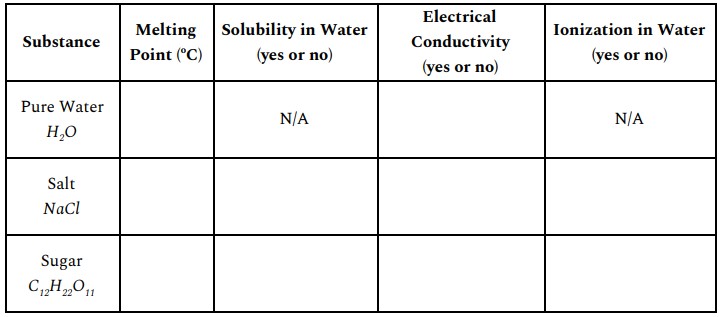
  2. Using the "Chemical and Physical Properties" section of the provided website, search for water, sodium chloride (salt), and sucrose (sugar) locate the melting point (not the same as decomposition) for water, sodium chloride, and sucrose as well as the solubility in water for sodium chloride and sucrose.
  3. Use the observations from Part B to determine electrical conductivity and ionization in water.
Conductivity - did the conductivity tester turn on?
Ionization - did the molecules break apart when they were mixed in water?
Required
1
Required
1
Required
1
Required
1
Required
1
Required
1
Required
1
Required
1
Required
1
Required
1
Question 25
25.
Based on the chemical formulas of each substance tested (see the above data table), indicate whether they are covalent or ionic compounds.

Salt (NaCl) _______
Sugar (C12H22O11) _______
Question 26
26.

Does evidence recorded on the data table above support your answer to prior question? Explain.

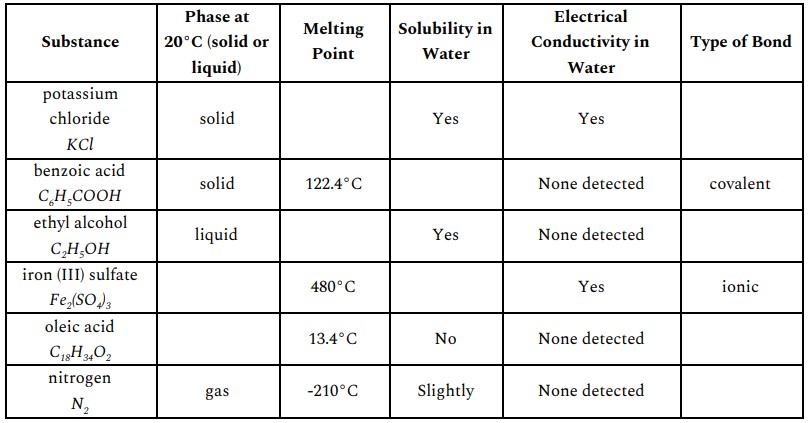
Below, a data table is provided below with information on substances not tested in the simulation. Complete any missing information by looking up the chemical and physical properties for each chemical using the same link provided earlier for part C (PubChem (nih.gov)).

Phase at 20oC - look up melting point, if it melts below that point, it is a liquid; if not, it is a solid.

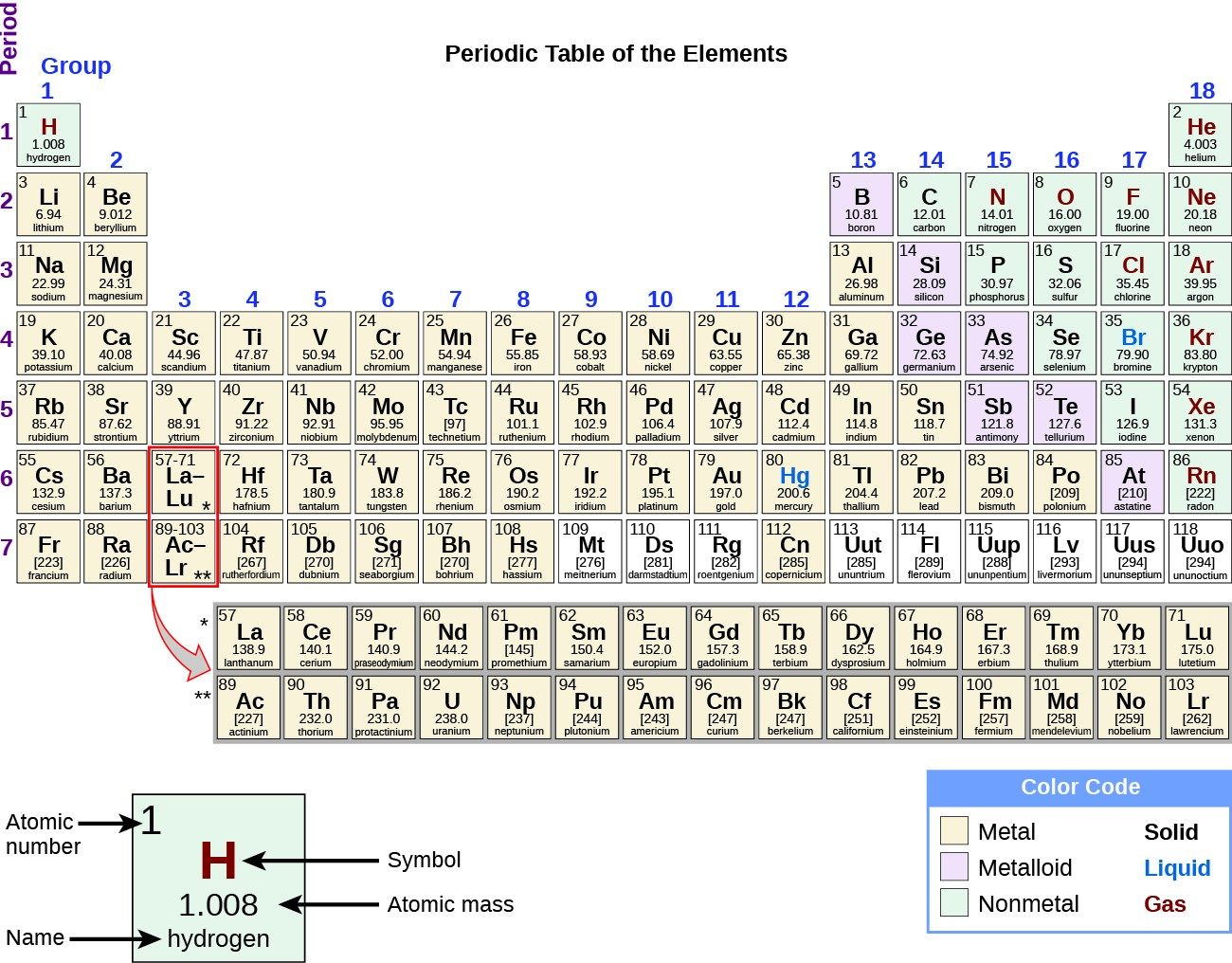
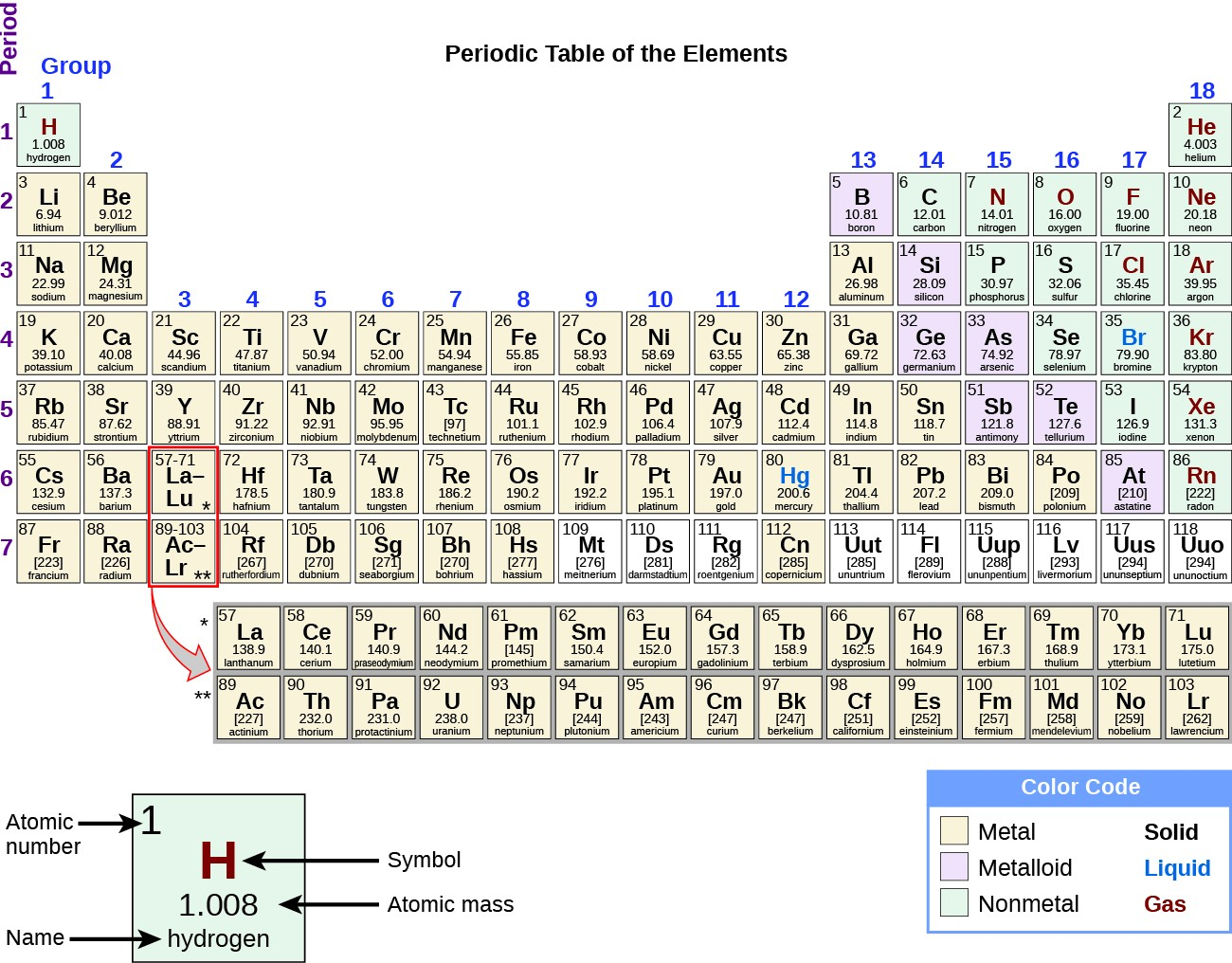
Type of Bond - ionic or covalent (use periodic table and the pre-lab reading regarding ionic and covalent bonds)


Required
1
Required
1
Required
1
Required
1
Required
1
Required
1
Required
1
Required
1
Question 35
35.

Using the data you gathered during the simulation, as well as the data table from the previous question, what are some properties exhibited by covalent compounds?

Question 36
36.

What are some properties exhibited by the ionic compounds tested in the simulation and/or shown in the first data table?

Question 37
37.

Although both sugar and salt are soluble in water, the way in which they dissolve is not shown the same in the simulation. How is their dissolving process different? Explain why these differences exist.

Question 38
38.

What would the simulation have shown if oleic acid was added to water? Would it look different than what was shown for sugar and/or salt? Explain. (Tip - refer to the data that you have on oleic acid in one of the above data tables.)

Question 39
39.

When some ionic compounds dissolve, not all of their bonds dissociate. What kind of conductivity would you expect such a solution to have? Explain.

Question 40
40.
Based on the formula and using the provided periodic table, predict whether each of the following compounds is likely an ionic or covalent compound. If you are unsure how to classify compounds are covalent or ionic, refer to the pre-lab reading.


Sodium iodide (NaI) _______
Methane (CH4) _______
Calcium chloride (CaCl2) _______
Ammonia (NH3) _______
Glucose (C6H12O6) _______

Pre-Lab Reading


Ionic Bonds

Oppositely charged particles attract each other.  This attractive force is often referred to as an electrostatic force.  An ionic bond is the electrostatic force that holds oppositely-charged ions together in an ionic compound.  The strength of the ionic bond is directly dependent upon the quantity of the charges and inversely dependent on the distance between the charged particles.  A cation with a 2+ charge will make a stronger ionic bond than a cation with a 1+ charge.  A larger ion makes a weaker ionic bond because of the greater distance between its electrons and the nucleus of the oppositely charged ion.

We will use sodium chloride as an example to demonstrate the nature of the ionic bond and how it forms.  As you know, sodium is a metal and loses its one valence electron to become a cation.  Chlorine is a nonmetal and gains one electron in becoming an anion.  Both achieve a noble-gas electron configuration.  However, electrons cannot be simply “lost” to nowhere in particular.  A more accurate way to describe what is happening is that a single electron is transferred from the sodium atom to the chlorine atom as shown below.


The ionic bond is the attraction of the Na+ ion for the Cl− ion.  It is conventional to show the cation without dots around the symbol to emphasize that the original energy level that contained the valence electron is now empty.  The anion is now shown with a complete octet of electrons.

For a compound such as magnesium chloride, it is not quite as simple.  Because magnesium has two valence electrons, it needs to lose both to achieve the noble-gas configuration.  Therefore, two chlorine atoms will be needed.
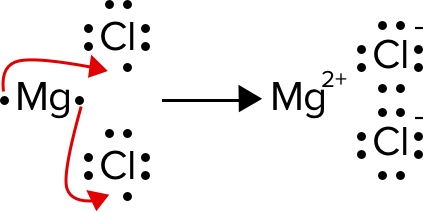

The final formula for magnesium chloride is MgCl2.

Covalent Bonds

A covalent bond is the force of attraction that holds together two atoms that share a pair of valence electrons. The shared electrons are attracted to the nuclei of both atoms. This forms a molecule consisting of two or more atoms. Covalent bonds form only between atoms of nonmetals.

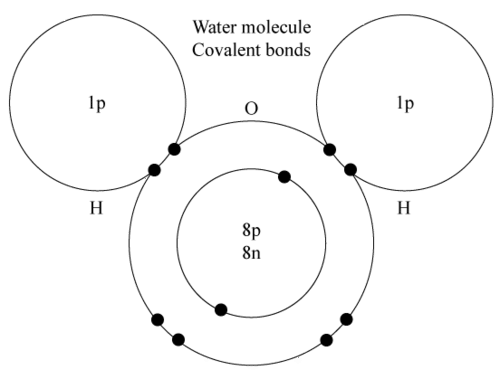
The two atoms that are held together by a covalent bond may be atoms of the same element or different elements. When atoms of different elements form covalent bonds, a new substance, called a covalent compound, results. Water is an example of a covalent compound. A water molecule is modeled in the Figure below. A molecule is the smallest particle of a covalent compound that still has the properties of the compound.


The diagram in the Figure below shows an example of covalent bonds between two atoms of the same element, in this case two atoms of oxygen. The diagram represents an oxygen molecule, so it’s not a new compound. Oxygen normally occurs in diatomic (“two-atom”) molecules. Several other elements also occur as diatomic molecules: hydrogen, nitrogen, and all but one of the halogens (fluorine, chlorine, bromine, and iodine).
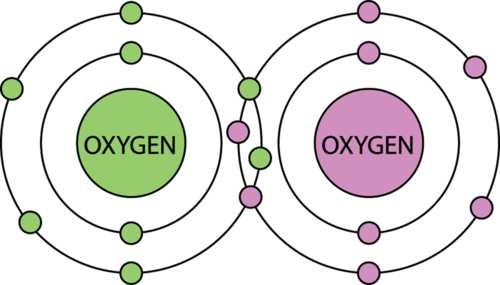


Covalent bonds form because they give atoms a more stable arrangement of electrons. Look at the oxygen atoms in the Figure above. Alone, each oxygen atom has six valence electrons. By sharing two pairs of valence electrons, each oxygen atom has a total of eight valence electrons. This fills its outer energy level, giving it the most stable arrangement of electrons. The shared electrons are attracted to both oxygen nuclei, and this force of attraction holds the two atoms together in the oxygen molecule.
Use your observations from Part A to answer the following question.

Select all of those that caused the light on the conductivity tester to turn on.
sugar
salt
Use your observations from Part A to answer the following question.

Select all of those that are conductive.
salt
sugar
Review which substance (salt or sugar) from Part A was conductive.
Compare your observations from Part B for salt (NaCl) and sugar (sucrose) with your observations for each of the other substances tested. You will use these comparisons to determine if those substances are likely to be conductive or not.

Select all of those substances that are likely to be conductive.
NaCl
sucrose
calcium chloride
sodium nitrate
glucose
Question 15
15.
_______
Question 16
16.
_______
Question 17
17.
_______
Question 18
18.
_______
Question 19
19.
_______
Question 20
20.
_______
Question 21
21.
_______
Question 22
22.
_______
Question 23
23.
_______
Question 24
24.
_______
Question 27
27.
_______
Question 28
28.
_______
Question 29
29.
_______
Question 30
30.
_______
Question 31
31.
_______
Question 32
32.
_______
Question 33
33.
_______
Question 34
34.
_______