Log in
Sign up for FREE
arrow_back
Library

Copy of Covalent Bonds 2 - A Review with Polar and Non-Polar Bonds (5/28/2026)

star
star
star
star
star
Last updated about 2 hours ago
45 questions
Note from the author:
Part 1 - Naming, Prefixes, and Compounds
6
1
1
7
1
1
1
Part 3 - Polar and Nonpolar Bonding
1
1
1
2
2
1
2
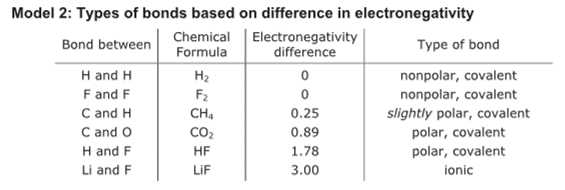
2
1
2
1
2
2
2
1
2
2
2
2
2
1
1
2
2
Learning Goals:
  • Given a covalent compound’s name, identify the proper chemical formula for the compound.
  • Given a covalent compound’s chemical formula, identify the proper name for the compound.
  • Recognize electronegativity's role in forming polar and nonpolar covalent bonds.
  • Recognize how electrons are shared in polar and nonpolar covalent bonds.
  • Recognize the relationship between dipole moments and polar covalent bonds.
  • Recognize partially positive and partially negative atoms in a covalent compound using electronegativities.
  • Determine the ionic character of atoms in a covalent compound based on differences in electronegativities.
Use any reading, models, and tables on this POGIL to assist you in answering these questions.
Learning Goals:
  • Given a covalent compound’s name, identify the proper chemical formula for the compound.
  • Given a covalent compound’s chemical formula, identify the proper name for the compound.
  • Recognize electronegativity's role in forming polar and nonpolar covalent bonds.
  • Recognize how electrons are shared in polar and nonpolar covalent bonds.
  • Recognize the relationship between dipole moments and polar covalent bonds.
  • Recognize partially positive and partially negative atoms in a covalent compound using electronegativities.
  • Determine the ionic character of atoms in a covalent compound based on differences in electronegativities.
Use any reading, models, and tables on this POGIL to assist you in answering these questions.
Review of Covalent Bonding and Covalent Compounds

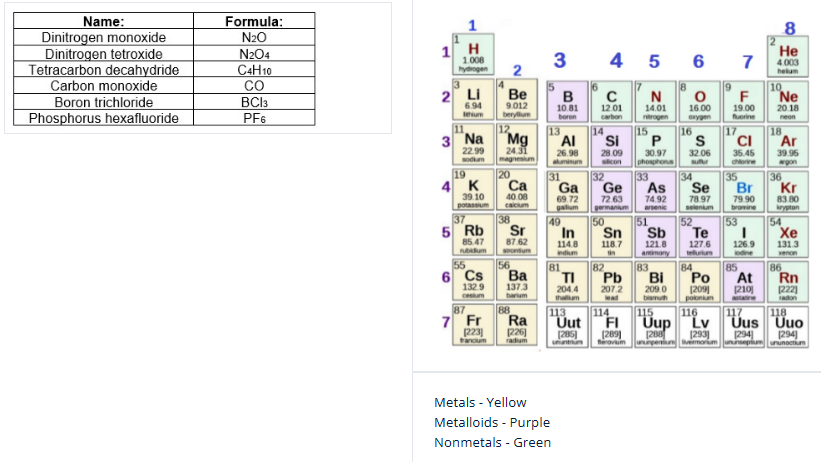
In this part of the activity, we will use gases and other compounds to illustrate naming covalent compounds.  Covalent compounds are groups of atoms that stay together because of shared electrons in chemical bonds.  There are an infinite number of covalent compounds.  Here, we will focus on naming some of the smaller covalent compounds. The names of covalent compounds are similar to those of the ionic compounds, but there are differences.
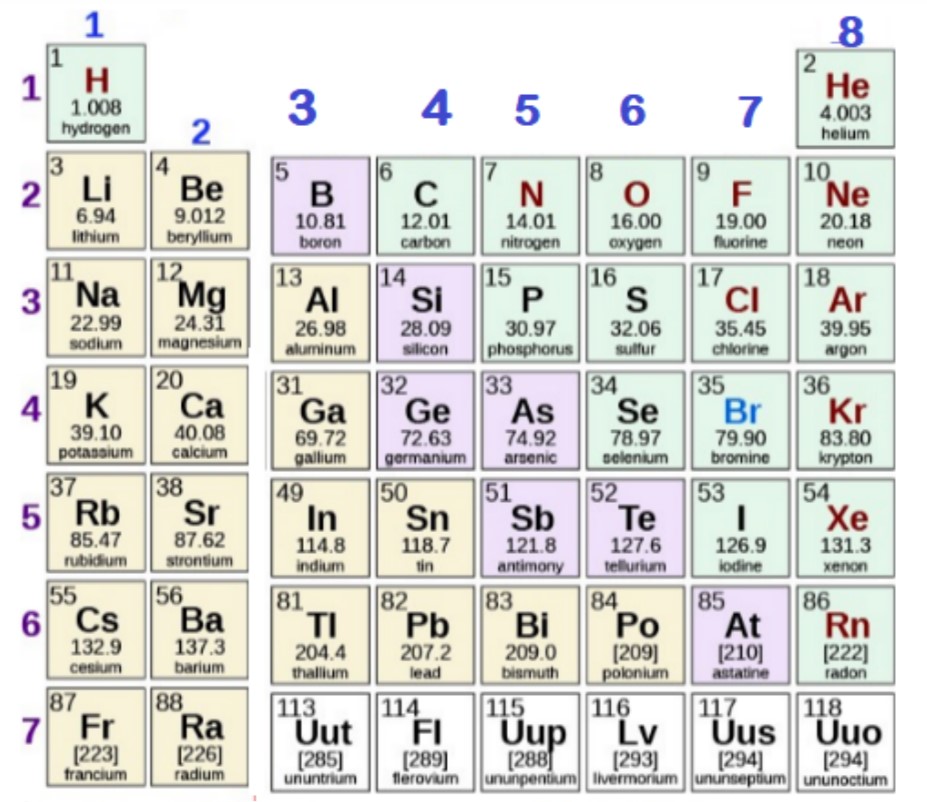
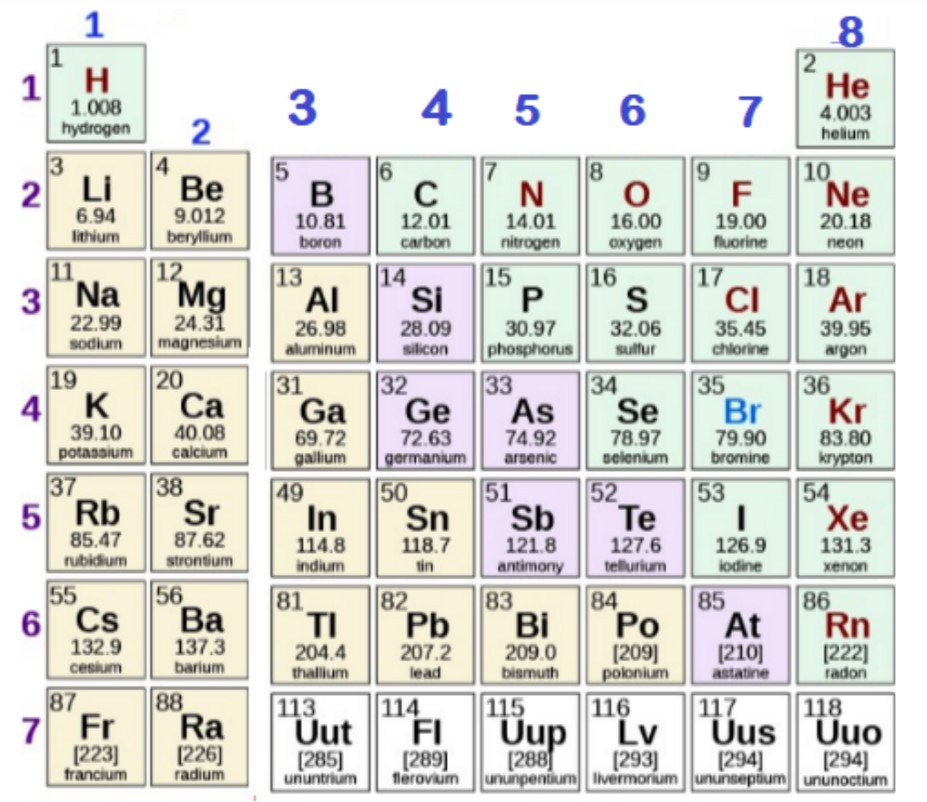
Metals - Yellow
Metalloids - Purple
Nonmetals - Green
Question 1
1.

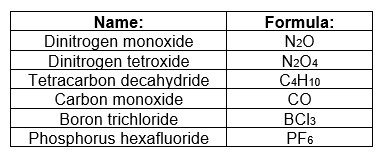
a.) Review the compounds in the table. Where in the periodic table are all the elements used in each compound found? _______
b.) What suffix (word ending) is used in each compound? _______
c.) How is the name of some of the first elements changed as it goes from an individual atom to a component in a compound? _______
d.) How is the name of the second element in each name changed as it goes from an individual atom to a component in a compound? _______
e.) How many nitrogen atoms are present in dinitrogen tetroxide? _______
f.) How many fluorine atoms are present in phosphorus hexafluoride? _______
Metals - Yellow
Metalloids - Purple
Nonmetals - Green
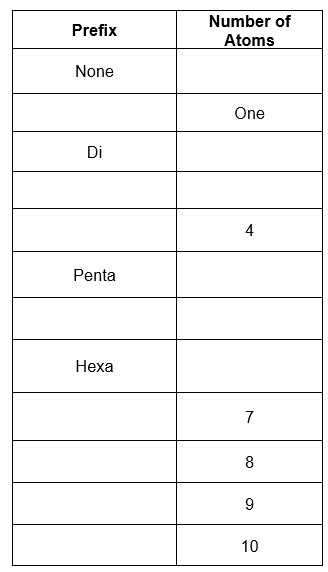
Instructions:
In the incomplete table to the left, you will determine the correct prefix that aligns with the correct number of atoms.
Each blank box of the table has a circled number; each will correspond to a numbered blank to the right.
Insert the missing information that belongs to the table in the corresponding blank.
The left column is for all possible prefixes; the right column is their corresponding number of atoms.

Tip - see the above table that contains the compounds with their formula.
1
1
1
1
1
1
1
1
1
1
1
1
1
1
Question 16
16.

Nitrogen oxide and nitrogen monoxide seem to be two possible names for the same compound (NO).  What is the difference in these names, and which is the correct form?

Question 17
17.
A dentist calls you up and needs to order more laughing gas for his dental clinic.  You check in a chemistry reference and find that the chemical name for laughing gas is dinitrogen monoxide.  
You may order N2O, NO, or NO2.  
One is the correct compound and the other two are toxic gases.  
Which should be ordered to keep the patients happy and alive? _______
Question 18
18.

Use what you have learned about prefixes and numbers of atoms to identify either the compound name or the compound formula for each:

a.) sulfur difluoride: _______
b.) PCl3: _______
c.) silicon dioxide: _______
d.) H2S: _______
e.) carbon tetrachloride: _______
f.) SiBr2: _______
g.) P4O10: _______
Question 19
19.

Use everything we have reviewed and learned about prefixes, numbers of atoms, and naming to provide a statement expressing the basic rules for naming a compound and/or identifying its formula.

Question 20
20.

Question 21
21.

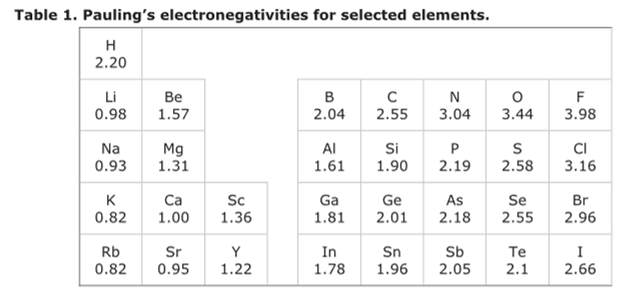
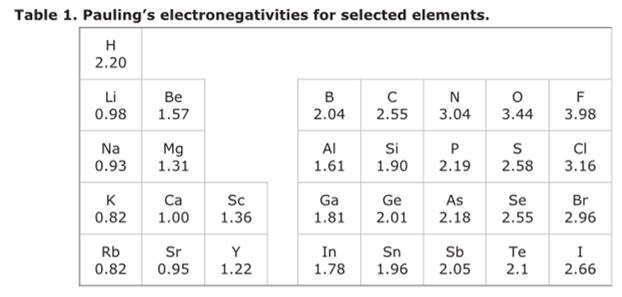
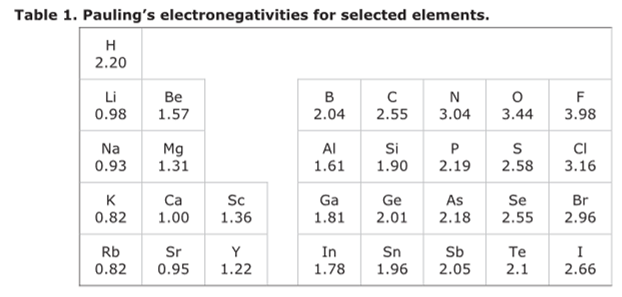
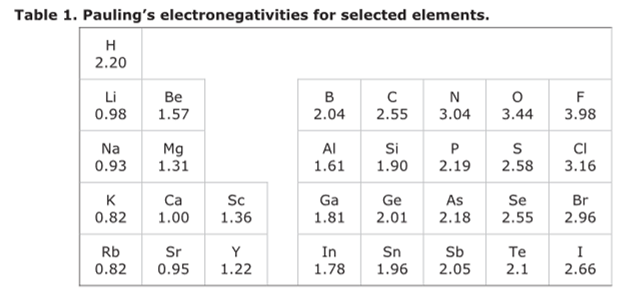
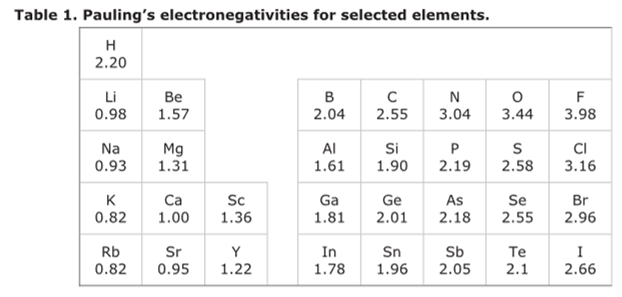
Relative Electronegativity Values for Selected Elements

Read This!

Linus Pauling noticed that bonds between different elements (heteronuclear "different nuclei") appeared to be stronger than bonds between two atoms of the same element (homonuclear "same nuclei"). He proposed that the bonding electrons in heteronuclear molecules were not shared equally, reasoning that one atom attracted the electrons in the bond more strongly than the other atom.

The electronegativity of an atom is its ability to attract electrons in a covalent bond closer to itself. Fluorine is the most electronegative element.

Question 22
22.

Using Table 1, describe the trend in electronegativity of elements from left to right across a period of the Periodic Table.

Question 23
23.

Using Table 1, describe the trend in electronegativity from top to bottom of a group of the Periodic Table.

Question 24
24.
When carbon and oxygen are covalently bonded, the electrons in the bond between them are attracted closer to which atom? _______
Read This!

Molecular Polarity:
  • A dipole is molecule or compound with a positive and a negative end; another way of saying this is "polar".
  • A polar molecule (dipole) is a molecule where the bonds are asymmetric, meaning that the electrons in the bond are not shared equally between the atoms involved in the bond.
  • How the electrons are shared in a bond is determined by the electronegativity of the atoms involved in the bond.
  • Atoms that have an imbalance in electronegativities will not share electrons equally and the electrons will be nearer to the atom with the greatest electronegativity - this type of bond is a polar bond.
  • Polar bonds display a dipole, meaning that the atom that is nearest the electrons has a partial-negative charge and the atom that is farthest from the electrons has a partial-positive charge.

Question 25
25.
Which atom (C or O) is at the negatively polarized end of a bond between carbon and oxygen? _______ Which atom is at the positively polarized end? _______
Question 26
26.

Explain the answers to the previous question.

Question 27
27.
Using the data in Table 1, determine which atom in a bond between carbon and nitrogen would be negatively polarized (C or N). _______
Question 28
28.

Explain your answer to the previous question.

Question 29
29.

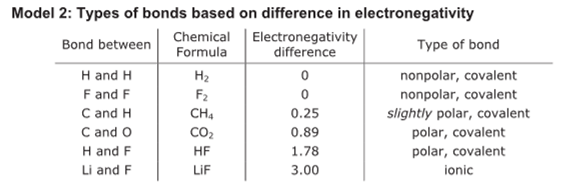
Model 2 states that a H–H bond is nonpolar. Using the information from Model 2, devise a definition for the term "nonpolar bond".

Question 30
30.
Considering Model 2, which would you expect to be more polar—a C–O bond, or an H–F bond? _______
Question 31
31.

Explain your answer to the previous question.


Question 32
32.
Which would be more polar: a C-O bond, or a C-Cl bond? _______
Question 33
33.

Explain your answer to the previous question.

Question 34
34.

For each atom in the molecules below, select each one that would have a partially negative charge.

Question 35
35.

For each atom in the molecules below, select each one that would have a partially positive charge.


Question 36
36.
Refer to Table 1 and Model 2, above.

Based on the difference in their electronegativities, a bond between lithium (Li) and fluorine (F) would be extremely polarized. Which end of the bond would be negatively polarized, Li or F? _______
Question 37
37.

Explain your answer to the previous question.

Question 38
38.

Tip - consider the difference between covalent and ionic compounds and how they are formed.

Question 39
39.

Recall that ions are charged atoms. The idea of an atom having an ionic character refers to an atom acting like an ion, even if it does not accept or donate electrons as in the formation of a true ion that occurs during ionic bonding. Atoms involved in polar covalent bonds can display ionic character depending on the differences in their electronegativities.

Explain the following statement: The ionic character of a bond increases as the electronegativity difference between the two bonded atoms increases.

Question 40
40.

Question 41
41.

Model 3: Carbon dioxide is overall nonpolar.
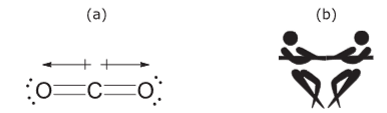

Consider the model of carbon dioxide in (a) above. Both C–O bonds are polar, with the negative ends on each oxygen. The arrows, or vectors, indicate that each electronegative oxygen is pulling electrons equally toward itself. Since both bonds are equally polarized in opposite directions, no particular side or end of the CO2 molecule is negatively or positively polarized. In other words, the individual bond polarities “cancel out.”

This type of canceling can occur whenever all the electrons around a central atom are in identical covalent bonds (to the same elements) and therefore are equally polarized.

As an analogy, consider image (b) in Model 3. Picture the C–O bonds as ropes, with the two oxygens pulling on the ropes in a “tug-of-war” game. Since they are “pulling” the electrons equally in opposite directions, there is no net movement of the electrons. So even though each C-O bond is polar, the molecule as a whole is nonpolar.
Question 42
42.

Question 43
43.


Question 44
44.

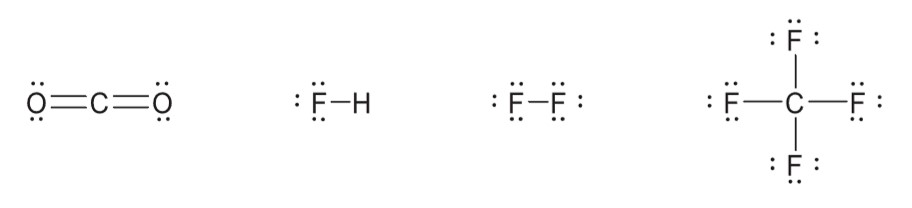
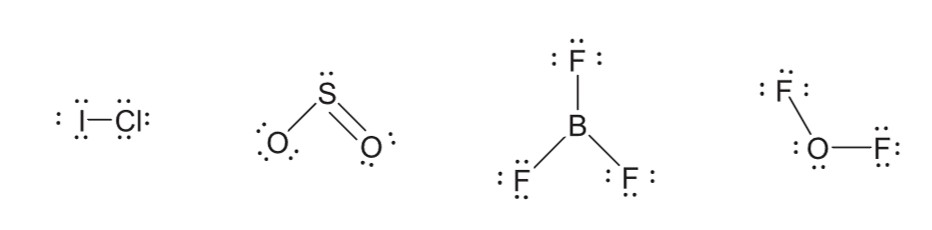
Three of the four molecules below have polar bonds, but only one molecule is polar. Write an explanation for this.

Question 45
45.

Consider all that has been discussed in this activity and think about how to arrive at a rule for determining whether a particular bond in a covalent molecule is polar. Write your rule in a complete sentence or two.

Question 2
2.
_______
Question 3
3.
_______
Question 4
4.
_______
Question 5
5.
_______
Question 6
6.
_______
Question 7
7.
_______
Question 8
8.
_______
Question 9
9.
_______
Question 10
10.
_______
Question 11
11.
_______
Question 12
12.
_______
Question 13
13.
_______
Question 14
14.
_______
Question 15
15.
_______
Identify the correct compound for ammonia (NH3)
Identify the correct compound for methanol (CH3OH)