Copy of Theoretical Yield, Limiting Reagent Percent Yield Practice 1-2 (5/28/2026)
star
star
star
star
star
Last updated 3 months ago
5 Nsɛmmisa
Hyɛ no nsow a efi ɔkyerɛwfo no hɔ:
Untitled Section
Practice Questions
5
5
5
5
5
C.4.5 Use a balanced chemical equation to calculate the quantities of reactants needed and products made in a chemical reaction that goes to completion.
Learning Goals:
I can use a balanced chemical equation to calculate the quantities of reactants needed in a completed chemical reaction.
I can use a balanced chemical equation to calculate the products made in a completed chemical reaction.
C.4.5 Use a balanced chemical equation to calculate the quantities of reactants needed and products made in a chemical reaction that goes to completion.
Learning Goals:
I can use a balanced chemical equation to calculate the quantities of reactants needed in a completed chemical reaction.
I can use a balanced chemical equation to calculate the products made in a completed chemical reaction.
Reactant 1 + Reactant 2 → Product(s)
Usually, one of the reactants is fully consumed in a reaction before the other.
Limiting Reagent - the reactant that is fully consumed, first.
The reaction will stop when the limiting reagent is consumed.
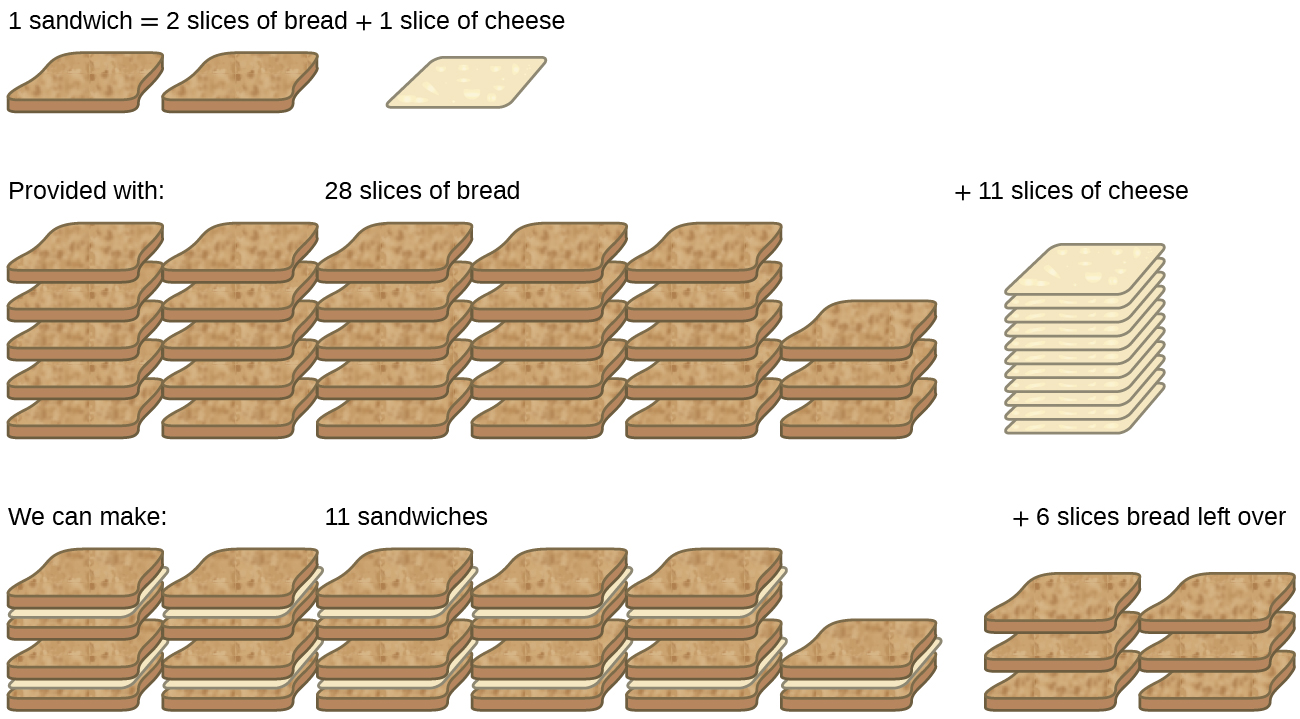
Example - Grilled Cheese Sandwiches
2 slices of bread + 1 slice of cheese → 1 grilled cheese
Cheese is consumed, first.
Cheese is the limiting reagent.
Identifying the Limiting Reagent:
Sometimes we will find this via stoichiometric calculations.
In many of your first questions, it will tell you one of the reactions is in excess and another has a specific quantity; usually the reactant in excess is NOT the limiting reagent while the reactant with a provided quantity is the limiting reagent.
CuSO4 + Zn → Cu + ZnSO4
1.274 g of CuSO4 was reacted with an excess of Zn to produce 0.392 g Cu.
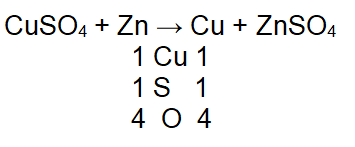
Step 1 – Balance the Equation
CuSO4 + Zn → Cu + ZnSO4
1.274 g of CuSO4 was reacted with an excess of Zn to produce 0.392 g Cu.
Step 1 – Balance the Equation
Step 2 - Theoretical Yield
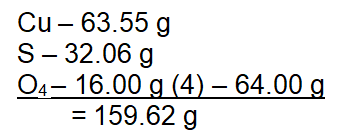
Need molar masses of CuSO4 and Cu
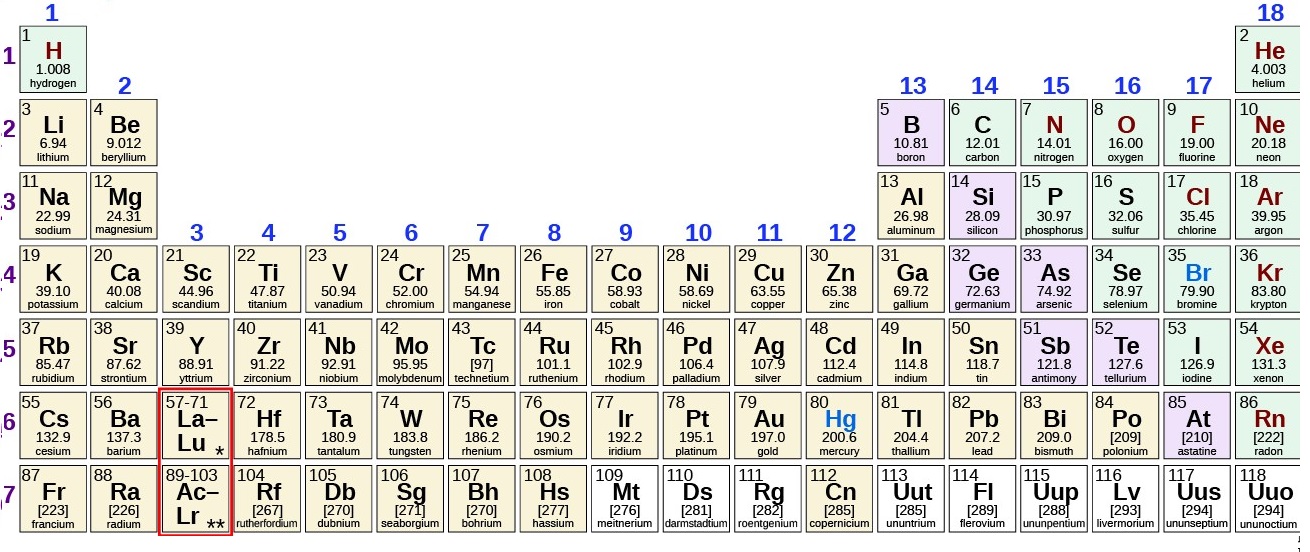
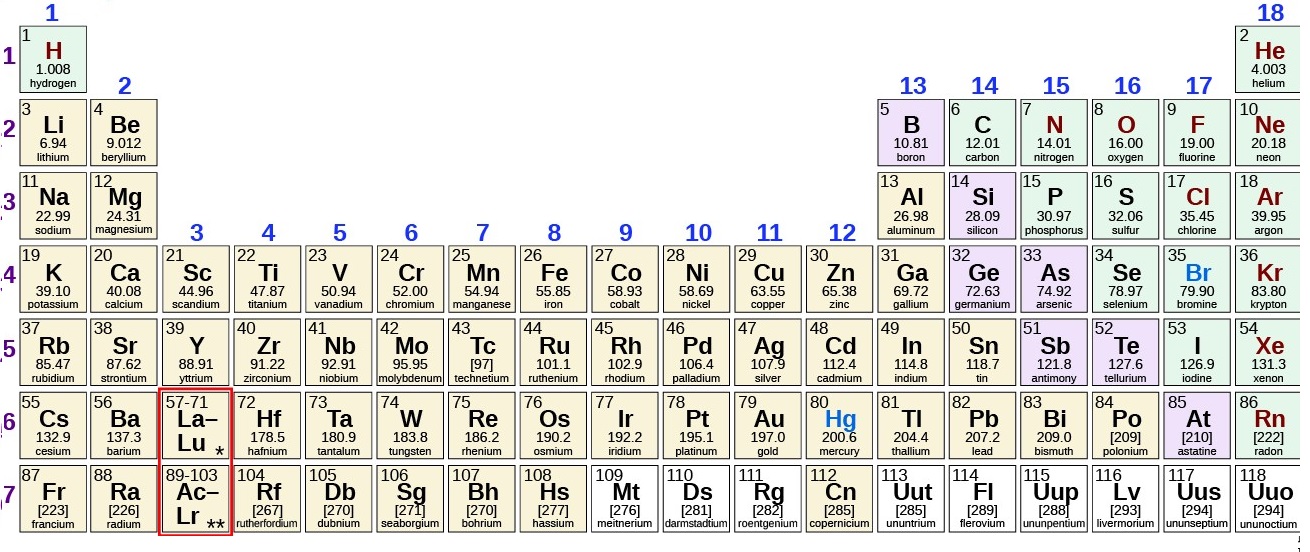
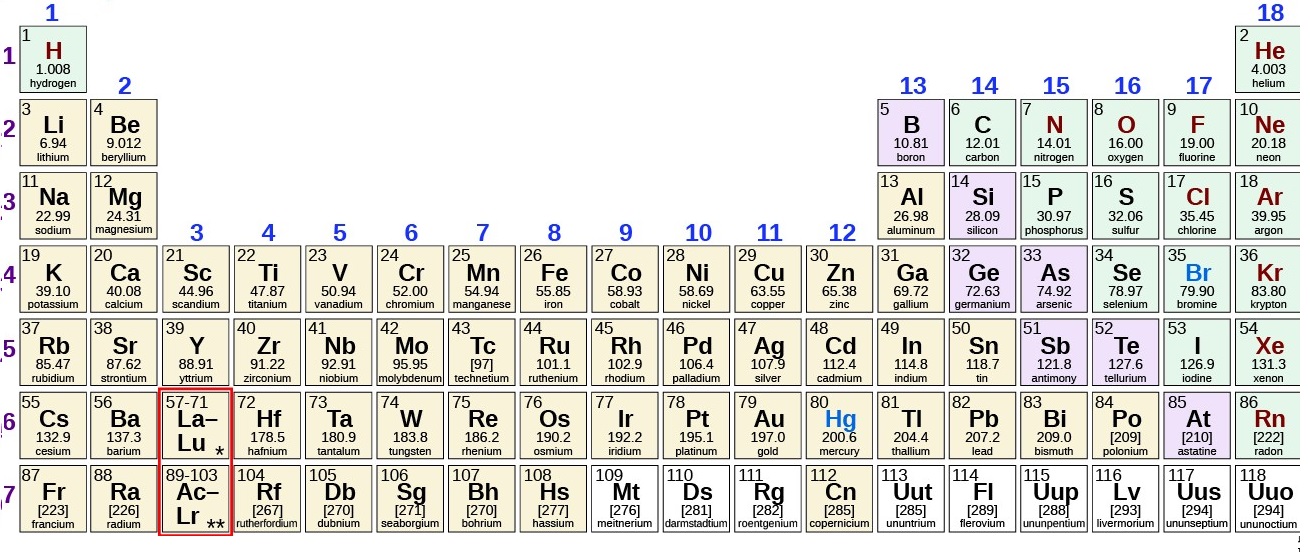
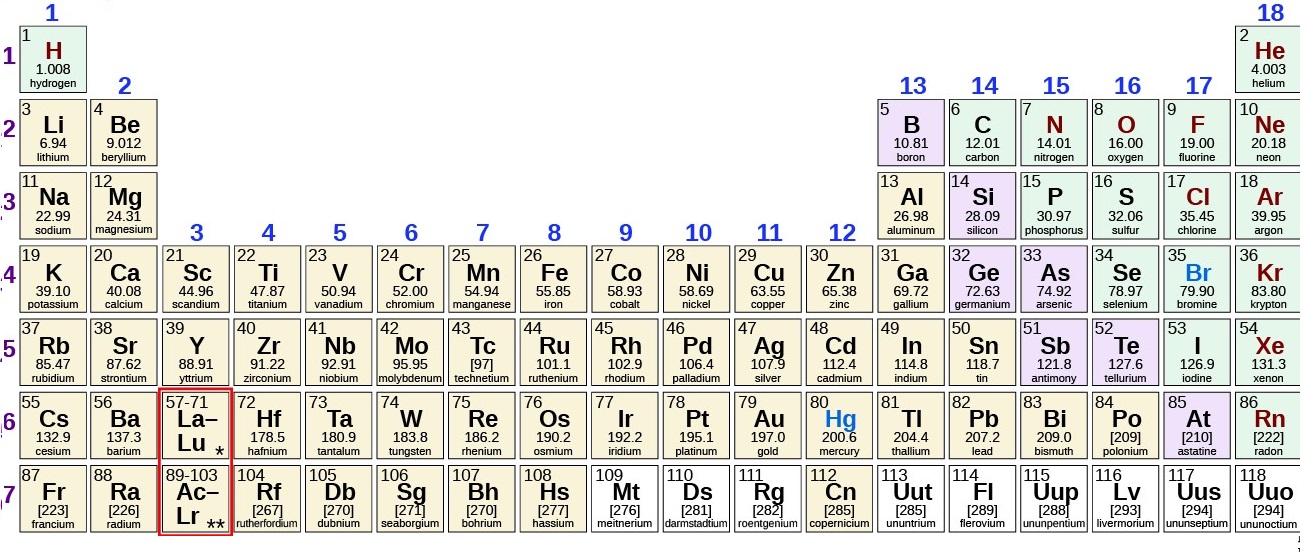
Use periodic table.
CuSO4 + Zn → Cu + ZnSO4
1.274 g of CuSO4 was reacted with an excess of Zn to produce 0.392 g Cu.
Step 1 – Balance the Equation
Step 2 - Theoretical Yield
Need molar masses of CuSO4 and Cu
Use periodic table.
CuSO4 + Zn → Cu + ZnSO4
1.274 g of CuSO4 was reacted with an excess of Zn to produce 0.392 g Cu.
Step 1 – Balance the Equation
Step 2 - Theoretical Yield
Need molar masses of CuSO4 and Cu
Use periodic table.
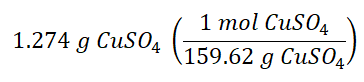
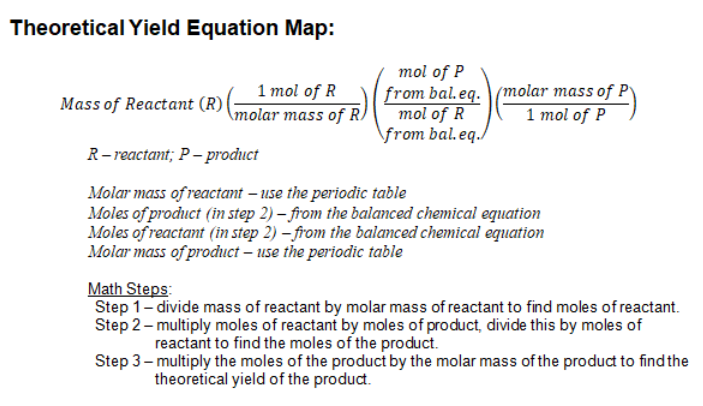
Set-up the equation (3 parts)
Mass of reactant to moles of reactant (need the molar mass of reactant).
CuSO4 + Zn → Cu + ZnSO4
1.274 g of CuSO4 was reacted with an excess of Zn to produce 0.392 g Cu.
Step 1 – Balance the Equation
Step 2 - Theoretical Yield
Need molar masses of CuSO4 and Cu
Use periodic table.
Set-up the equation (3 parts)
Mass of reactant to moles of reactant.
Moles of reactant to moles of product (1 mol of CuSO4 → 1 mol Cu).
CuSO4 + Zn → Cu + ZnSO4
1.274 g of CuSO4 was reacted with an excess of Zn to produce 0.392 g Cu.
Step 1 – Balance the Equation
Step 2 - Theoretical Yield
Need molar masses of CuSO4 and Cu
Use periodic table.
Set-up the equation (3 parts)
Mass of reactant to moles of reactant.
Moles of reactant to moles of product.
Moles of product to mass of product (need the molar mass of product).
CuSO4 + Zn → Cu + ZnSO4
1.274 g of CuSO4 was reacted with an excess of Zn to produce 0.392 g Cu.
Step 1 – Balance the Equation
Step 2 - Theoretical Yield
Need molar masses of CuSO4 and Cu
Use periodic table.
Set-up the equation (3 parts)
Mass of reactant to moles of reactant.
Moles of reactant to moles of product.
Moles of product to mass of product.
CuSO4 + Zn → Cu + ZnSO4
1.274 g of CuSO4 was reacted with an excess of Zn to produce 0.392 g Cu.
Step 1 – Balance the Equation
Step 2 - Theoretical Yield
Need molar masses of CuSO4 and Cu
Use periodic table.
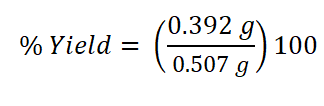
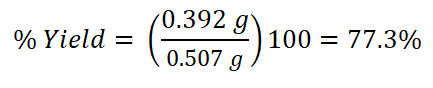
Theoretical Yield = 0.507 g Cu
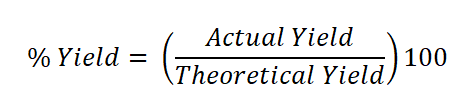
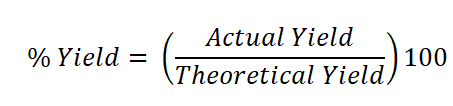
Step 3 - Percent Yield
Actual Yield = 0.392 g Cu
CuSO4 + Zn → Cu + ZnSO4
1.274 g of CuSO4 was reacted with an excess of Zn to produce 0.392 g Cu.
Step 1 – Balance the Equation
Step 2 - Theoretical Yield
Need molar masses of CuSO4 and Cu
Use periodic table.
Theoretical Yield = 0.507 g Cu
Step 3 - Percent Yield
Actual Yield = 0.392 g Cu
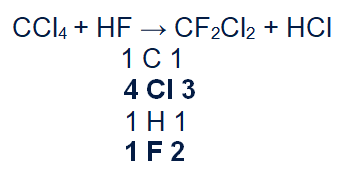
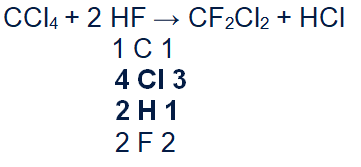
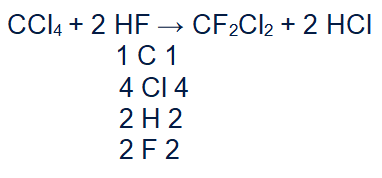
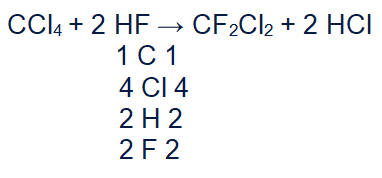
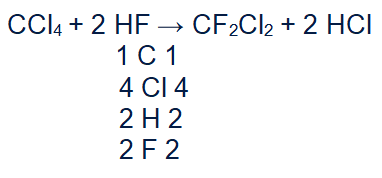
CCl4 + HF → CF2Cl2 + HCl
32.9 g CCl4 is reacted with an excess of HF to produce 12.5 g CF2Cl2
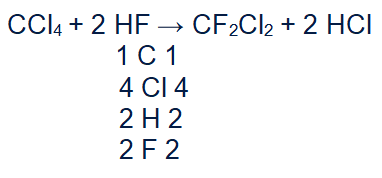
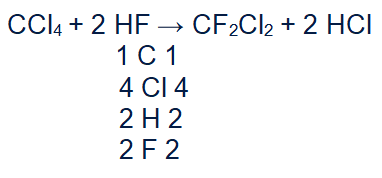
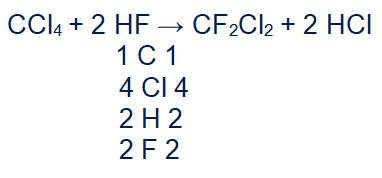
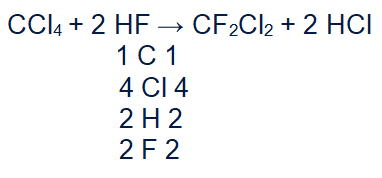
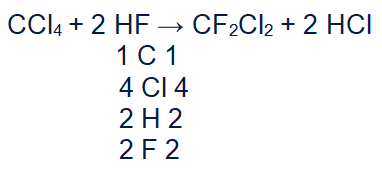
Step 1 - Balance the Equation.
CCl4 + HF → CF2Cl2 + HCl
32.9 g CCl4 is reacted with an excess of HF to produce 12.5 g CF2Cl2
Step 1 - Balance the Equation.
CCl4 + HF → CF2Cl2 + HCl
32.9 g CCl4 is reacted with an excess of HF to produce 12.5 g CF2Cl2
Step 1 - Balance the Equation.
CCl4 + HF → CF2Cl2 + HCl
32.9 g CCl4 is reacted with an excess of HF to produce 12.5 g CF2Cl2
Step 1 - Balance the Equation.
CCl4 + HF → CF2Cl2 + HCl
32.9 g CCl4 is reacted with an excess of HF to produce 12.5 g CF2Cl2
Step 1 - Balance the Equation.
Step 2 - Theoretical Yield
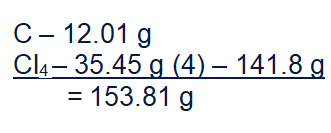
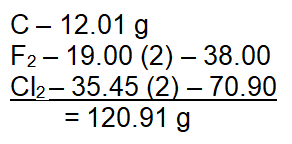
Need molar mass of CCl4 and CF2Cl2
Use periodic table.
CCl4 + HF → CF2Cl2 + HCl
32.9 g CCl4 is reacted with an excess of HF to produce 12.5 g CF2Cl2
Step 1 - Balance the Equation.
Step 2 - Theoretical Yield
Need molar mass of CCl4 and CF2Cl2
Use periodic table.
CCl4 + HF → CF2Cl2 + HCl
32.9 g CCl4 is reacted with an excess of HF to produce 12.5 g CF2Cl2
Step 1 - Balance the Equation.
Step 2 - Theoretical Yield
Need molar mass of CCl4 and CF2Cl2
Use periodic table.
Set-up the equation (3 parts)
Mass of reactant to moles of reactant (need the molar mass of reactant.)
CCl4 + HF → CF2Cl2 + HCl
32.9 g CCl4 is reacted with an excess of HF to produce 12.5 g CF2Cl2
Step 1 - Balance the Equation.
Step 2 - Theoretical Yield
Need molar mass of CCl4 and CF2Cl2
Use periodic table.
Set-up the equation (3 parts)
Mass of reactant to moles of reactant (need the molar mass of reactant.)
CCl4 + HF → CF2Cl2 + HCl
32.9 g CCl4 is reacted with an excess of HF to produce 12.5 g CF2Cl2
Step 1 - Balance the Equation.
Step 2 - Theoretical Yield
Need molar mass of CCl4 and CF2Cl2
Use periodic table.
Set-up the equation (3 parts)
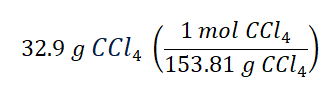
Mass of reactant to moles of reactant.
Moles of reactant to moles of product (1 mol CCl4 → 1 mol CF2Cl2).
CCl4 + HF → CF2Cl2 + HCl
32.9 g CCl4 is reacted with an excess of HF to produce 12.5 g CF2Cl2
Step 1 - Balance the Equation.
Step 2 - Theoretical Yield
Need molar mass of CCl4 and CF2Cl2
Use periodic table.
Set-up the equation (3 parts)
Mass of reactant to moles of reactant.
Moles of reactant to moles of product.
Moles of product to mass of product (use molar mass of product).
CCl4 + HF → CF2Cl2 + HCl
32.9 g CCl4 is reacted with an excess of HF to produce 12.5 g CF2Cl2
Step 1 - Balance the Equation.
Step 2 - Theoretical Yield
Need molar mass of CCl4 and CF2Cl2
Use periodic table.
Set-up the equation (3 parts)
Mass of reactant to moles of reactant.
Moles of reactant to moles of product.
Moles of product to mass of product.
CCl4 + HF → CF2Cl2 + HCl
32.9 g CCl4 is reacted with an excess of HF to produce 12.5 g CF2Cl2
Step 1 - Balance the Equation.
Step 2 - Theoretical Yield
Need molar mass of CCl4 and CF2Cl2
Use periodic table.
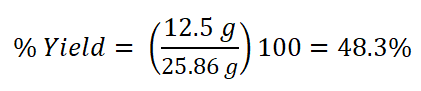
Theoretical Yield = 25.86 g CF2Cl2
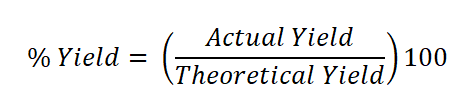
Step 3 - Percent Yield
Actual Yield = 12.5 g CF2Cl2
CCl4 + HF → CF2Cl2 + HCl
32.9 g CCl4 is reacted with an excess of HF to produce 12.5 g CF2Cl2
Step 1 - Balance the Equation.
Step 2 - Theoretical Yield
Need molar mass of CCl4 and CF2Cl2
Use periodic table.
Theoretical Yield = 25.86 g CF2Cl2
Step 3 - Percent Yield
Actual Yield = 12.5 g CF2Cl2
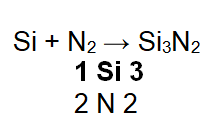
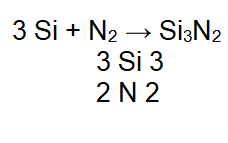
Si + N2 → Si3N2
2.00 g Si was reacted with 1.50 g N2 to form 1.52 g Si3N2.
In this example, we will be using both reactants and the product to determine the limiting reagent.
Si + N2 → Si3N2
2.00 g Si was reacted with 1.50 g N2 to form 1.52 g Si3N2.
Step 1 - Balance the Equation.
Si + N2 → Si3N2
2.00 g Si was reacted with 1.50 g N2 to form 1.52 g Si3N2.
Step 1 - Balance the Equation.
Si + N2 → Si3N2
2.00 g Si was reacted with 1.50 g N2 to form 1.52 g Si3N2.
Step 1 - Balance the Equation.
Step 2 - Theoretical Yield.
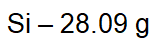
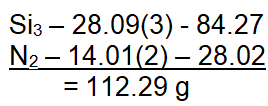
Need molar mass of both reactants and the product (necessary to deter. limiting reagent).
Use periodic table
Si + N2 → Si3N2
2.00 g Si was reacted with 1.50 g N2 to form 1.52 g Si3N2.
Step 1 - Balance the Equation.
Step 2 - Theoretical Yield.
Molar masses
Si + N2 → Si3N2
2.00 g Si was reacted with 1.50 g N2 to form 1.52 g Si3N2.
Step 1 - Balance the Equation.
Step 2 - Theoretical Yield.
Molar masses
Set-up two reactions (for both reactants) - 3 parts.
Reaction 1 - for silicon (Si):
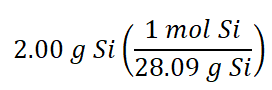
Mass of reactant to moles of reactant (use molar mass of Si).
Si + N2 → Si3N2
2.00 g Si was reacted with 1.50 g N2 to form 1.52 g Si3N2.
Step 1 - Balance the Equation.
Step 2 - Theoretical Yield.
Molar masses
Set-up two reactions (for both reactants) - 3 parts.
Reaction 1 - for silicon (Si):
Mass of reactant to moles of reactant.
Moles of reactant to moles of product (3 mol Si → 1 mol Si3N2).
Si + N2 → Si3N2
2.00 g Si was reacted with 1.50 g N2 to form 1.52 g Si3N2.
Step 1 - Balance the Equation.
Step 2 - Theoretical Yield.
Molar masses
Set-up two reactions (for both reactants) - 3 parts.
Reaction 1 - for silicon (Si):
Mass of reactant to moles of reactant.
Moles of reactant to moles of product.
Moles of product to mass of product (use molar mass of product).
Si + N2 → Si3N2
2.00 g Si was reacted with 1.50 g N2 to form 1.52 g Si3N2.
Step 1 - Balance the Equation.
Step 2 - Theoretical Yield.
Molar masses
Set-up two reactions (for both reactants) - 3 parts.
Reaction 1 - for silicon (Si):
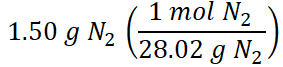
Reaction 2 - for nitrogen (N2):
Mass of reactant to moles of reactant.
Si + N2 → Si3N2
2.00 g Si was reacted with 1.50 g N2 to form 1.52 g Si3N2.
Step 1 - Balance the Equation.
Step 2 - Theoretical Yield.
Molar masses
Set-up two reactions (for both reactants) - 3 parts.
Reaction 1 - for silicon (Si):
Reaction 2 - for nitrogen (N2):
Mass of reactant to moles of reactant.
Moles of reactant to moles of product (1 mol N2 → 1 mol Si3N2).
Si + N2 → Si3N2
2.00 g Si was reacted with 1.50 g N2 to form 1.52 g Si3N2.
Step 1 - Balance the Equation.
Step 2 - Theoretical Yield.
Molar masses
Set-up two reactions (for both reactants) - 3 parts.
Reaction 1 - for silicon (Si):
Reaction 2 - for nitrogen (N2):
Mass of reactant to moles of reactant.
Moles of reactant to moles of product (1 mol N2 → 1 mol Si3N2).
Moles of product to mass of product (use the molar mass of Si3N2).
Si + N2 → Si3N2
2.00 g Si was reacted with 1.50 g N2 to form 1.52 g Si3N2.
Step 1 - Balance the Equation.
Step 2 - Theoretical Yield.
Molar masses
Set-up two reactions (for both reactants) - 3 parts.
Reaction 1 - for silicon (Si):
Reaction 2 - for nitrogen (N2):
Si + N2 → Si3N2
2.00 g Si was reacted with 1.50 g N2 to form 1.52 g Si3N2.
Step 1 - Balance the Equation.
Step 2 - Theoretical Yield.
Molar masses
Set-up two reactions (for both reactants) - 3 parts.
Reaction 1 - for silicon (Si):
Reaction 2 - for nitrogen (N2):
Si + N2 → Si3N2
2.00 g Si was reacted with 1.50 g N2 to form 1.52 g Si3N2.
Step 1 - Balance the Equation.
Step 2 - Theoretical Yield.
Molar masses
Reaction 1 - for silicon (Si):
Reaction 2 - for nitrogen (N2):
Step 3 - Limiting Reagent
Compare the theoretical yields.
The lowest one is the limiting reagent.
Si + N2 → Si3N2
2.00 g Si was reacted with 1.50 g N2 to form 1.52 g Si3N2.
Step 1 - Balance the Equation.
Step 2 - Theoretical Yield.
Molar masses
Reaction 1 - for silicon (Si):
Reaction 2 - for nitrogen (N2):
Step 3 - Limiting Reagent
Compare the theoretical yields.
The lowest one is the limiting reagent.
Si → 2.70 g Si3N2
N2 → 6.01 g Si3N2
Si will be consumed first, since it will produce the least amount of product.
Si + N2 → Si3N2
2.00 g Si was reacted with 1.50 g N2 to form 1.52 g Si3N2.
Step 1 - Balance the Equation.
Step 2 - Theoretical Yield.
Molar masses
Reaction 1 - for silicon (Si):
Reaction 2 - for nitrogen (N2):
Step 3 - Limiting Reagent
Compare the theoretical yields.
The lowest one is the limiting reagent.
Si → 2.70 g Si3N2
N2 → 6.01 g Si3N2
Si will be consumed first, since it will produce the least amount of product.
Step 4 - Percent Yield
You Need:
Scientific Calculator (recommend - Natural Scientific Calculator app for cellphone)
Paper
Pencil (it erases...)
Periodic Table (provided on each question).
The following reaction was performed:
LiOH + KCl → LiCl + KOH
20.0 g of LiOH was reacted with an excess of KCl to produce 6.0 g LiCl.
Step 1 - Balance the equation (if you need "1" of anything, place an _ in the blank - "shift" + "hyphen").
Step 2 - Calculate the theoretical yield of LiCl.
Theoretical yield
Step 3 - Calculate the percent yield if 6.0 g of LiCl was actually produced.
Percent yield
The following reaction was performed:
C3H8 + O2 → CO2 + H2O
5.0 g C3H8 is reacted with excess O2
Step 1 - Balance the equation (if you need "1" of anything, place an _ in the blank - "shift" + "hyphen").
Step 2 - Calculate the theoretical yield of H2O.
Theoretical yield
Step 3 - Calculate the percent yield if 7.9 g of H2O was actually produced.
Percent yield
The following reaction was performed:
NaCl + CaO → CaCl2 + Na2O
20.0 g of CaO is reacted with excess NaCl.
Step 1 - Balance the equation (if you need "1" of anything, place an _ in the blank - "shift" + "hyphen").
Step 2 - Calculate the theoretical yield of Na2O.
Theoretical yield
Step 3 - Calculate the percent yield if 4.5 g Na2O was produced.
Percent yield
The following reaction was performed:
Sn3(PO4)4 + Na2CO3 → Sn(CO3)2 + Na3PO4
36 grams Sn3(PO4)4 is reacted with an excess of Na2CO3
Step 1 - Balance the equation (if you need "1" of anything, place an _ in the blank - "shift" + "hyphen").
Step 2 - Calculate the theoretical yield of Sn(CO3)2
Theoretical Yield of Sn(CO3)2
Step 3 - Percent yield, if 29.8 g Sn(CO3)2 are actually produced.
Percent yield
The following reaction was performed:
H2 + N2 → NH3
5.0 grams N2 and 5.0 grams H2 were reacted to form 3.25 g of ammonia.
Step 1 - Balance the equation (if you need "1" of an anything, place an _ in the blank - "shift" + "hyphen").
Step 2 - Determine the mass of the product produced by each reactant.
For H2
For N2
Step 3 - Compare the amounts calculated in step 2 to identify the limiting reagent.
Limiting Reagent
Step 4 - The lowest quantity calculated in step 2 will be the theoretical yield.
Theoretical Yield
Step 5 - Calculate the percent yield if the actual product produced was measured to be 3.25g.
Percent yield