Log in
Sign up for FREE
arrow_back
Library

Copy of Combination Reactions Reading (5/28/2026)

star
star
star
star
star
Last updated about 2 hours ago
11 questions
Note from the author:
Required
1
Required
1
Required
1
Required
1
Required
1
Required
1
Required
1
Required
1
Required
1
Required
1
Required
1
Read the article, view the videos, and answer the questions.
Question 1
1.

Question 2
2.

Question 3
3.

Question 4
4.

Question 5
5.

Question 6
6.

Question 7
7.

Question 8
8.

Question 9
9.
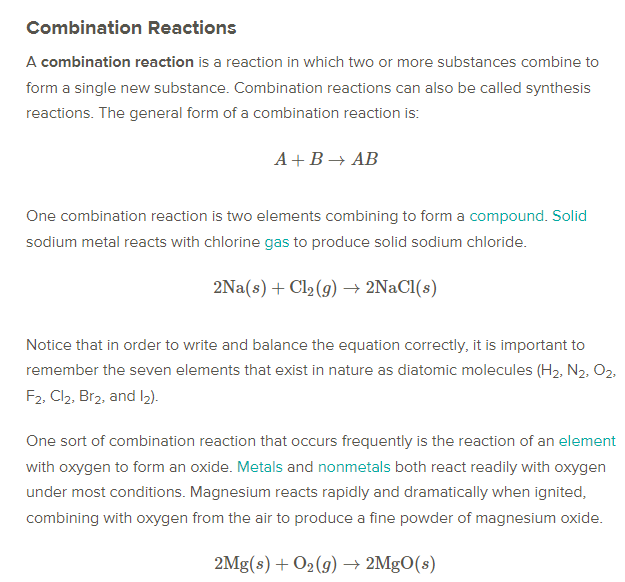
Reactions in which two or more substances combine to form a new single substance are referred to _______ reactions.
Question 10
10.

Question 11
11.

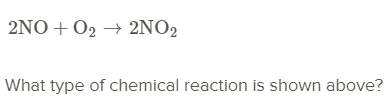
Synthesis
Combustion Reaction
Single Displacement
Decomposition
Double Displacement
Double Displacement
Single Displacement
Demposition
Synthesis
Combustion Reaction
Double Displacement
Single Displacement
Combustion Reaction
Synthesis
Decomposition
In the formation of sodium chloride by the combination of sodium (Na) and chlorine (Cl):
sodium loses electrons but chlorine gains electrons
sodium gains electrons but chlorine loses electrons
both sodium and chlorine gain electrons
both sodium and chlorine lose electrons
Can a metal and a nonmetal participate in a combination reaction?
Yes, forming ionic compounds.
Yes, forming a molecular compound
No.
Only alkali metals and halogens can.
True
False
A synthesis reaction is also known as a combination reaction.
True
False
Two or more chemical species combine to form a more complex product in a synthesis reaction.
True
False