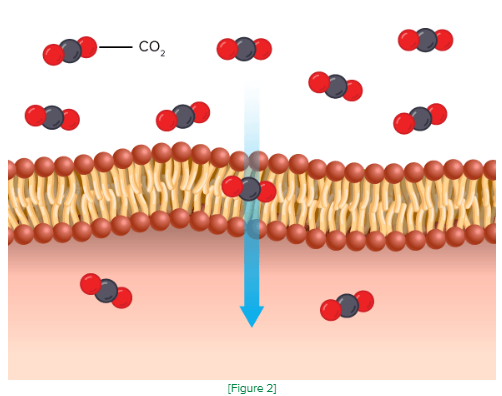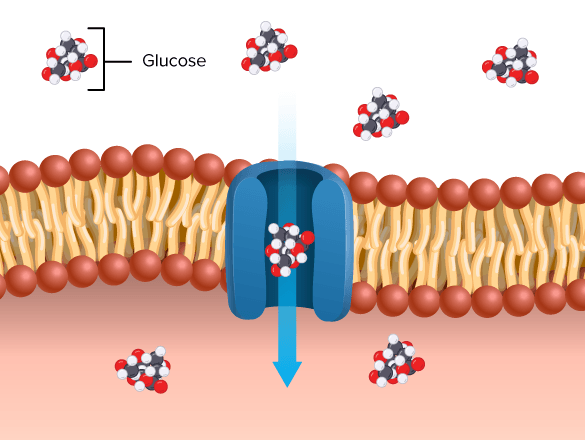
What happens if a substance needs assistance to move across or through the cellĀ membrane? Facilitated diffusion is the diffusion of solutes through transport proteins in the cellĀ membrane. Facilitated diffusion is a type of passive transport. Even though facilitated diffusion involves transport proteins, it is still passive transport because the solute is moving down the concentration gradient (see the Figure below).
1
1
1
1
1
1
1
Text
00:00
keyboard_arrow_down
Facilitiated diffusion through the cell membrane.
Channel proteins and carrier proteins are shown.
Water molecules and ions move through channel proteins.
Glucose molecules are carried across the cell membrane by carrier proteins.
Ion Channels
Ions such as sodium (Na+), potassium (K+), calcium (Ca2+), and chloride (Cl-), are important for many cell functions. Because they are charged (polar), these ions cannot diffuse through the membrane. Instead they move through ion channel proteins. These ion channels are necessary because the tails of the phospholipids that make up the bulk of the cell membrane are nonpolar and repel anything that is charged or polar. These ion channels shield the ions from the nonpolar interior of the cell membrane.
Ion channels allow the formation of a concentration gradient between the extracellular fluid and the cytosol. Ion channels are very specific, as they allow only certain ions through the cell membrane. Some ion channels are always open, others are "gated" and can be opened or closed. Gated ion channels can open or close in response to different types of stimuli, such as electrical or chemical signals.
1
Question 13
13.
_______ do not require a carrier or channel protein for their movement across the cell membrane.
Question 14
14.
_______ allows gases, such as carbon dioxide and oxygen, to move across the cell membrane.
Summary
Diffusion is the movement of molecules from an area of high concentration of the molecules to an area with a lower concentration. The difference in the concentrations of the molecules in the two areas is called the concentration gradient.
Facilitated diffusion is the diffusion of solutes through transport proteins in theĀ cell membrane. Channel proteins, gated channel proteins, and carrier proteins are three types of transport proteins that are involved in facilitated diffusion.
Osmosis
What will you learn
The process of osmosis
Osmotic pressure and its role in water balance in organisms
How organisms control osmosis
1
1
1
1
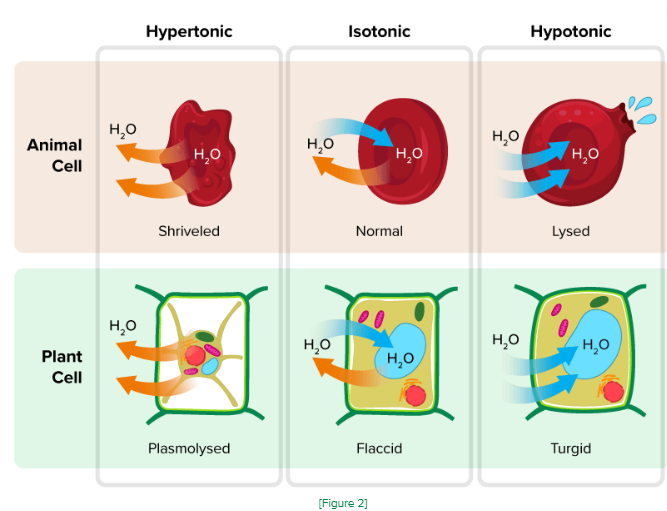
Unless an animal cell (such as the red blood cell in the top panel) has an adaptation that allows it to alter the osmotic uptake of water, it will lose too much water and shrivel up in a hypertonic environment. If placed in a hypotonic solution, water molecules will enter the cell, causing it to swell and burst.
Plant cells (bottom panel) become plasmolyzed in a hypertonic solution, but tend to do best in a hypotonic environment. Water is stored in the central vacuole of the plant cell.
Osmotic Pressure
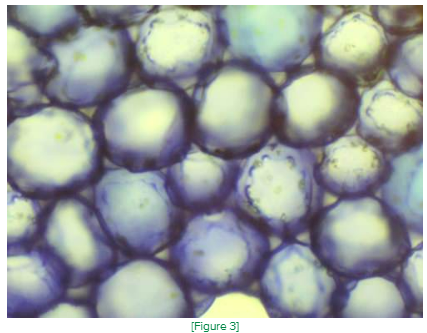
When water moves into a cell by osmosis, osmotic pressure may build up inside the cell. If a cell has a cell wall, the wall helps maintain the cellās water balance. Osmotic pressure is the main cause of support in many plants. When a plant cell is in a hypotonic environment, the osmotic entry of water raises the turgor pressure exerted against the cell wall until the pressure prevents more water from coming into the cell. At this point the plant cell is turgid (see theĀ Figure below).
The central vacuoles of the plant cells in this image are full of water, so the cells are turgid.
The action of osmosis can be very harmful to organisms, especially ones without cell walls. For example, if a saltwater fish (whose cells are isotonic with seawater), is placed in freshwater, its cells will take on excess water, lyse (burst), and the fish will die. Another example of a harmful osmotic effect is the use of table salt to kill slugs and snails.
Controlling Osmosis
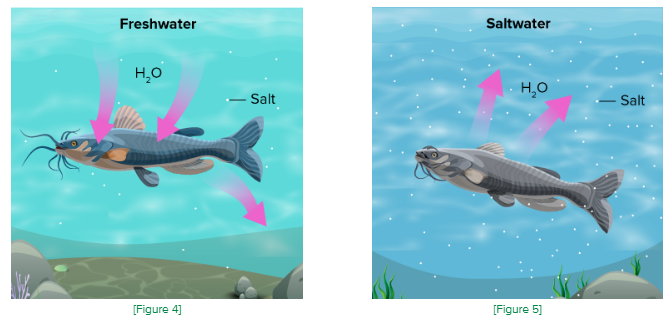
Organisms that live in a hypotonic environment such as freshwater, need a way to prevent their cells from taking in too much water by osmosis. Freshwater and saltwater fish have the ability to adjust to the osmotic pressure in the water around them. The Figure below explains what happens to a freshwater fish that is put in saltwater versus freshwater.
1
Freshwater fish regulate the amount of water going in and out of their bodies through several mechanisms like drinking less water and producing dilute urine.
If freshwater fish are put in saltwater, they lose water from their bodies due to the hypertonic environment. Their cells shrivel and die.
Summary
Osmosis is the diffusion of water.
In comparing two solutions of unequal solute concentration, the solution with the higher solute concentration is hypertonic, and the solution with the lower concentration is hypotonic. Solutions of equal solute concentration are isotonic.
A contractile vacuole is a type of vacuole that removes excess water from a cell.
The goal of osmosis is to establish equilibrium, in which the concentration of the solutions on both sides of the cell membrane are the same.
1
Can you help me move?
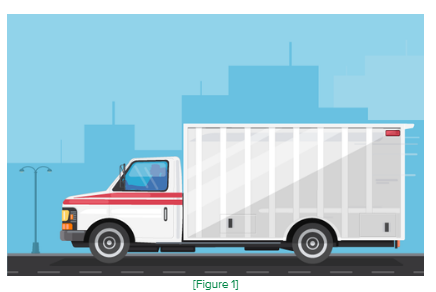
Often a large truck might be needed if you are moving large boxes and furniture. Just as a truck is needed to help move these items from one location to another, a cell needs help moving things as well, or facilitating the diffusion process. This would be the job of a special type of protein.
Diffusion and Facilitated Diffusion:
Diffusion
Diffusion is the movement of molecules from an area of high concentration of the molecules to an area with a lower concentration. The difference in the concentrations of the molecules in the two areas is called the concentration gradient. Diffusion will continue until this gradient has been eliminated. Since diffusion moves materials from an area of higher concentration to the lower, it is described as moving solutes "down the concentration gradient." The end result of diffusion is an equal concentration, or equilibrium, of molecules on both sides of the membrane.
If a molecule can pass freely through a cell membrane, it will cross the membrane by diffusion (see theĀ Figure below).
Question 1
1.
Diffusion is the movement of molecules from areas of _______ to areas of _______.
Question 2
2.
A concentration gradient exists when there is a _______ in the concentration of the same type of particles (molecules, atoms) in two nearby areas.
Question 3
3.
The end result of diffusion is _______, which is when the concentrations of the same type of particle is equal on both sides of the cell membrane.
Question 4
4.
A particle (molecule, atom) will diffuse if it can _______ through the cell membrane easily.
Question 5
5.
Facilitated diffusion is the diffusion of particles through _______.
Question 6
6.
Facilitated diffusion is another form of _______ because it still involves the movement of particles from high to low concentration (down the concentration gradient).
Small nonpolar molecules can easily diffuse across the cell membrane. However, due to the hydrophobic nature of the lipids that make up cell membranes, polar molecules (such as water) and ions cannot do so. Instead, they diffuse across the membrane through transport proteins. A transport protein completely spans the membrane, and allows certain molecules or ions to diffuse across the membrane. Channel proteins, gated channel proteins, and carrier proteins are three types of transport proteins that are involved in facilitated diffusion.
A channel protein, a type of transport protein, acts like a pore in the membrane that lets water molecules or small ions through quickly. Water channel proteins (aquaporins) allow water to diffuse across the membrane at a very fast rate. Ion channel proteins allow ions to diffuse across the membrane.
A gated channel protein is a transport protein that opens a "gate," allowing a molecule to pass through the membrane. Gated channels have a binding site that is specific for a given molecule or ion. A stimulus causes the "gate" to open or shut. The stimulus may be chemical or electrical signals, temperature, or mechanical force, depending on the type of gated channel. For example, the sodium gated channels of a nerve cell are stimulated by a chemical signal which causes them to open and allow sodium ions into the cell.
A carrier proteinis a transport protein that is specific for an ion, molecule, or group of substances. Carrier proteins "carry" the ion or molecule across the membrane by changing shape after the binding of the ion or molecule. Carrier proteins are involved in passive and active transport. Glucose molecules are too big to diffuse through the cell membrane easily, so they are moved across the membrane through carrier proteins. In this way glucose diffuses very quickly across a cell membrane, which is important because many cells depend on glucose for energy.
Question 7
7.
Molecules that diffuse easily through the cell membrane are _______ molecules.
Question 8
8.
Polar molecules _______ easily diffuse through the cell membrane due to the nonpolar (hydrophobic) nature of the tails of the phospholipids.
Question 9
9.
An example of a channel protein that permits water to pass through the cell membrane are _______.
Question 10
10.
Carrier proteins can be involved in both _______ and _______.
Question 11
11.
Glucose requires a carrier protein because it is _______ to diffuse through the cell membrane.
Question 12
12.
Ions require channels to pass through the cell membrane because the tails of the phospholipids are nonpolar and will _______ anything that carries a charge.
Saltwater Fish vs. Freshwater Fish?
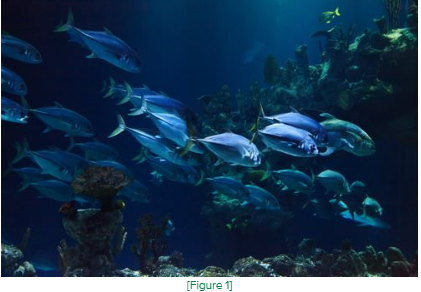
Fish cells, like all cells, have semi-permeable membranes. Eventually, the concentration of "stuff" on either side of them will even out. A fish that lives in salt water will have somewhat salty water inside itself. Put it in the freshwater, and the freshwater will, through osmosis, enter the fish, causing its cells to swell, and the fish will die. What will happen to a freshwater fish in the ocean?
Osmosis
Imagine you have a cup that has 100ml water, and you add 15g of table sugar to the water. The sugar dissolves and the mixture that is now in the cup is made up of a solute (the sugar) that is dissolved in the solvent (the water). The mixture of a solute in a solvent is called a solution.
Imagine now that you have a second cup with 100mL of water, and you add 45 grams of table sugar to the water. Just like the first cup, the sugar is the solute, and the water is the solvent. But now you have two mixtures of different solute concentrations. In comparing two solutions of unequal solute concentration, the solution with the higher solute concentration is hypertonic, and the solution with the lower solute concentration is hypotonic. Solutions of equal solute concentration are isotonic. The first sugar solution is hypotonic to the second solution. The second sugar solution is hypertonic to the first.
You now add the two solutions to a beaker that has been divided by a selectively permeable membrane, with pores that are too small for the sugar molecules to pass through, but are big enough for the water molecules to pass through. The hypertonic solution is on one side of the membrane and the hypotonic solution on the other. The hypertonic solution has a lower water concentration than the hypotonic solution, so a concentration gradient of water now exists across the membrane. Water molecules will move from the side of higher water concentration (hypotonic solution) to the side of lower water concentration (hypertonic solution) until both solutions are isotonic. At this point, equilibrium is reached.
Osmosis is the diffusion of water molecules across a selectively permeable membrane from an area of higher concentration to an area of lower concentration. Water moves into and out of cells by osmosis. If a cell is in a hypertonic solution, the solution has a lower water concentration than the cell cytosol, and water moves out of the cell until both solutions are isotonic. Cells placed in a hypotonic solution will take in water across their membrane until both the external solution and the cytosol are isotonic. An easy way to remember the direction of water movement in osmosis is this - water will always move toward the hypertonic solution.
A cell that does not have a rigid cell wall, such as a red blood cell, will swell and lyse (burst) when placed in a hypotonic solution. Cells with a cell wall will swell when placed in a hypotonic solution, but once the cell is turgid (firm), the tough cell wall prevents any more water from entering the cell. When placed in a hypertonic solution, a cell without a cell wall will lose water to the environment, shrivel, and probably die. In a hypertonic solution, a cell with a cell wall will lose water too. The plasma membrane pulls away from the cell wall as it shrivels, a process called plasmolysis. Animal cells tend to do best in an isotonic environment, plant cells tend to do best in a hypotonic environment, as shown in the Figure below.
Question 15
15.
A _______ is the mixture of a solute and a solvent.
Question 16
16.
There are three different types of solutions.
A hypertonic solution has the highest concentration of solutes compared to the solution on the other side of a selectively permeable membrane.
A hypotonic solution has the _______ concentration of solutes compared to the solution on the other side of a selectively permeable membrane.
Solutions of _______ concentration are referred to as isotonic.
Question 17
17.
The diffusion of water through a selectively permeable membrane is known as _______.
Question 18
18.
When water diffuses through a selectively permeable membrane, it will always move toward the _______ solution.
Question 19
19.
If a marine fish (saltwater fish) is placed into a body of fresh water, it is essentially placed in a hypotonic solution. Therefore water will _______ the cells of the fish.
Question 20
20.
Like diffusion, osmosis moves water into the cell until it reaches _______ and the concentration of the solutions inside and outside of the cell are the same.