Log in
Sign up for FREE
arrow_back
Library

Copy of Active Transport (Sep 2022) (5/28/2026)

star
star
star
star
star
Last updated about 2 hours ago
14 questions
5
1
2
1
1
2
2
1
1
5
1
1
1
Learning Goals:
  1. Compare different types of active transport.
  2. Explain the role of ATP in active transport.
  3. Identify the role of a concentration gradient within active transport.
  4. Compare and contrast active and passive transport.
Next, you will watch a video displaying a process that is related to active transport.

As you watch, think about the following questions:
  • What is occurring?
  • What structures on the cell are involved?
  • What do you think is needed for what you see to occur?
Question 1
00:15
keyboard_arrow_down
1
Question 1
1.

What do you think happened in the video? Be as specific as you can.

In the previous video, you saw an example of how the immune system works to destroy foreign cells.

The large cell in the center was a human macrophage cell, which a cell of the immune system.

The small cells around it were red blood cells from a sheep. The human macrophage was engulfing the sheep RBC's because they recognized them as foreign cells.

When macrophages engulf material (invading cells and bacteria) this is a form of active transport.

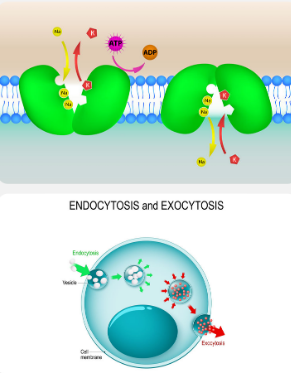
Basic Forms of Active Transport

  • Endocytosis
  • Exocytosis
  • Protein Pumps
Next, you will watch a video that discusses these three types of active transport.

Pay attention for any differences between each type of active transport, as well as the role of the cell membrane and the vesicle.
Question 2
2.
Draggable itemarrow_right_altCorresponding Item
arrow_right_alt
arrow_right_alt
arrow_right_alt
arrow_right_alt
arrow_right_alt
Next, you will watch a video that discusses the protein pump.

Pay attention for the role of ATP and the importance of a concentration gradient.
Question 3
3.
The protein pump is located in the _______
Question 4
4.
Molecules moving against the concentration gradient move from an area of _______ concentration to an area of _______ concentration
Question 5
5.

Question 6
6.

Passive Transport vs. Active Transport

Next, you will watch a video that compares active and passive transport.

Pay attention for:
  • similarities between active and passive transport.
  • differences between active and passive transport.
  • types of active and passive transport.
Question 7
7.

Provide two similarities between active and passive transport.

Question 8
8.
Is ATP required for:
  • active transport: _______
  • passive transport: _______
Movement up or down the concentration gradient:
  • active transport: _______
  • passive transport: _______
Question 9
9.

Provide two examples of active transport.

Question 10
10.

Provide two examples of passive transport.

Summary of Active Transport

  • Movement of particles from low to high concentration.
  • Against the concentration gradient.
  • Uses protein pumps.
  • ATP is used as the energy source - this is why it's active.
Endocytosis and Exocytosis
  • Movement of bulk materials into (endocytosis) and out (exocytosis) of the cell by utilizing vesicles.
  • Vesicle - constructed of the same material as the cell membrane; made when they are needed.
  • Do not use protein pumps.
Question 11
11.
_______ occurs when a vesicle merges with the cell membrane to release substances.

If molecules are moving from an area of low to high concentration, _______ is needed as an energy source.

Endocytosis and exocytosis rely on two structures to move molecules into and out of the the cell; one of them is the cell membrane, the other is a _______ (hint, it begins with "v").

True or false - A protein pump is an example of endocytosis since it brings molecules into the cell. _______

Which of these - endocytosis, exocytosis, osmosis, protein pump - is not an example of active transport? _______

Exit Ticket

Question 12
12.

From what you have learned in this activity, explain why it might be that active transport is necessary in order for a cell to survive.

Question 13
13.

Provide a short list of some things that you learned in this activity.

Question 14
14.

Endocytosis
Used when molecules and ions pass through the cell membrane against the concentration gradient; it utilizes ATP as an energy source.
Passive Transport
Occurs when a vesicle merges with the cell membrane to bring material into the cell.
Protein Pump
Occurs when a vesicle merges to release material from the cell.
Exocytosis
The general movement of molecules across a cell membrane using ATP.
Active Transport
The movement of molecules across a cell membrane without the use of ATP.
The sodium and potassium ions need a protein pump to pass through the cell membrane, because...
The ions have a charge and cannot pass directly through the cell membrane.
The ions are moving against the concentration gradient.
Energy is needed to move the ions.
None of these are correct.
Protein pumps are efficient because they...
will move two types of ions
will only move one type of ion
use energy
use diffusion
How has your confidence changed regarding your understanding of active transport?
Very much
Somewhat more
A little more
It's about the same as before
Hasn't changed at all.