1
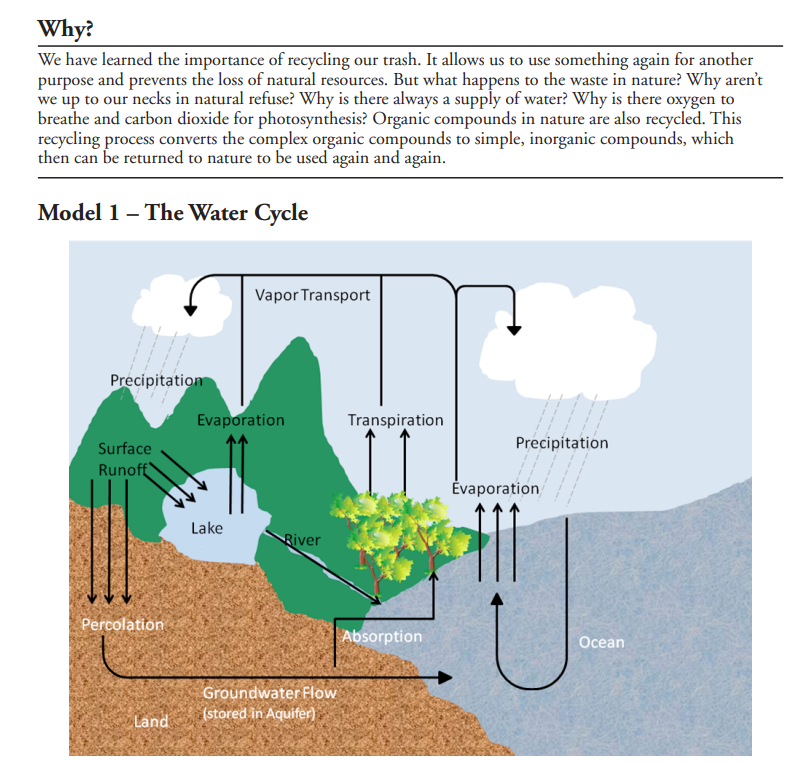
Model 1 illustrates how natural processes recycle
2
1
2
2
1
1
2
1
2
Standards:
B.3.1 Use mathematical and/or computational representation to explain why the carrying capacity ecosystems can support is limited by the available energy, water, oxygen, and minerals and by the ability of ecosystems to recycle the remains of dead organisms.
B.3.2 Design, evaluate, and refine a model which shows how human activities and natural phenomena can change the flow of matter and energy in an ecosystem and how those changes impact the environment and biodiversity of populations in ecosystems of different scales, as well as, how these human impacts can be reduced.
Learning Goals (I can...):
Evaluate how the flow and cycling of matter can impact ecosystems.
Explain how the flow and cycling of matter occurs in ecosystems and, in some cases, globally.
Standards:
B.3.1 Use mathematical and/or computational representation to explain why the carrying capacity ecosystems can support is limited by the available energy, water, oxygen, and minerals and by the ability of ecosystems to recycle the remains of dead organisms.
B.3.2 Design, evaluate, and refine a model which shows how human activities and natural phenomena can change the flow of matter and energy in an ecosystem and how those changes impact the environment and biodiversity of populations in ecosystems of different scales, as well as, how these human impacts can be reduced.
Learning Goals (I can...):
Evaluate how the flow and cycling of matter can impact ecosystems.
Explain how the flow and cycling of matter occurs in ecosystems and, in some cases, globally.
Model 1 illustrates how natural processes recycle
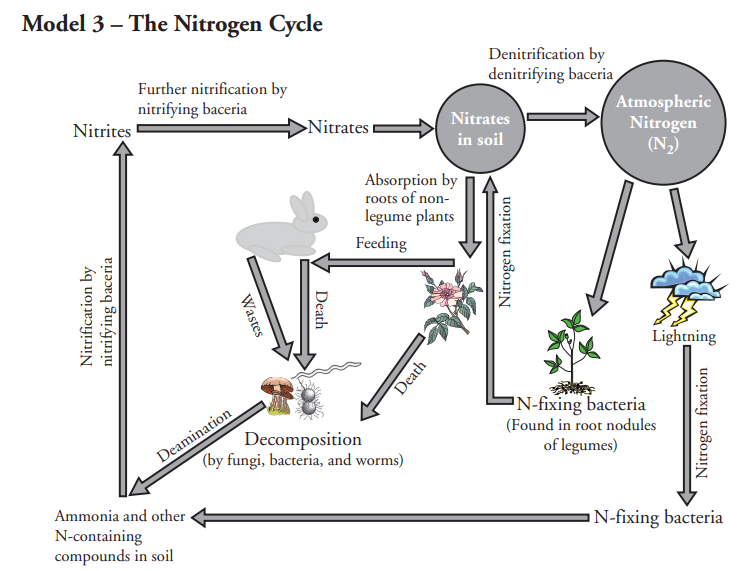
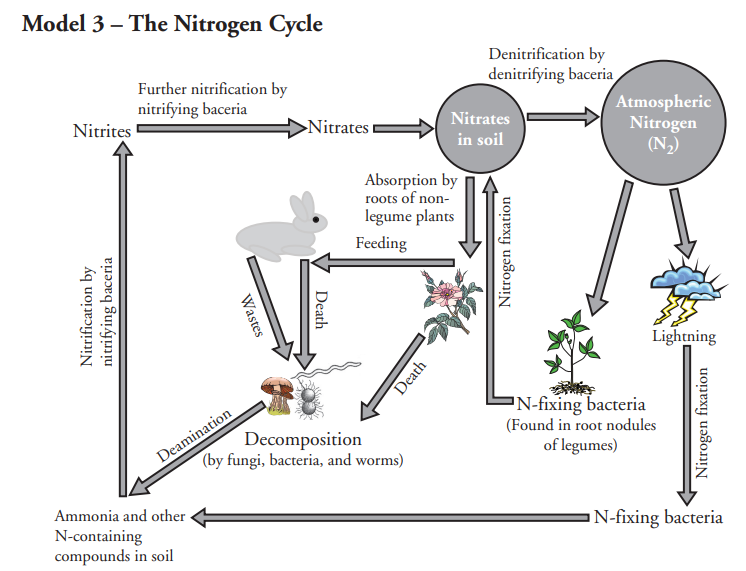
Model 3 illustrates how
There are three types of bacteria involved in the nitrogen cycle; they are
There are two ways in which nitrogen is removed from the atmosphere. They are accomplished by
The process in which animal wastes and dead organisms converted to other nitrogen-containing compounds is called
The only form of nitrogen that nonlegume plants can take in and use is
What do the denitrifying bacteria do during the denitrifying process?
Model 1 illustrates four major areas of water storage on Earth. They are the atmosphere, surface water,
Groundwater is stored in
There are two processes in Model 1 in which water is converted to vapor (a gas); they are
There are two methods by which water on land (in lakes and rivers) returns to the oceans; they are
Rain, sleet, and snow are examples of
If the air contains high levels of pollutants, what effect might this have on water quality?
Go over the paragraph that accompanies the model and then examine the model.
Which process(es) of the water cycle (precipitation, evaporation, condensation, runoff, percolation, or transpiration) might contribute to the addition of pollutants to rivers, lakes, and oceans? Why?
Which of the processes associated with the water cycle might be responsible for helping to clean or filter the water?
The water cycle is a closed system, meaning no water enters from beyond the system nor leaves the system. What does that say about the importance of keeping the water on Earth free from pollution?
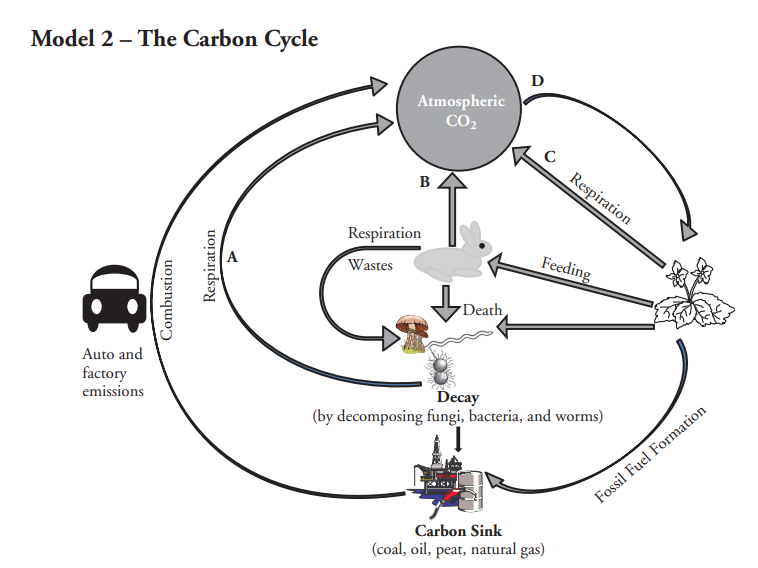
Model 2 illustrates how nature recycles
There are two ways in which carbon, in the form of CO2, enters the atmosphere; they are
Imagine the large circle, that is labeled "atmospheric CO2", represents the sun. The process arrow, labeled "D" that moves CO2 from the atmosphere to the plant, would be
What type of organisms carry out process arrow A?
Decay (decomposition) is carried out by a group of organisms that are collectively referred to as decomposers. What might happen if decomposition did not occur?
Not all dead organisms are acted on by decomposers. Instead of being immediately recycled, the carbon from some organisms is kept in a type of long-term storage, or carbon sink. Using Model 2, answer the questions below about this long-term storage.
Four materials that contain stored carbon are
The collective term for the four materials in question 16 is
How do humans use the materials in the carbon sink.
The name of the process that is carried out by cells on arrow C is
Provide a list of at least three but no more than five examples of combustion (the burning of fossil fuels) in your everyday life.
Many carbon-based fuels are categorized as fossil fuels because they are formed from decayed organisms over many years. List as many examples of fossil fuels as you can.
How does our use of these carbon stores affect the amount of CO2 in the atmosphere?