Log in
Sign up for FREE
arrow_back
Library

Copy of Development of the Atomic Model (Sep 2023) (5/28/2026)

star
star
star
star
star
Last updated about 2 hours ago
18 questions
Dalton's Theory
Atoms
Exit Ticket
Required
0
Required
0

Dalton's Atomic Theory

Goals:
  • Describe Dalton's views of the atom.
  • Identify which elements of the atomic theory have changed since Dalton proposed his ideas of the atom.


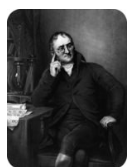
John Dalton

While it must be assumed that many more scientists, philosophers, and others studied the composition of matter after Democritus, a major leap forward in our understanding of the composition of matter took place in the 1800s with the work of the British scientist John Dalton. He started teaching school at age twelve, and was primarily known as a teacher.  In his twenties, he moved to the growing city of Manchester, where he was able to pursue some scientific studies.  His work in several areas of science brought him a number of honors.  When he died, over 40,000 people in Manchester marched at his funeral.

Dalton studied the weights of various elements and compounds. He noticed that matter always combined in fixed ratios based on weight, or volume in the case of gases. Chemical compounds always contain the same proportion of elements by mass, regardless of amount, which provided further support for Proust's law of definite proportions.  Dalton also observed that there could be more than one combination of two elements.
1
1
Question 2
2.
1
1

Atom

Goals:
  • Identify how the atomic model has changed as more information about the atom has been learned.
  • Described the most important elements of each atomic model.
  • Identify the three subatomic particles and their properties.


Discovering the Atom

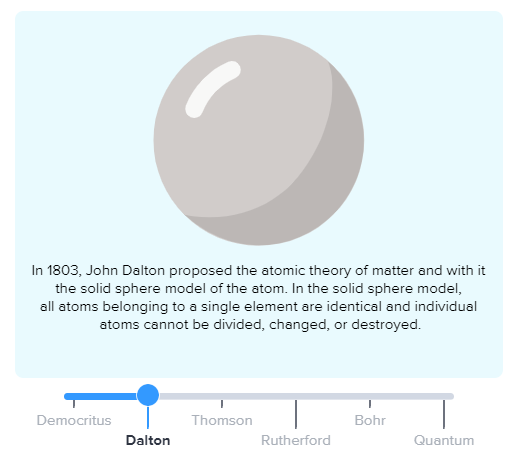
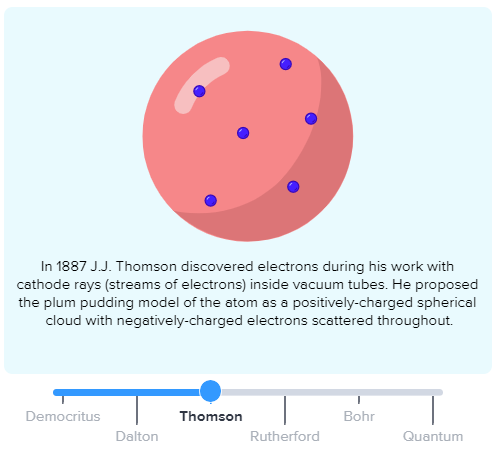
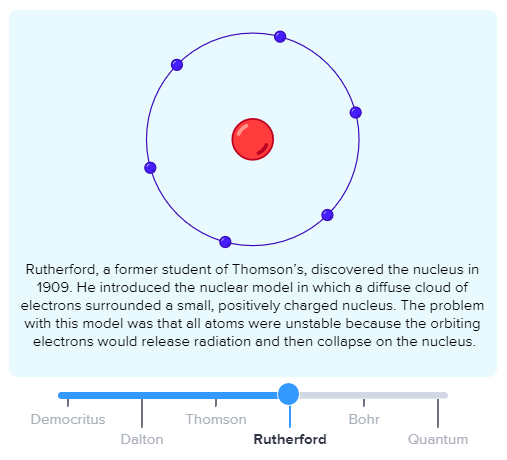
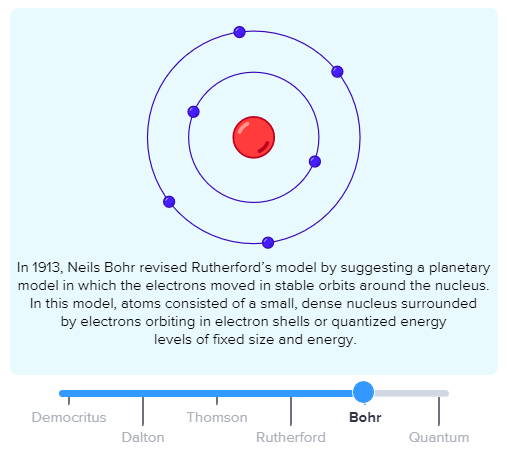
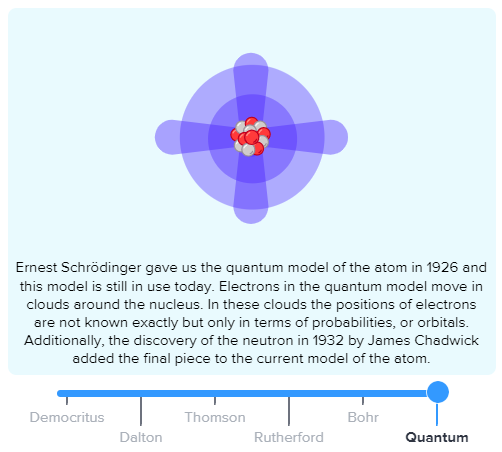
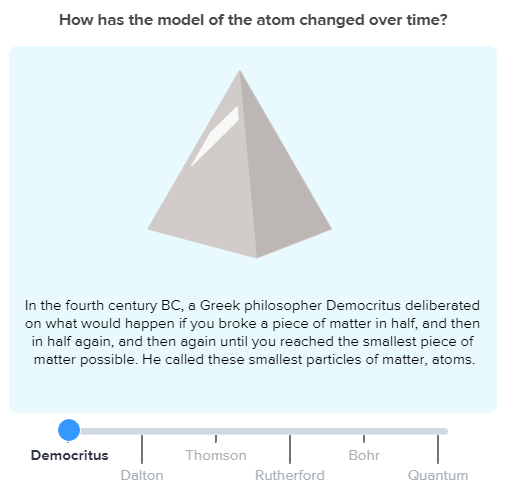
Atoms are very tiny, so tiny that they could not be seen before scanning tunneling microscopes were invented in 1981. However, the atom and its parts were discovered long before the tunneling microscope was invented. How did scientists discover the atom if they couldn’t see it? They made models. A scientific model is a tool constructed by the scientist based on all the known experimental evidence about a particular thing, such as an atom. The first model of the atom goes back to ancient Greece. As time went by and more experiments are performed, models evolve and change to account for new understanding. Explore the timeline below to see how the model of the atom was initially developed and how it has changed over time into what we now have come to accept as the modern model of the atom.
1
Question 5
5.
1
1
2
1
1
2

Atoms

Atoms are the building blocks of matter. They are the smallest particles of an element that still have the element's properties. Elements, in turn, are pure substances—such as nickel, hydrogen, and helium—that make up all kinds of matter. All the atoms of a given element are identical in that they have the same number of protons, one of the building blocks of atoms (see below). They are also different from the atoms of all other elements, as atoms of different elements have different numbers of protons.

Size of Atoms

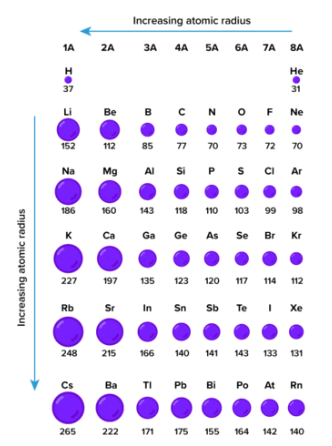
Unlike bricks, atoms are extremely small. The radius of an atom is well under 1 nanometer, which is one-billionth of a meter. If a size that small is hard to imagine, consider this: trillions of atoms would fit inside the period at the end of this sentence. Although all atoms are very small, elements vary in the size of their atoms. The Figure below compares the sizes of atoms of more than 40 different elements. The elements in the figure are represented by chemical symbols, such as H for hydrogen and He for helium. Of course, real atoms are much smaller than the circles representing them in the Figure below.
1
Atomic Size Chart

1
Question 13
13.

Subatomic Particles

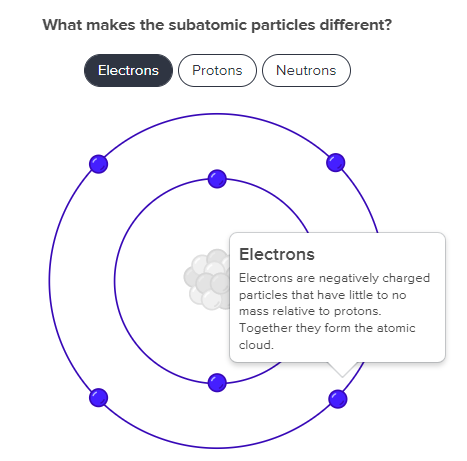
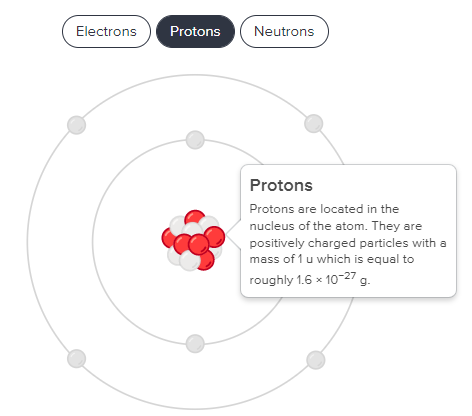
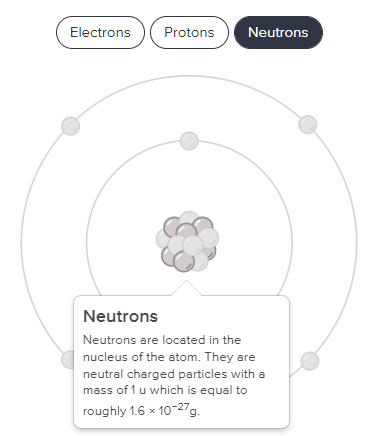
Although atoms are very tiny, they consist of even smaller particles. Three main types of particles that make up all atoms are protons, neutrons, and electrons. The interactive below shows how these particles are arranged in an atom. Click on the subatomic particle to learn more about each type.


The atom shown above represented by the model is carbon, but the particles of all atoms are arranged in the same way. At the center of the atom is a dense area called the nucleus, where all the protons and neutrons are clustered closely together. The electrons constantly move around the nucleus. Helium has two protons and two neutrons in its nucleus and two electrons moving around the nucleus. Atoms of other elements have different numbers of subatomic particles, but the number of protons always equals the number of electrons. This makes atoms neutral in charge because the positive and negative charges "cancel out."
3
1
1

Summary

  • Atoms are the building blocks of matter.
  • They are the smallest particles of an element that still have the element's properties. All atoms are very small, but atoms of different elements vary in size.
  • Three main types of particles that make up all atoms are protons, neutrons, and electrons.
Question 17
17.

What is one area of this concept that you feel like that you understood the least?

Question 18
18.

Question 1
1.
One of Dalton's observations regarding matter is that it always combined in _______based on weight.
Dalton's Atomic Theory (1804)

From his experiments and observations, as well as the work from peers of his time, Dalton proposed a new theory of the atom. This later became known as Dalton's atomic theory. The general tenets of this theory were as follows:
  • All matter is composed of extremely small particles called atoms.
  • Atoms of the same element are identical in size, mass, and other properties. Atoms of different elements differ in size, mass, and other properties.
  • Atoms cannot be subdivided, created, or destroyed.
  • Atoms of different elements can combine in simple whole number ratios to form chemical compounds.
  • In chemical reactions, atoms are combined, separated, or rearranged.
Dalton's atomic theory has been largely accepted by the scientific community, with the exception of three changes. We know now that:
  1. an atom can be further sub-divided,
  2. all atoms of an element are not identical in mass,
  3. using nuclear fission and fusion techniques, we can create or destroy atoms by changing them into other atoms
Dalton proposed several things about atoms. Including that atoms make up (compose) all _______.
Question 3
3.
Atoms that have the same size, mass, and other properties are of the same _______.
Question 4
4.
When atoms are combined, separated, or rearranged, they are going through _______.
The idea of the atom is believed to have originated in _______ .


Question 6
6.
The man responsible for the idea of the atom was _______ .
Question 7
7.
Dalton pictured the model of the atom to resemble a _______ .
Question 8
8.
To develop his plum pudding model, J. J. Thompson studied electrons using _______ . He pictured the model of the atom to be a positively-charged spherical cloud dotted with _______ .
Question 9
9.
Ernest Rutherford further developed Thompson's ideas regarding the atom. He performed experiments in which he shot beams of alpha particles at sheets of gold foil and from his experiments, he discovered the _______ in which he viewed all of the electrons would orbit around it.
Question 10
10.
Bohr's atomic model is this one most people are familiar with, even though it is not accurate any longer. He suggested a planetary model for the atom that was similar to Rutherford's. In Bohr's model, the nucleus is a small but dense structure in the center of the atom and the electrons orbit it in _______ or energy levels.
Question 11
11.
Schrondinger and Chadwick developed the quantum model of the atom that is used today. In the quantum model, the nucleus is preseved, but it is made-up of protons and _______ and the electrons are located in _______ in which the position of the electrons cannot every be known exactly.
Question 12
12.
The smallest particle of an element that still retains all of the properties of that element is the _______ .
By examing the chart to the left, you can determine that atoms of different elements will have _______ radii (plural for "radius").
Question 14
14.
There are three subatomic particles in the atom, and they are generally described to the left.

_______ are located in the nucleus and have a positive charge.
_______ are located in the nucleus but do not have a charge.
_______ are negatively-charged particles that exist outside of the nucleus.
Question 15
15.
The subatomic particle that has the lowest mass is the _______ .
Question 16
16.
A neutral atom (lacks a charge) has equal number of _______ and electrons.
How has your confidence regarding this concept changed after having completed this activity?
Significantly Increased
Moderately Increased
Somewhat Increased
Not Changed
Somewhat Decreased
Moderately Decreased
Significantly Decreased