Copy of Build an Atom Simulation (5/28/2026)
star
star
star
star
star
Last updated 3 months ago
16 Nsɛmmisa
Part 1: Atom
2
6
1
1
2
1
1
1
Read This Before Proceeding
Part 2: Symbol
3
3
1
1
1
1
1
1
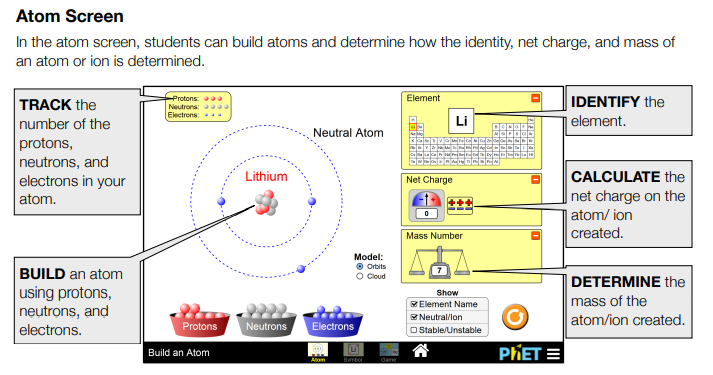
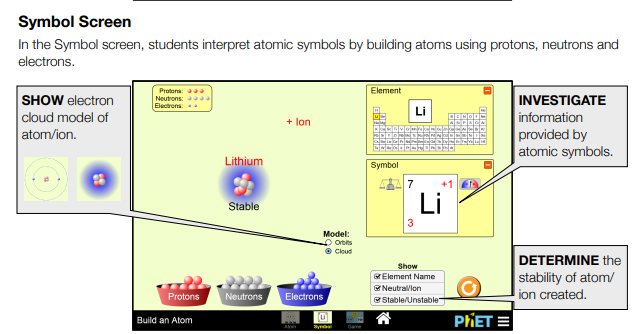
Review the information in the image, above.
Begin this activity by clicking, the left icon titled, "Atom" - this will open the screen shown in the above image.
When the screen opens, click the green plus symbol in the "Net Charge" and "Mass Number" to the right of the activity screen.
What particle(s) are found in the center (nucleus) of the atom?
Add and remove subatomic particles until you figure out which one determines the identity of the element:
What is the identify of each of the following:
Atom with 3 protons and 4 neutrons:
Atom with 2 protons and 4 neutrons:
Atom with 4 protons and 4 neutrons:
Atom with 1 proton and 0 neutrons:
Atom with 6 protons and 6 neutrons:
Play with the simulation to discover which particles affect the charge of an atom or ion:
What is the charge of the particles from the above question (#3)?
Fill in the blanks below to show your results:
Neutral atoms have the same number of protons and electrons.
Positive ions have
Negative ions have
Develop a relationship (in the form of a single sentence or equation) that can predict the charge based on the number and types of particles.
Play with the simulation to discover what affects the mass number of your atom or ion:
Mass Number = the number of
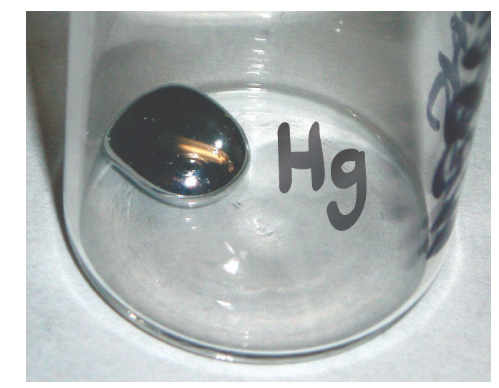
A chemical symbol is an abbreviation that we use to indicate an element or an atom of an element. For example, the symbol for mercury is Hg (Figure 2.13). We use the same symbol to indicate one atom of mercury (microscopic domain) or to label a container of many atoms of the element mercury (macroscopic domain).
Figure 2.13 The symbol Hg represents the element mercury regardless of the amount; it could represent one atom of mercury or a large amount of mercury.
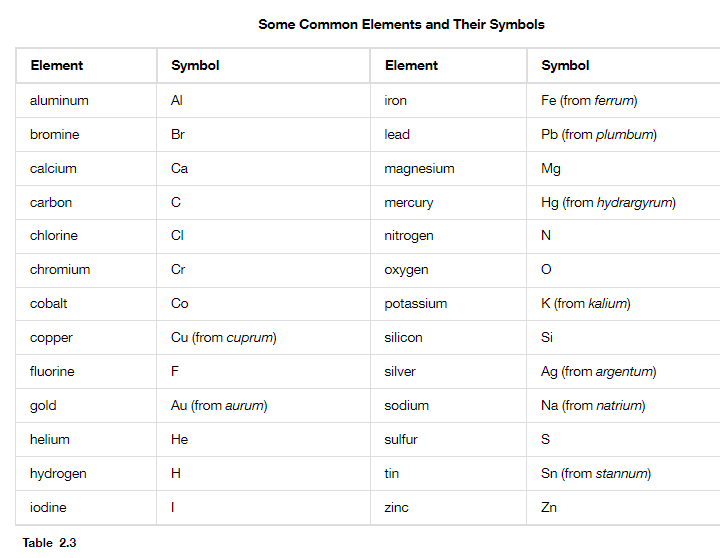
The symbols for several common elements and their atoms are listed in Table 2.3. Some symbols are derived from the common name of the element; others are abbreviations of the name in another language. Most symbols have one or two letters, but three-letter symbols have been used to describe some elements that have atomic numbers greater than 112. To avoid confusion with other notations, only the first letter of a symbol is capitalized. For example, Co is the symbol for the element cobalt, but CO is the notation for the compound carbon monoxide, which contains atoms of the elements carbon (C) and oxygen (O). All known elements and their symbols are in the periodic table in Figure 2.26 (also found in Appendix A).
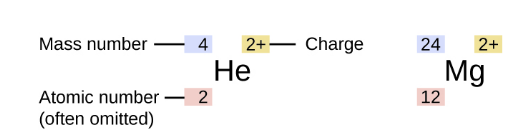
The symbol for a specific isotope of any element is written by placing the mass number as a superscript to the left of the element symbol (Figure 2.14). The atomic number is sometimes written as a subscript preceding the symbol, but since this number defines the element’s identity, as does its symbol, it is often omitted. For example, magnesium exists as a mixture of three isotopes, each with an atomic number of 12 and with mass numbers of 24, 25, and 26, respectively. These isotopes can be identified as 24Mg, 25Mg, and 26Mg. These isotope symbols are read as “element, mass number” and can be symbolized consistent with this reading. For instance, 24Mg is read as “magnesium 24,” and can be written as “magnesium-24” or “Mg-24.” 25Mg is read as “magnesium 25,” and can be written as “magnesium-25” or “Mg-25.” All magnesium atoms have 12 protons in their nucleus. They differ only because a 24Mg atom has 12 neutrons in its nucleus, a 25Mg atom has 13 neutrons, and a 26Mg has 14 neutrons.
Figure 2.14 The symbol for an atom indicates the element via its usual two-letter symbol, the mass number as a left superscript, the atomic number as a left subscript (sometimes omitted), and the charge as a right superscript.
Because each proton and each neutron contribute approximately one amu to the mass of an atom, and each electron contributes far less, the atomic mass of a single atom is approximately equal to its mass number (a whole number). However, the average masses of atoms of most elements are not whole numbers because most elements exist naturally as mixtures of two or more isotopes.
The mass of an element shown in a periodic table or listed in a table of atomic masses is a weighted, average mass of all the isotopes present in a naturally occurring sample of that element. This is equal to the sum of each individual isotope’s mass multiplied by its fractional abundance.
Symbol a represents the element symbol.
Symbol b represents the
Symbol c represents the
Symbol d represents the
Symbol a represents any possible atomic/element abbreviation.
Symbol b is determined by subatomic particle(s)
Symbol c is determined by subatomic particle(s)
Symbol d is determined by subatomic particle(s)
Create a definition or description for the following, based upon the information from questions 9 and 10.
Element Symbol
Create a definition or description for the following, based upon the information from questions 9 and 10.
Charge (net charge)
Create a definition or description for the following, based upon the information from questions 9 and 10.
Atomic Number
Create a definition or description for the following, based upon the information from questions 9 and 10.
Mass Number
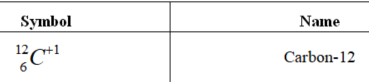
In addition to atomic symbol, we can represent atoms by name and mass number.
You can use the symbol simulation to help you solve the below two questions (15-16).
What is the name of the above symbol (include the name and the atomic mass; example - carbon - 12)?
What is the name of the above symbol (include the name and the atomic mass; example - carbon - 12)?