Copy of Surface Tension, Evaporation, and Vapor Pressure (5/28/2026)
star
star
star
star
star
Last updated about 2 hours ago
32 questions
Surface Tension
2
1
1
1
1
1
1
Evaporation
1
1
1
1
1
1
2
Vapor Pressure
1
1
1
1
1
1
1
1
1
1
1
1
1
1
1
How is this insect able to stand on water?
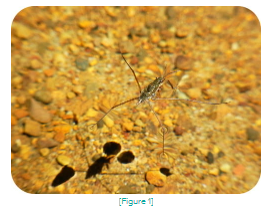
The next time you are by a still body of water, take a close look at what is scooting along on the surface. You may see insects seemingly floating on top of the water. These creatures are known by a variety of names including water skaters, water striders, pond skaters, and other equally descriptive names. They take advantage of a property called surface tension to stay above the water and not sink. The force they exert downward is less than the forces exerted among the water molecules on the surface of the pond, so the insect does not penetrate beneath the surface of the water.
Surface Tension
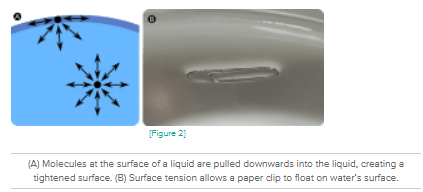
Molecules within a liquid are pulled equally in all directions by intermolecular forces. However, molecules at the surface are pulled downwards and sideways by other liquid molecules, but not upwards away from the surface. The overall effect is that the surface molecules are pulled into the liquid, creating a surface that is tightened like a film (see A in Figure below). The surface tension of a liquid is a measure of the elastic force in the liquid’s surface. Liquids that have strong intermolecular forces, like the hydrogen bonding in water, exhibit the greatest surface tension. Surface tension allows objects that are denser than water, such as the paper clip shown in B in Figure below, to nonetheless float on its surface. It is also responsible for the beading up of water droplets on a freshly waxed car because there are no attractions between the polar water molecules and the nonpolar wax.
Other liquids, such as diethyl ether, do not demonstrate strong surface tension interactions. The intermolecular forces for the ether are the relatively weak dipole-dipole interactions that do not draw the molecules together as tightly as hydrogen bonds would.
Summary
The surface tension of a liquid is a measure of the elastic force in the liquid’s surface.
Liquids with strong intermolecular forces have higher surface tensions than liquids with weaker forces.
Question 1
1.
_______ bonds are responsible for the strong surface tension observed in water.
Question 2
2.
The property of water that enabled the water strider to stay afloat was the _______ of water.
Question 3
3.
Does diethyl ether have a stronger of weaker surface tension compared to water? _______
Question 4
4.
Water's surface tension creates a curved surface on a thin column of water called a _______.
Question 5
5.
Surface tension can be defined as...
Question 6
6.
Liquids with _______ (three words) have the greatest surface tension.
Question 7
7.
Is this statement completely correct: surface tension allows objects with a greater density than a liquid to float on that liquid's surface.
_______
Explore how heat and temperature relate to phase change in this simulation:
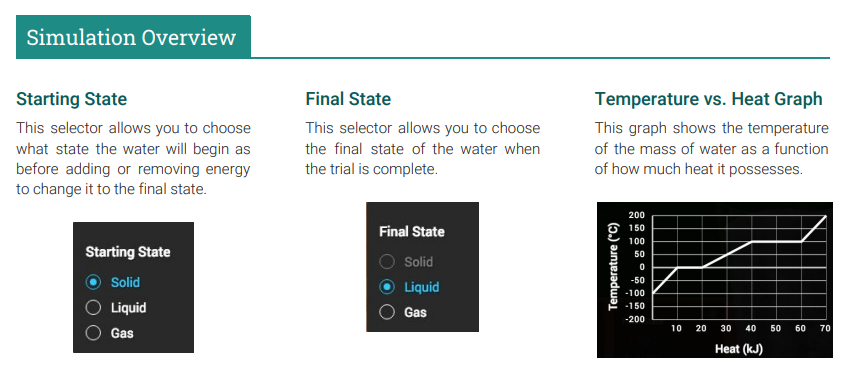
For the simulation - set the starting state as "Solid" and the final state as "gas".
1
Question 8
8.
Does the temperature of the water rise while it is boiling?
1
2
Link to the above simulation in case it doesn't work -
You'll have to have it open in another tab and move back and forth to answer the questions. Also, the tab will require most or all of the room on your screen.
Summary
Evaporation is the conversion of a liquid to its vapor below the boiling temperature of the liquid.
Condensation is the change of state from a gas to a liquid.
As the temperature increases, the rate of evaporation increases.
Question 11
11.
Question 12
12.
If a substance is a vapor, it is in the _______ phase.
Question 13
13.
Question 14
14.
_______ is the process of converting a gas into a liquid.
Question 15
15.
If the temperature of a liquid is raised above its boiling point, then the substance is in its _______ form of matter.
Question 16
16.
_______ is the conversion of a liquid to a gas below the boiling point of the liquid.
Question 17
17.
What causes this toy to move?
The drinking duck is a toy that many kids (and adults) enjoy playing with. You can see the drinking duck in action in the video below.
Summary
Vapor pressure is a measure of the pressure exerted by a gas above a liquid in a sealed container.
Strong intermolecular forces produce a lower rate of evaporation and a lower vapor pressure.
Weak intermolecular forces produce a higher rate of evaporation and a higher vapor pressure.
As the temperature increases, the vapor pressure increases.
Question 18
18.
As the temperature rises, the number of molecules escaping from a liquid surface tend to _______.
Question 19
19.
Question 20
20.
A liquid is placed in a closed container and time passes until the level of the liquid is constant.
The general situation described by the rate of evaporation is equal to the rate of condensation is called a _______
Question 21
21.
The _______ pressure is produced when molecules are released from the liquid state and enter the gaseous state above the surface of the liquid.
Question 22
22.
Weak intermolecular forces produce a _______ rate of evaporization and vapor pressure.
What is the fastest way to boil water?
One of the first lessons in cooking is how to boil water. Yes, it sounds simple, but there are a couple of hints that speed things up. One hint is to put a lid on the pot. The picture above has water boiling uncovered with the steam escaping to the atmosphere. If the lid is on the pot, less water will be boiled off and the water will boil faster. The buildup of pressure inside the pot helps speed up the boiling process.
Vapor Pressure Curves
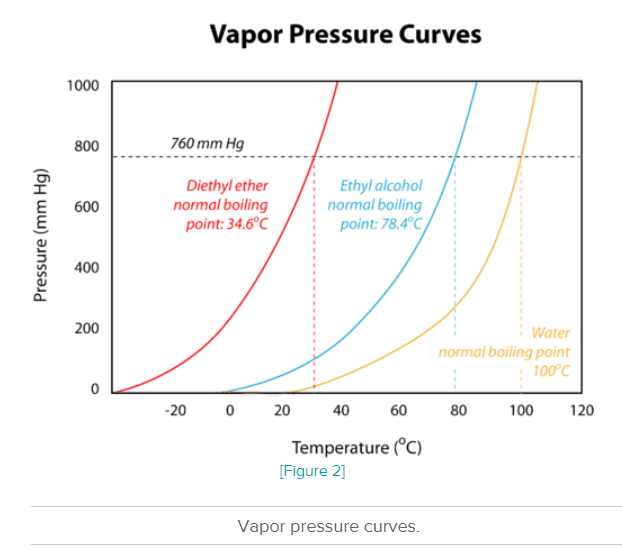
The boiling points of various liquids can be illustrated in a vapor pressure curve (Figure below). A vapor pressure curve is a graph of vapor pressure as a function of temperature. To find the normal boiling point of a liquid, a horizontal line is drawn from the left at a pressure equal to standard pressure. At whatever temperature that line intersects the vapor pressure curve of a liquid is the boiling point of that liquid.
The boiling points of liquid also correlate to the strength of the intermolecular forces. Recall that diethyl ether has weak dispersion forces, which meant that the liquid has a high vapor pressure. The weak forces also mean that it does not require a large an input of energy to make diethyl ether boil and so it has a relatively low normal boiling point of 34.6°C. Water, with its much stronger hydrogen bonding, has a low vapor pressure and a higher normal boiling point of 100°C.
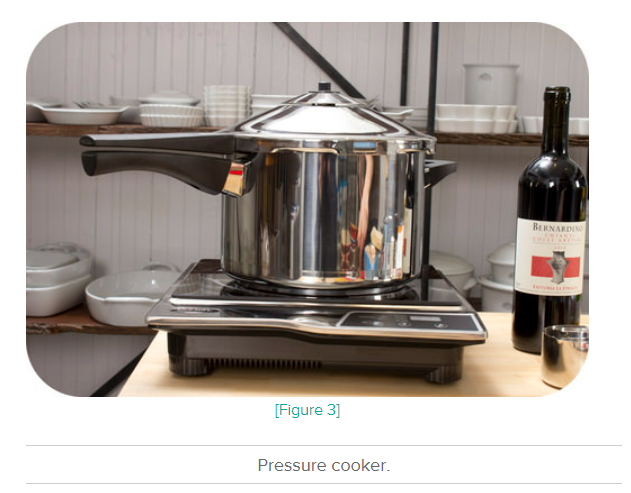
As stated earlier, boiling points are affected by external pressure. At higher altitudes, the atmospheric pressure is lower. With less pressure pushing down on the surface of the liquid, it boils at a lower temperature. This can also be seen from the vapor pressure curves. If one draws a horizontal line at a lower vapor pressure, it intersects each curve at a lower temperature. The boiling point of water is 100°C at sea level, where the atmospheric pressure is standard. In Denver, Colorado at 1600 m above sea level, the atmospheric pressure is about 640 mmHg and water boils at about 95°C. On the summit of Mt. Everest the atmospheric pressure is about 255 mmHg and water boils at only 70°C. On the other hand, water boils at greater than 100°C if the external pressure is higher than standard. Pressure cookers do not allow the vapor to escape and the vapor pressure increases. Since water now boils at a temperature above 100°C, the food cooks more quickly.
The effect of decreased air pressure can be demonstrated by placing a beaker of water in a vacuum chamber. At a low enough pressure, about 20 mmHg, water will boil at room temperature.
Summary
A vapor pressure curve is a graph of vapor pressure as a function of temperature.
Boiling points are affected by external pressure
Question 23
23.
Question 24
24.
Pure water typically boils at _______ degrees Celcius.
Question 25
25.
A vapor pressure curve is a graph of vapor pressure as a function of _______ .
Question 26
26.
Question 27
27.
Question 28
28.
Question 29
29.
The temperature at which a substance changes from a liquid to a gas is its _______ point.
Question 30
30.
A liquid at _______ pressure has a low boiling point.
Question 31
31.
Question 32
32.
A liquid in a vacuum has a _______ boiling point as compared to the same liquid at atmospheric pressure.
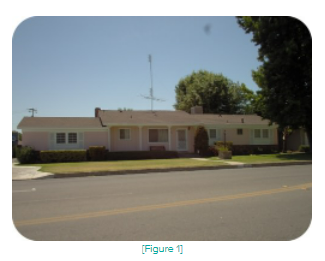
What is that box on the house's roof?
On the roof of the house in the picture above is a device known as a “swamp cooler.” This piece of equipment traces its origin back to the ancient Egyptians who hung wet blankets across the doors of their homes. As the warm air passed through the blankets, water would evaporate and cool the air. The royalty went one step further and had servants fan wet cloths over jugs of water to get more evaporation and cooling.
The origin of the term “swamp cooler” is not known – they certainly don’t work in a swamp. Best conditions for cooling include a high temperature (over 80°F) and a low humidity (preferably less than 30%). These coolers work well in desert areas, but don’t provide any cooling in the humid areas of the country.
Evaporation
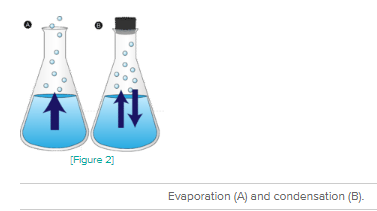
A puddle of water left undisturbed eventually disappears. The liquid molecules escape into the gas phase, becoming water vapor. Vaporization is the process in which a liquid is converted to a gas. Evaporation is the conversion of a liquid to its vapor below the boiling temperature of the liquid. If the water is instead kept in a closed container, the water vapor molecules do not have a chance to escape into the surroundings and so the water level does not change. As some water molecules become vapor, an equal number of water vapor molecules condense back into the liquid state. Condensation is the change of state from a gas to a liquid.
In order for a liquid molecule to escape into the gas state, the molecule must have enough kinetic energy to overcome the intermolecular attractive forces in the liquid. Recall that a given liquid sample will have molecules with a wide range of kinetic energies. Liquid molecules that have this certain threshold kinetic energy escape the surface and become vapor. As a result, the liquid molecules that remain now have a lower average kinetic energy. As evaporation occurs, the temperature of the remaining liquid decreases. You have observed the effects of evaporative cooling. On a hot day, the water molecules in your perspiration absorb body heat and evaporate from the surface of your skin. The evaporating process leaves the remaining perspiration cooler, which in turn absorbs more heat from your body.
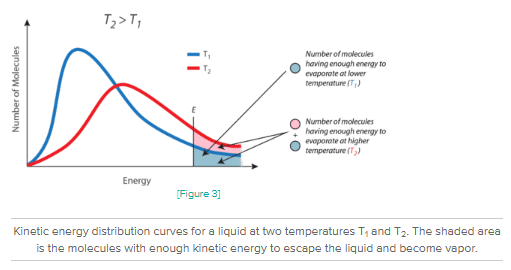
A given liquid will evaporate more quickly when it is heated. This is because the heating process results in a greater fraction of the liquid’s molecules having the necessary kinetic energy to escape the surface of the liquid. Figure below shows the kinetic energy distribution of liquid molecules at two temperatures. The numbers of molecules that have the required kinetic energy to evaporate are shown in the shaded area under the curve at the right. The higher temperature liquid (T2) has more molecules that are capable of escaping into the vapor phase than the lower temperature liquid (T1).
Question 9
9.
When you boil water, why does the level of liquid decrease?
Question 10
10.
As a change of state takes place, heat _______ and temperature _______ .
As the temperature increases the rate of ____ increases.
Freezing
Condensation
Evaporation
Molecule restrictions
Evaporation is a type of _____ and is a surface phenomenon
vaporizaton
condensation
sublimation
all of these are correct
Which of the following influences the rate of evaporation?
Temperature
Volume of the liquid
Surface Area of the liquid
Flow rate of the air above the liquid
Amount of the evaporating gas already present in the air around it.
Vapor Pressure
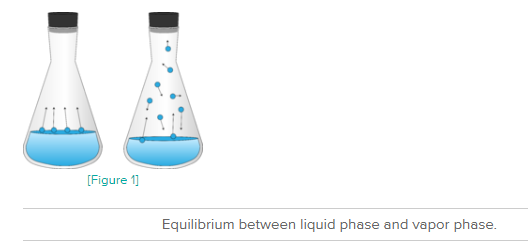
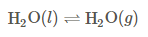
When a partially filled container of liquid is sealed with a stopper, some liquid molecules at the surface evaporate into the vapor phase. However, the vapor molecules cannot escape from the container and so after a certain amount of time, the space above the liquid reaches a point where it cannot hold any more vapor molecules. Now some of the vapor molecules condense back into a liquid. The system reaches the point where the rate of evaporation is equal to the rate of condensation (see Figure below). This is called a dynamic equilibrium between the liquid and vapor phases.
A dynamic equilibrium can be illustrated by an equation with a double arrow, meaning that the reaction is occurring in both directions and at the same rate.
The forward direction represents the evaporation process, while the reverse direction represents the condensation process.
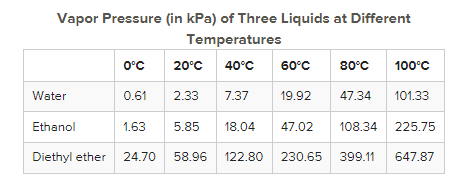
Because they cannot escape the container, the vapor molecules above the surface of the liquid exert a pressure on the walls of the container. The vapor pressure is a measure of the presure (force per unit area) exerted by a gas above a liquid in a sealed container. Vapor pressure is a property of a liquid based on the strength of its intermolecular forces. A liquid with weak intermolecular forces evaporates more easily and has a high vapor pressure. A liquid with stronger intermolecular forces does not evaporate easily and thus has a lower vapor pressure. For example, diethyl ether is a nonpolar liquid with weak dispersion forces. Its vapor pressure at 20°C is 58.96 kPa. Water is a polar liquid whose molecules are attracted to one another by relatively strong hydrogen bonding. The vapor pressure of water at 20°C is only 2.33 kPa, far less than that of diethyl ether.
Vapor Pressure and Temperature
Vapor pressure is dependent upon temperature. When the liquid in a closed container is heated, more molecules escape the liquid phase and evaporate. The greater number of vapor molecules strike the container walls more frequently, resulting in an increase in pressure. Table below shows the temperature dependence of the vapor pressure of three liquids.
Notice that the temperature dependence of the vapor pressure is not linear. From 0°C to 80°C, the vapor pressure of water increases by 46.73 kPa, while it increases by 53.99 kPa in only a span of twenty degrees from 80°C to 100°C.
What is the relationship of vapor pressure to temperature of a liquid? Select all that apply.
The relationship depends on the polarity of the liquid.
As temperature increases, vapor pressure decreases.
As temperature increases, vapor pressure increases.
Vapor pressure is not dependent on temperature.
Which intermolecular force(s) hold water molecules together?
Covelant Bonds
Hydrogen Bonds
Oxygen Bonds
Nitrogen Bonds
James Bond
If the intermolecular forces between the molecules of a liquid are ____ then its boiling point will be relatively high.
strong
constant
weak
none of these
A clear liquid boils at 60 degress Celsius under atmospheric pressure but it is not water. Which property of matter helps to make the distinction between this liquid and water?
Vapor Pressing
Vapor Density
Boiling Point
Melting Point
None of these
A vapor pressure curve is a graph of ____ as a function of ____.
boiling point; vapor pressure
vapor pressure; intermolecular forces
vapor pressure; temperature
vapor pressure; time
If a liquid has weak intermolecular forces then its boiling point will be relatively high.