Copy of Boiling Point and Melting Point (5/28/2026)
star
star
star
star
star
Last updated 3 months ago
11 Nsɛmmisa
Untitled Section
2
1
1
1
2
Melting Point
1
2
1
1
1
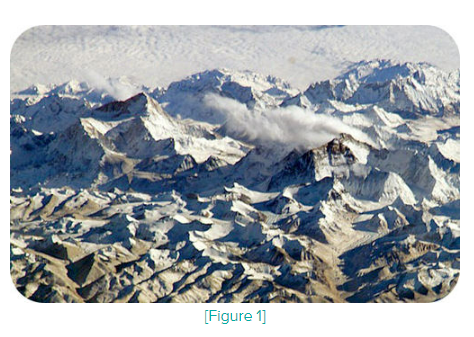
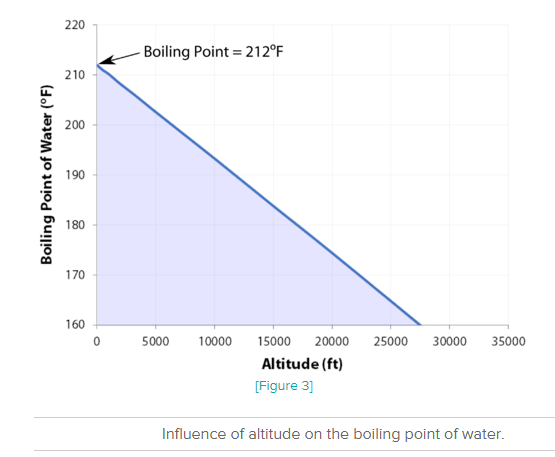
At 29,029 feet (8,848 m), Mount Everest in the Himalayan range on the border between China and Nepal is the highest point on the earth. Its altitude presents many practical problems to climbers. The oxygen content of the air is much lower than at sea level, making it necessary to bring oxygen tanks along (although a few climbers have reached the peak without oxygen). One other problem is that of boiling water for cooking food. Although water boils at 100°C at sea level, the boiling point on top of Mount Everest is only about 70°C. This difference makes it very difficult to get a decent cup of tea (which definitely frustrated some of the British climbers).
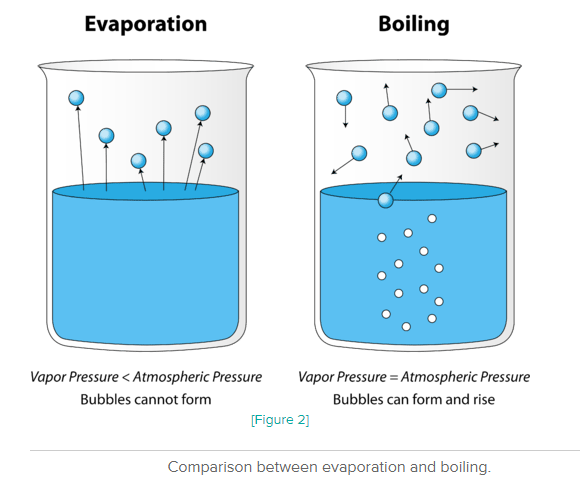
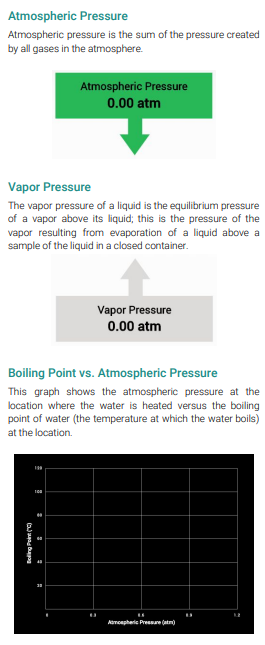
As a liquid is heated, the average kinetic energy of its particles increases. The rate of evaporation increases as more and more molecules are able to escape the liquid’s surface into the vapor phase. Eventually a point is reached when the molecules all throughout the liquid have enough kinetic energy to vaporize. At this point the liquid begins to boil. The boiling point is the temperature at which the vapor pressure of a liquid is equal to the external pressure. Figure below illustrates the boiling of liquid.
In the picture on the left, the liquid is below its boiling point, yet some of the liquid evaporates. On the right, the temperature has been increased until bubbles begin to form in the body of the liquid. When the vapor pressure inside the bubble is equal to the external atmospheric pressure, the bubbles rise to the surface of liquid and burst. The temperature at which this process occurs is the boiling point of the liquid.
The normal boiling point is the temperature at which the vapor pressure of the liquid is equal to standard pressure. Because atmospheric pressure can change based on location, the boiling point of a liquid changes with the external pressure. The normal boiling point is a constant because it is defined relative to the standard atmospheric pressure of 760 mmHg (or 1 atm or 101.3 kPa).
What is the relationship between temperature and vapor pressure? The higher the temperature the
What is the relationship between altitude and boiling point? The higher the altitude the
Which statement(s) is true for a liquid at its boiling point? (select all that apply)
Which statement(s) is true for a liquid at its boiling point? (select all that apply)
What happens when a liquid is heated? (select all that apply)
What is the relationship between vapor pressure and boiling point? The higher the vapor pressure the
What is the relationship between altitude and vapor pressure? The higher the altitude the
In the winter, many people find the snow and ice beautiful. They enjoy getting out to ski or ice-skate. Others don’t find that time of year to be so much fun. When the snow melts, the roads get very sloppy and messy. Those people look forward to spring when all the ice and snow are gone and the weather is warmer.
Solids are similar to liquids in that both are condensed states, with particles that are far closer together than those of a gas. However, while liquids are fluid, solids are not. The particles of most solids are packed tightly together in an orderly arrangement. The motion of individual atoms, ions, or molecules in a solid is restricted to vibrational motion about a fixed point. Solids are almost completely incompressible and are the densest of the three states of matter.
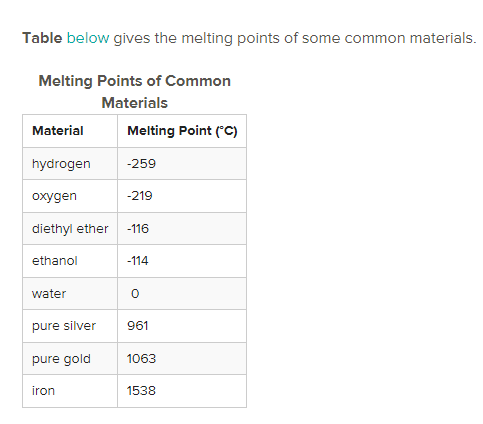
As a solid is heated, its particles vibrate more rapidly as the solid absorbs kinetic energy. Eventually, the organization of the particles within the solid structure begins to break down and the solid starts to melt. The melting point is the temperature at which a solid changes into a liquid. At its melting point, the disruptive vibrations of the particles of the solid overcome the attractive forces operating within the solid. As with boiling points, the melting point of a solid is dependent on the strength of those attractive forces. Sodium chloride (NaCl) is an ionic compound that consists of a multitude of strong ionic bonds. Sodium chloride melts at 801°C. Ice (solid water) is a molecular compound whose molecules are held together by hydrogen bonds. Though hydrogen bonds are the strongest of the intermolecular forces, the strength of hydrogen bonds is much less than that of ionic bonds. The melting point of ice is 0°C.
The melting point of a solid is the same as the freezing point of the liquid. At that temperature, the solid and liquid states of the substance are in equilibrium. For water, this equilibrium occurs at 0°C.
We tend to think of solids as those materials that are solid at room temperature. However, all materials have melting points of some sort. Gases become solids at extremely low temperatures, and liquids will also become solid if the temperature is low enough.
The freezing point of pure water is
The
The type of motion that solid particles exibit is
The melting point and the
Daryl adds 100 mL of boiling water to 200 mL of ice water. If he places this 300 mL sample of water into the freezer, at temperature will this sample of water freeze?
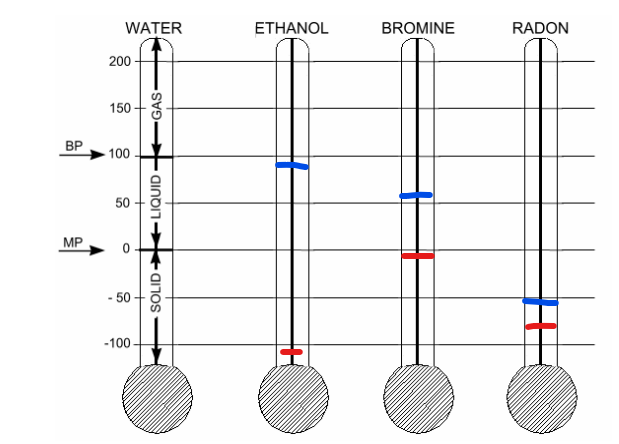
The blue lines on ethanol, bromine, and radon represent the boiling point, while the red lines represent their melting point.
The boiling and melting points of water have been labeled.
If the temperature were increased at the same rate for all four substances, which substance would turn into a gas first?
Which substance has a freezing point of approximately -6 degrees Celsius?
Which substance would you expect to turn into a gas last?
Which substance would you expect to be a liquid at the lowest temperature?
Which substance would you be most likely to encounter in its liquid form (consider the information on the labeled thermometer for water)?
If ethanol melts at -115 degrees Celsius, what temperature does it freeze at?
If the temperature was approximately 99 degrees Celsius, which of these substances would still be a liquid?