Log in
Sign up for FREE
arrow_back
Library

Copy of Sublimation (5/28/2026)

star
star
star
star
star
Last updated about 2 hours ago
12 questions
1
1
1
1
1
1
2
2
1
1
1
1

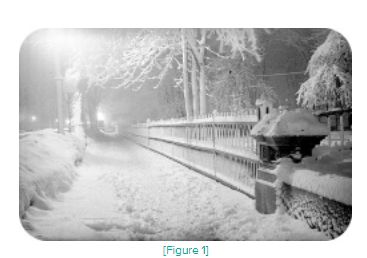
How did the early settlers do their laundry in the winter?

Of course, they could wash the clothes inside, but where to dry them?  There were no dryers available, so the clothes had to be hung up to dry.  In the winter, you would expect that ice would form on the clothes, but that didn’t happen.  Even in freezing weather, the water might freeze initially, but would eventually go off as a vapor – from solid ice directly to the gas stage.  There are still families today who have to rely on this cumbersome process to get their laundry done.

Sublimation

Vapor Pressure of a Solid

The vapor pressure of a liquid is dependent upon temperature.  Solids also have a vapor pressure, though it is generally much less than that of a liquid.  A snow bank will gradually disappear even if the temperature stays below 0°C.  The snow does not melt, but instead passes directly from the solid state to the vapor state.  Sublimation is the change of state from a solid to a gas without passing through the liquid state.


Examples of Sublimation

a.) Sublimation of Iodine

When iodine is heated sublimation can be readily observed. Iodine's vapor is a distinctive purple color and has a very strong scent, making it easy to detect. The video below shows the sublimation and deposition of iodine. The beaker containing iodine is covered with a round-bottom flask that contains ice. When the iodine is heated it sublimes. When iodine vapors cool, deposition occurs. Deposition is the change of state from a gas to a solid.
b.) Dry Ice

"Dry ice," or solid carbon dioxide, is a substance that sublimes at atmospheric pressures.  Dry ice is very cold (−78°C) and so is used as a coolant for goods such as ice cream that must remain frozen during shipment.  Because the dry ice sublimes rather than melting, there is no liquid mess associated with its change of state as the dry ice warms. Watch the following video to observe the sublimation of dry.
C.) Ferrocene
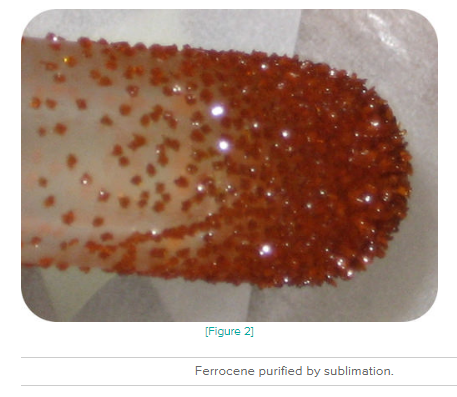
Ferrocene (an iron-containing compound) is usually purified by sublimation. A sample of crude ferrocene is gently heated causing it to sublime. When the ferrocene is cooled, reddish ferrocene crystals deposited on the outside of that tube as shown in Figure below.

Summary

  • Sublimation is the change of state from a solid to a gas without passing through the liquid state.
  • Deposition is the change of state from a gas to a solid.

  • Carbon dioxide is an example of a material that easily undergoes sublimation.
Question 1
1.
The change of state from a solid to a gas while by-passing the liquid state is _______ .
Question 2
2.
An example of a substance that undergoes sublimation would include _______
Question 3
3.
The chang of state from a gas to a solid is called _______
Question 4
4.
A substance undergoes a phase change. However, before that phase chage, the substance does not flow. However, after the phase change, the substance is able to fill its container. The phase change is _______.
Question 5
5.
The process of a gas being converted directly to a solid is called _______
Question 6
6.
How do the vapor pressures of liquids and solids compare? The vapor pressure of liquids is usually _______ than that of solids.
Question 7
7.

Question 8
8.

Question 9
9.
Particles of this state of matter are closely packed together and are not easily compressed. After a phase change, the particles are able to flow and are easily compressed. The phase change was _______ .
Question 10
10.
Ferrocene is purified by _______ using gentle heating at atmospheric pressure.
Question 11
11.
This diagram best represents _______.

Question 12
12.
The conversion of a liquid to a gas is called _______ .
Which of these respresents sublimation (select all that apply)?
Which of these respresents deposition (select all that apply)?