Copy of Electrolytes, Nonelectrolytes, and Dissociation (5/28/2026)
star
star
star
star
star
Last updated 3 months ago
11 Nsɛmmisa
Electrolytes and Nonelectrolytes
1
1
1
2
1
Dissociation
1
1
2
2
1
1
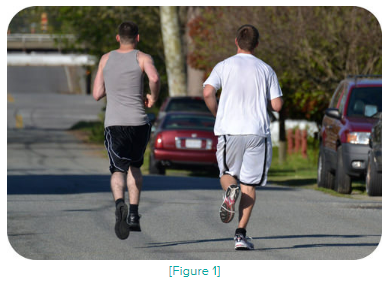
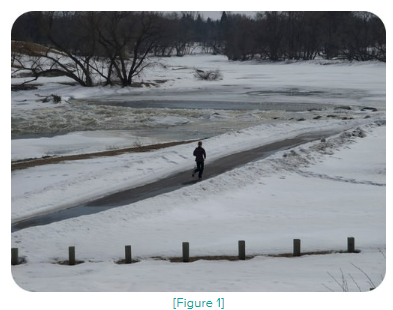
Millions of people in the world jog for exercise. For the most part, jogging can be a healthy way to stay fit. However, problems can also develop for those who jog in the heat. Excessive sweating can lead to electrolyte loss that could be life-threatening. Early symptoms of electrolyte deficiency can include nausea, fatigue, and dizziness. If not treated, individuals can experience muscle weakness and increased heart rate (which could lead to a heart attack). Many sports drinks can be consumed to restore electrolytes quickly in the body.
An electrolyte is a compound that conducts an electric current when it is in an aqueous solution or melted. In order to conduct a current, a substance must contain mobile ions that can move from one electrode to the other. All ionic compounds are electrolytes. When ionic compounds dissolve, they break apart into ions which are then able to conduct a current (conductivity). Even insoluble ionic compounds such as CaCO3 are electrolytes because they can conduct a current in the molten (melted) state.
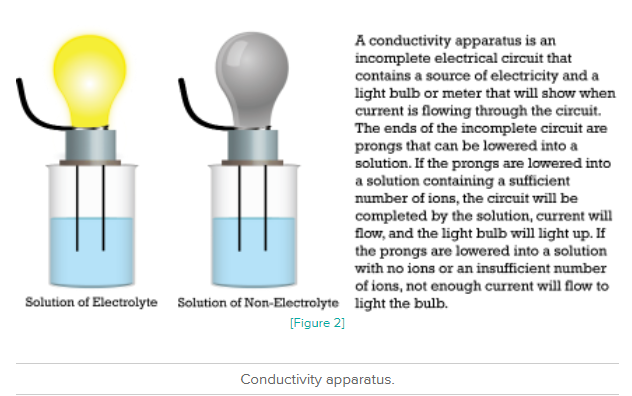
A nonelectrolyte is a compound that does not conduct an electric current in either aqueous solution or in the molten state. Many molecular compounds, such as sugar or ethanol, are nonelectrolytes. When these compounds dissolve in water, they do not produce ions. Figure below illustrates the difference between an electrolyte and a nonelectrolyte.
Several electrolytes play important roles in the body. Here are a few significant electrolytes:
calcium – in bone and teeth. Also important for muscle contraction, blood clotting, and nerve function.
sodium – found outside the cell. Mainly involved in water balance as well as nerve signaling.
potassium – major cation inside the cell. Important for proper functioning of heart, muscles, kidneys, and nerves.
magnesium – in bone and cells. Involved in muscle, bone, nervous system, and takes part in many biochemical reactions.
According to the video, what must you add to distilled water in order for it to carry an electric current?
According to the video, when you add salt into water, it dissociates into charged
According to the video, when you add sugar into water, it remains as
An electrotrolyte is a substance that
In many areas, ice on the streets and sidewalks represent a serious walking and driving hazard. One common approach to melting the ice is to put some form of deicing salt on the surface. Materials such as sodium chloride or calcium chloride are frequently employed for this purpose. In order to be effective, the solid material must first dissolve and break up into the ions that make up the compound.
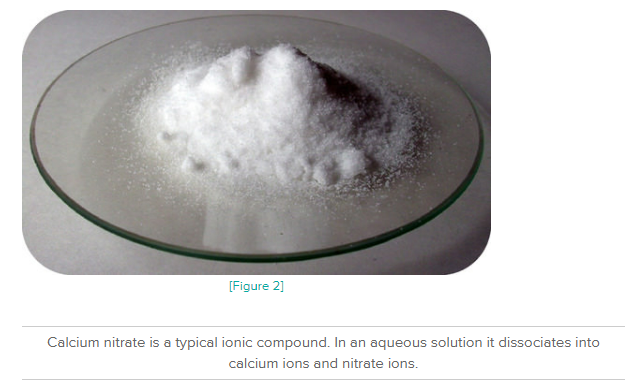
An ionic crystal lattice breaks apart when it is dissolved in water. Dissociation is the separation of ions that occurs when a solid ionic compound dissolves. It is important to be able to write dissociation equations. Simply undo the crisscross method that you learned when writing chemical formulas of ionic compounds. The subscripts for the ions in the chemical formulas become the coefficients of the respective ions on the product side of the equation. Shown below are dissociation equations for NaCl, Ca(NO3)2, and (NH4)3PO4.
NaCl(s) → Na+(aq) + Cl-(aq)
Ca(NO3)2(aq) → Ca2+(aq) + 2NO3-(aq)
(NH4)3PO4(s) → 3NH4+(aq) + PO43-(aq)
The formula unit of sodium chloride dissociates into one sodium ion and one chloride ion. The calcium nitrate formula unit dissociates into one calcium ion and two nitrate ions. This is because of the 2+ charge of the calcium ion. Two nitrate ions, each with a 1− charge are required to make the equation balance electrically. The ammonium phosphate formula unit dissociates into three ammonium ions and one phosphate ion. Note that the polyatomic ions themselves do not dissociate further, but remain intact.
Do not confuse the subscripts of the atoms within the polyatomic ion for the subscripts that result from the crisscrossing of the charges that make the original compound neutral. The 3 subscript of the nitrate ion and the 4 subscript of the ammonium ion are part of the polyatomic ion and simply remain as part of its formula after the compound dissociates. Notice that the compounds are solids (s) which then become ions in aqueous solution (aq).
According to the video, dissociation only happens in a
According to the video
According to the video, compounds that typically dissociate in a solution are made of two things: a
Tip - refer to NaCl and MgO.
Dissociation is the
When a compound dissociates it forms two