Log in
Sign up for FREE
arrow_back
Library

Copy of Unit 3 Summative - Summer School (07/03/2025) (6/2/2026)

star
star
star
star
star
Last updated about 2 hours ago
34 questions
Immune System
Required
1
Required
0.5
Required
0.5
Communicable Disease
Required
1
Required
1
Required
1.25
Required
1
Required
2
Required
1
Required
1
Required
1
Required
1
Required
1
Required
2
Required
2
Non-Communicable Disease
Required
0.5
Required
1
Required
2
Required
2
Required
1
Required
0.5
Required
0.5
Required
1
Required
1
Required
1
Required
1
Required
1
Required
1
Required
1
Required
1
Required
1
Required
1
Required
1
Required
1
Question 1
1.

Question 2
2.

Question 3
3.

Question 4
4.

Define the term pathogen

Question 5
5.
2 types of pathogens are _______ and _______

Pathogen, not type of disease.
Question 6
6.

Question 7
7.
Other Answer Choices:
Cleansed
The time that the pathogen enters the body
Invasion
Infection
The time that the pathogen can cause harm to the person.
The time that the pathogen is multiplying until the first symptom is shown
The time from symptoms are shown until the pathogen wins or the person wins
Incubation
Question 8
8.

Question 9
9.

Briefly explain the difference between an epidemic and a pandemic.

Question 10
10.

Question 11
11.

Question 12
12.

Question 13
13.

Question 14
14.
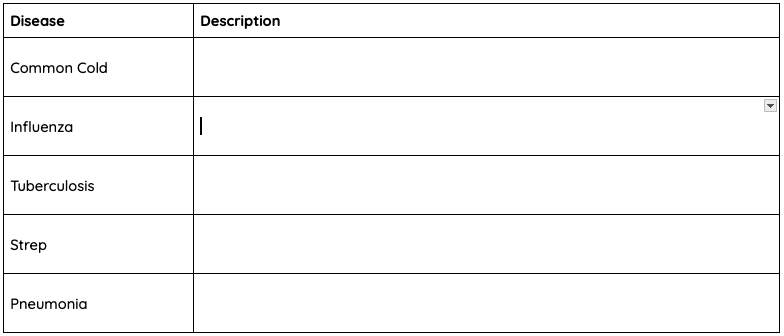
Match the description to the appropriate disease.
Other Answer Choices:
Caused by a viral infection of the liver
Fatal bacterial infection that can cause muscle paralysis
Viral infection/inflammation of the mucous membranes in the nose and throat
Can be a bacterial or viral infection of the lungs with fever and cough. Also causes fluid to develop in the lungs.
Bacterial infection of the throat that can cause white patches to develop.
Bacterial infection that affects the lungs and can cause the person to cough up blood
Viral infection of the respiratory tract with high fever, aches, & chills.
Question 15
15.
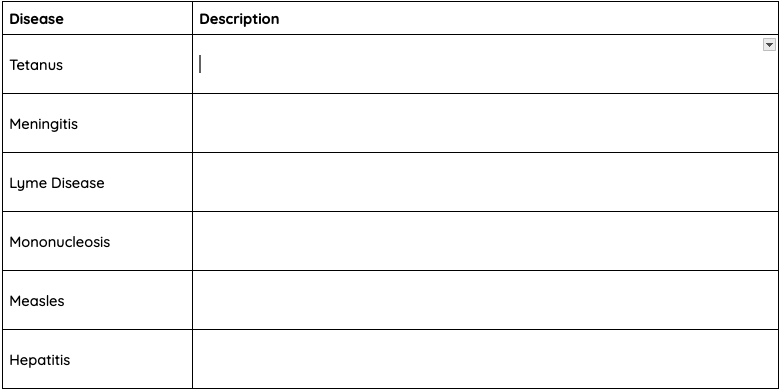
Match the description to the appropriate disease.
Other Answer Choices:
A disease caused by an intestinal parasite which causes nausea and vomiting.
A bacterial infection that can cause muscle paralysis
Viral infection causes swollen spleen and extreme fatigue known as ”kissing disease”
Viral disease that causes a red rash on the skin
Bacterial infection that can cause “bulls eye” rash and joint pain
Viral infection that causes an inflammation of the liver
Bacterial or viral infection that causes a high fever swelling around brain and spinal cord and a very stiff neck
Question 16
16.
The hormone created by the pancreas that is most associated with diabetes is _______
Question 17
17.
The sugar that is found in your blood that your cells use for energy is known as_______
Question 18
18.

Name two risk factors that increase the risk of developing Type 2 diabetes.

Question 19
19.

Question 20
20.

Question 21
21.

Question 22
22.

Question 23
23.

Question 24
24.

Question 25
25.

Question 26
26.

Question 27
27.

Question 28
28.
What does the acronym F.A.S.T stand for?

F - _______
A - _______
S - _______
T - _______
Question 29
29.

Question 30
30.
What do the ABCs of skin cancer stand for?

A -_______
B -_______
C -_______
D -_______
E -_______
Question 31
31.

Question 32
32.

Question 33
33.

Question 34
34.

Which of the following symptoms indicates the body's response to a pathogen?

Select all that apply.
Increase in white blood cells present in the blood
Decrease in white blood cells present in the blood
C Cells begin to produce antibodies
Inflammation
Fever
Please match the term with the appropriate definition relating to types of immunity
Immunity that is non-specific and that acts as the first line of defense
Immunity that comes from receiving antibodies from an outside source but you do not make antibodies
Immunity that comes from getting the disease, fighting it off, and then making antibodies to develop immunity
Active
Innate
Passive
Please select the examples that best match the type of immunity

Each option will only be used once.
Active
Innate
Passive
Receiving a vaccine which requires your body to fight off the disease
Receiving antibodies from mother's breastmilk
Skin which keeps pathogens out of the body
Identify the ways that communicable diseases can be spread.
Touching a table that was sneezed on
Insects
Heredity
Direct contact
Poor diet
Coughing
Age
Improperly cooked food
Sharing a bluetooth device
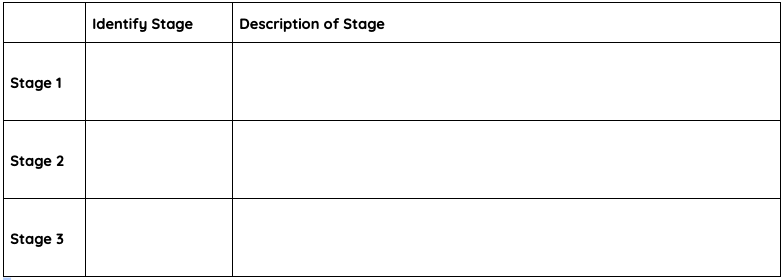
Please identify the stages of communicable disease in order along with the description that matches.
Identify the behaviors that can keep you and your immune system healthy.
Sharing a toothbrush
Avoid close contact with sick individuals
Never wash your hands unless they look dirty
Washing your hands regularly
Cleaning surfaces only if they look dirty
Wear insect repellant
Vaccinations
Cough and sneeze into your hands or the open air
Ensure food is cooked properly
Drink from contaminated water source
What does the term "healthy carrier" refer to when describing communicable disease? (Choose the BEST response)
A person who cannot spread a specific disease to others
A person who is immune to a disease
A person who is constantly sick
A person who has a disease but does not show symptoms
A person who is not able to lead a normal life
Antibiotics are generally used to fight what type of infection(s)? (Choose any that apply)
Worms
Protozoa
Bacteria
Fungi
Viruses
Which of the following way(s) should be done to prevent food poisoning (Select all that apply)
Cook meats to a recommended temperature or over
Eat ALL foods right when you buy them
Refrigerate or freeze perishable foods within 2 hours of purchasing
Defrost foods at room temperature (leave out on the counter) for at least 48 hours (2 days)
Wash surfaces that have been in contact with raw meats
Which of the following are common symptoms of food poisoning?

Select all that apply.
Diarrhea
High fever and chills
Dilated pupils
Nausea and vomiting
Skin rash
Abdominal pain / cramping
Persistent fatigue (tiredness) lasting for months
Identify lifestyle habits that can positively or negatively impact the circulatory system

All options are used.
Living a sedentary (non-active) lifestyle
Being aware and limiting sodium and cholesterol intake
Practicing time management in order to control stress
Engaging in smoking and alcohol
Sleeping habits are irregular
Exercising at least 30 minutes a day
Managing proper weight
Positive
Negative
Why is heart rate an important indicator of circulatory system health?
Heart rate only reflects emotional stress and has no connection to circulatory health.
A stable heart rate reflects stronger cardiovascular efficiency and less strain on the heart.
A higher heart rate always means the person is physically fit.
A lower heart rate suggests the heart is working harder to circulate blood.
Which of the following best defines hypertension?
Blood is pumping through your body too fast.
The force of blood is consistently too high against the arteries.
A condition where the heart pumps too slowly, reducing oxygen delivery to tissues.
A blockage of blood flow to the heart.
Which of the following is classified as a normal blood pressure reading?
118/68
137/90
140/80
127/100
Why is it important to get your blood pressure check regularly - especially adults?
Blood pressure readings will detect blood clots.
To make sure your respiratory system is working well.
Blood pressure readings determine your blood type.
Hypertension often has no symptoms but increases the risk of heart disease.
Select ways that one can keep blood pressure in a healthy range.

Choose all that apply.
Eliminate smoking/vaping
Exercise regularly
Consuming caffeinated beverages regularly
Get blood pressure check regularly
Limit your sodium intake
Do not manage stress
Make sure to eat saturated fats
What is a heart attack?
A condition where blood flow to the brain is blocked, causing tissue death in the brain.
A condition where the pressure in the circulatory system is frequently high.
An irregular heartbeat that temporarily stops blood from reaching the extremities.
A blockage of blood flow to the heart muscle, often due to a blood clot or plaque buildup.
What is a stroke?
A condition where the pressure in the circulatory system is frequently high.
A condition where the blood supply to part of the brain is interrupted or reduced, preventing brain tissue from getting oxygen.
A condition where blood flow to the heart is reduced, causing chest pain and dizziness.
A sudden loss of muscle function due to overexertion.
Identify the risk factors for heart attack and stroke.

Select all that apply.
Family history of heart disease
Exercising frequently
Low-sodium diet
Having consistent high blood pressure
Managing proper weight
Sedentary lifestyle (low physical activity)
High cholesterol levels in the blood
Smoking or vaping
Managing stress
Identify the symptoms/warning signs of a heart attack.
Shortness of Breath
Pain in Arm(s)
Rash
Chest Pain
Cold Sweat
Runny Nose
Face Drooping
Identify things that can increase someone's risk of developing skin cancer

Select all that apply.
Wearing sunscreen with SPF 30 or higher
Staying in the shade during peak sunlight hours
Using tanning oil
Spending long periods in direct sunlight without sunscreen
Frequently getting sunburns
Having a family history of skin cancer
Wearing a hat and sunglasses when outdoors
Using tanning beds
What are common cancers among teenagers?

Select all that apply.
Cervical cancer
Leukemia
Breast cancer
Skin cancer
Prostate cancer
Testicular cancer
What are common symptoms of cancer?

Select all that apply.
Consistently high energy levels
Persistent indigestion
Unexplained weight loss
Persistent cough or trouble breathing
Frequent colds
Unusual bleeding or discharge
Lumps or bumps that can be felt under the skin
How can cancer be treated?
Antibiotics
Chemotherapy
Surgery
Radiation Therapy
Multivitamins
Physical Therapy