Asemmisa {{asɛmmisaAhyɛnsode}}
7.
Work through the formative and make a set of model answers.
Work through the formative and make a set of model answers.
The products of electrolysis can vary depending on whether the salt forming the electrolyte is molten or in aqueous solution.
Explain this statement by referring to the products of electrolysis of molten sodium chloride and of electrolysis of sodium chloride solution.
Include in your answer the names of all the ions present in each electrolyte and how the product at each electrode is formed from ions present.
You may use half-equations if you wish.
At the (negative electrode), Na⁺ ions are attracted, gain electrons (), forming sodium metal: Na⁺ + e⁻ → .
At the (positive electrode), ions are attracted, lose electrons (), forming chlorine gas: 2Cl⁻ – 2e⁻ → .
Cl₂
reduced
Na
cathode
Na⁺
anode
oxidised
The products of electrolysis can vary depending on whether the salt forming the electrolyte is molten or in aqueous solution.
Explain this statement by referring to the products of electrolysis of molten sodium chloride and of electrolysis of sodium chloride solution.
Include in your answer the names of all the ions present in each electrolyte and how the product at each electrode is formed from ions present.
You may use half-equations if you wish.
In aqueous sodium chloride, Na⁺, Cl⁻, H⁺, and ions (from water dissociation) are present.
At the , H⁺ ions are preferentially reduced over Na⁺ (as hydrogen is ), forming hydrogen gas: 2H⁺ + 2e⁻ → .
At the , Cl⁻ ions are oxidized to form chlorine gas
2Cl⁻ – 2e⁻ → .
Sodium hydroxide () remains in solution.
anode
Cl₂
NaOH
cathode
OH⁻
less reactive
H₂
increases
oxidized
anode sludge
reduced
cathode
decreases
ions
anode
reduced
electrolyte
cathode
anode
atoms
oxidised
left
exothermic
endothermic
right
3
increase
2
right
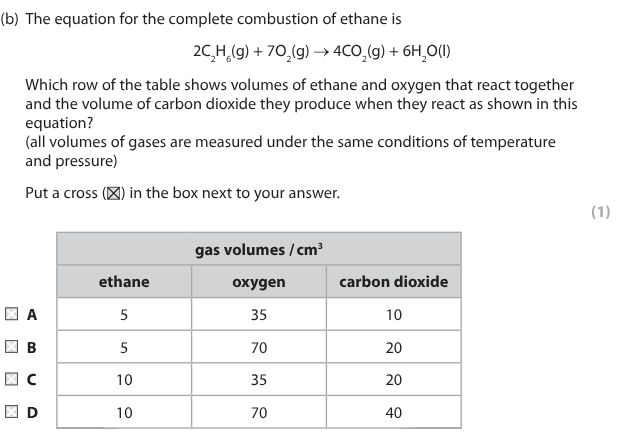
Note this is a simple ratio problem.
A solution of zinc chloride, ZnCl₂, is prepared by reacting zinc carbonate, ZnCO₃, with dilute hydrochloric acid.
(i) Write the balanced equation for this reaction. (3)
ZnCO₃ +

Cathode (Pure Copper): The cathode in size because copper (Cu²⁺) from the copper sulfate solution are attracted to this negative electrode. They gain electrons and are , depositing as pure copper atoms: Cu²⁺ + 2e⁻ → Cu.
Anode (Impure Copper): The anode in size as impure copper atoms lose electrons and are , dissolving into the solution as Cu²⁺ ions: Cu → Cu²⁺ + 2e⁻.
Solid Deposit: Less reactive impurities like gold and silver do not oxidize and fall to the bottom as an .
Solution Colour: The blue colour of the copper sulfate solution remains constant because the rate at which copper ions leave the solution at the is balanced by the rate at which they enter the solution from the .

The silver in the bar () are to form Ag+ ions in the solution.
The silver nitrate solution is the .
At the spoon the silver ions are to form a layer of silver atoms.

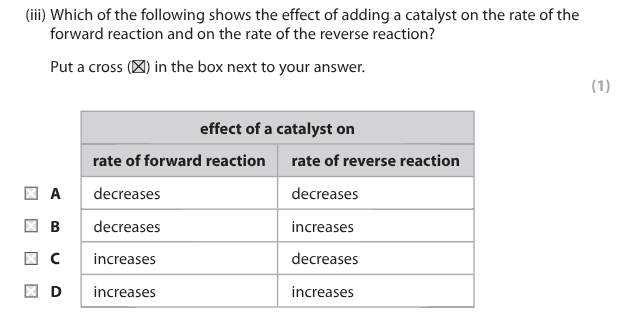
equilibrium shifts to the because reverse reaction is


Equilibrium shifts to the because there are fewer moles of products () than there are of reactants () and an in pressure shift equilibrium to the side with fewer moles of gas.

(ii) Concentration in g dm⁻³:
Calculate Mᵣ of ZnCl₂:
Zn = 65, Cl = 35.5.
So, Mᵣ = 65 + (2 × 35.5)
= 65 + 71
=
Convert mol dm⁻³ to g dm⁻³:
Concentration (g dm⁻³) = Concentration (mol dm⁻³) × Mᵣ.
= 0.25 mol dm⁻³ × 136 g/mol
=