What word or phrase best completes the sentence?
The tour guides don’t like seeing cats in the catacombs, Carlo doesn’t understand why.
Choose the answer that best completes the sentence below.
, Laurel did not think the Carlsbad Cavern National Park looked very spectacular, but her opinion changed after she explored the caves.
Choose the answer that best completes the sentence.
Taxonomists work to classify and name newly discovered creatures, other scientists study the newly discovered creatures and their populations.
Most people don’t understand how much bats help us. Some people even think bats are scary or creepy. In fact, people should be glad there are bats in their neighborhood!
Bats are mammals, like people. There are more than 1,300 species of bats. Some bats are small, with the wingspan of a bumblebee, while others have a wingspan of six feet! They also “see” with their ears. You may have heard the phrase “blind as a bat.” In real life, bats aren’t blind, but their specialized hearing helps them to “see” their environment even better. They make calls as they fly, making up to 160 calls per second. The sound travels and bounces off objects, helping bats to know exactly where objects are all around them. This is called echolocation.
Many of the most common bats eat insects. That’s right—bats are out every night eating mosquitos and other insects you might not want around. Scientists estimated recently that bats save people billions of dollars in pest-control costs. They eat the pests in yards and parks, and they protect farmers’ crops by eating bugs that could damage corn, rice, cotton, and other important crops.
Some species of bats don’t eat bugs; they eat nectar from flowers. These bats pollinate plants that give us some of our favorite foods, including bananas, avocados, peaches, and cocoa beans, the source of chocolate. Bats transfer the pollen from one plant to another, which helps the plants produce fruit.
Bats are also excellent planters. In rainforests, bats eat fruit and seeds and drop some of the seeds as they fly away. It is estimated that one square meter of forest floor can contain between 12 and 80 seeds dropped by bats!
The bad news for both us and bats is that bat populations are decreasing, meaning there are fewer of them. One reason for this is a disease called white-nose syndrome. It has killed more than one million bats. Bats catch it as they are hibernating during the winter.
A special group called the Bats for the Future Fund is collecting money to treat bats with white-nose syndrome. They are also trying to find ways to prevent the spread of the disease. One group of scientists plans to test environmental treatments for white-nose syndrome. This means they will treat the places where bats live, not the bats themselves. They plan to do this in Georgia, Ohio, and Pennsylvania.
Another group is exploring the idea of improving the food sources for bats just before and after they hibernate in Michigan and Manitoba, Canada. The hope is that if the bats have more fat reserves after eating so much, they will survive white-nose syndrome.
The conservationists and scientists hope these efforts will help bats survive this terrible disease and continue to help us with pest control and pollination.
Carlo hopped onto a marble slab. He was underground and it was dark, but he could see to the end of the tunnel. He pulled his tail around his four paws and began licking his fur. He was one of the ninth generation of cats to live in the catacombs. The catacombs are a series of tunnels below Rome, in Italy. Long ago, the ancient Romans buried people in the tunnels, and they were filled with tombs. Other cats might find it creepy to be around so many tombs. But Carlo was a Roman cat, and he had lived in the catacombs ever since he was a kitten.
“Meow?” Carlo heard the sound of another cat in the distance. It was probably his sister, returning from her nightly hunt. Just in case, Carlo jumped down and hid. If it was a strange cat, he didn’t want to be caught by surprise.
He heard the soft sound of paws on stone. The sound grew louder as the paws came closer. “Carlo? Are you there?” It was his sister, Daria.
Carlo sprang out from his hiding spot and his sister yowled in surprise.
“You scared me!” she said.
“I’m sorry, Daria,” said Carlo. “Did you find anything to eat?”
“I found three mice,” said Daria. “But I’ve already eaten them. You’ll have to hunt for yourself tonight. Be careful: there’s a tour group coming through.”
Daria and Carlo knew that they needed to be careful around humans. Tour groups often visited the catacombs. The humans brought lights with them and spent a lot of time staring at the stones. The tour guides didn’t like to see cats in the catacombs. Carlo did not understand why. After all, Carlo and Daria kept the mice away from the tour groups. Carlo did not know much about humans, but he knew that they liked mice even less than they liked cats.
“I’ll be careful,” said Carlo. “The tour group won’t even know I’m here.” Nobody knew the tunnels as well as Carlo and Daria. Even if the tour group saw Carlo, he would be able to outrun them.
Just then, the two cats heard a sound. CRASH! They froze, alert. “What was that?” asked Daria.
CRASH! The sound came again. This time it was closer.
Carlo began moving slowly toward the sound. He stayed close to the wall of the tunnel, sneaking along silently. CRASH! The noise continued. Carlo felt Daria moving behind him, following him to the noise. They turned a corner and saw two huge men with a hammer. CRASH! One of the men was swinging the hammer against a tomb.
“Daria! They’re trying to rob the tomb!” shouted Carlo.
The men looked up at the sound of his meow. “Did you hear that, Fabio?” the larger man asked. “It sounded like a cat.”
“Don’t be crazy,” the other man answered. “No cat could live down here. There’s nothing to eat. It’s dark. A cat wouldn’t last a day.”
Just as the man finished his sentence, Daria sprang onto his back. The man screamed in pain as Daria’s claws dug into him. “Oooooow!” he cried.
Carlo dove toward the feet of the other man, knocking him off balance. The man fell with a thud, dropping the hammer.
Just then a light appeared in one of the nearby tunnels. A tour group had heard the noise and come to see what was making it. The tour leader shined his torch on the cats and robbers. The two robbers were lying on the floor, and two very happy cats were perched on top of them.
“Mamma mia!” said the tour guide. “These men were trying to rob the tombs!” The guide blew his emergency whistle, and soon the police arrived to arrest the two robbers. By the time the police got there, the cats were already gone. Carlo and Daria had disappeared in the chaos. They hid in the shadows and watched as the robbers were taken away.
From that day on, whenever that tour guide passed through the catacombs he would leave two pieces of cheese. Carlo and Daria had changed one tour guide’s mind. They thought that maybe one day all the tour guides would like having cats in the catacombs.
Why did Carlo and Daria hide from the tour group?
What did the men with the hammer want to do?
What caused the robbers to get caught?
How did Carlo feel about living in the catacombs?
What is special about Carlo and Daria's family?
Read the sentences and answer the question.
"Just then, the two cats heard a sound. CRASH! They froze, alert. 'What was that?' asked Daria.
"CRASH! The sound came again. This time it was closer."
What does the word “alert” mean as used in this text?
Imagine watching hundreds of thousands of bats swirl around you, swarming to form a large, black mass that flies off into the horizon. At Carlsbad Caverns in New Mexico, this scene is a regular occurrence. The caverns, located in a United States National Park, are home to around 400,000 Mexican free-tailed bats that fly out into the night sky each evening at dusk to feed on nearby moths and insects, returning at dawn to their caves. The spectacle draws crowds from around the world into the Chihuahuan Desert, where the park is located. One such visitor was Laurel Mathews, who once visited the caves with her family on a road trip.
“At the entrance to one of the caves, there’s stadium seating for visitors to watch the bats,” she remembers. “We waited a long time to see them. Finally, they started circling out of the cave and they flew off—out came more and more and more, all of them flying in loops and then out into the sky. It was amazing that there were so many!”
Laurel also remembers the sound the bats made, describing the high, screeching noise. “It was really creepy, but also really cool,” she says.
Laurel recalls her family’s arrival at the Carlsbad Caverns National Park. “It didn’t look very spectacular when we first drove in,” she admits. “But then we started exploring the big network of underground caves.”
The formation of the caves is a result of a fossilized reef that existed 250 to 280 million years ago in an inland sea that has long since disappeared. Since limestone is typically made up of fragments of coral, a large limestone deposit eventually formed in the area. Today, you can still find several fossilized plants and animals in the caves’ limestone that date back to a time before dinosaurs walked the earth. Starting sometime between four and six million years ago, water from the earth’s surface began moving through the cracks in the stone deposit. There is a type of acid in surface water. When this water combined with rainwater, the two mixed to form another type of acid as a result of their chemical compositions. This acid slowly dissolved the limestone to eventually form the winding caves that exist today in Carlsbad Caverns. This is a very common process that happens to limestone—many caves all around the world exist in limestone deposits due to the stone’s solubility (the ability of a substance to be dissolved) in a mixture of water and acid.
Eventually, speleothems—formations that arise from mineral deposits in caves—began to take shape in the lower levels of the caverns. In fact, these speleothems existed during the last ice age, when instead of a desert, a pine forest sat above the caves. Over the years, park employees and rangers have found clues that hint at the caves’ history. For example, according to the National Park Service, people have found some bones of ancient ice age animals scattered around the entrance to some of the caves. In 2003, an employee found a part of a stone scraper dating back to the last ice age near a cave entrance as well. Clearly, the caves have a long history—researchers have discovered that Native Americans first inhabited the area sometime between 12,000 and 14,000 years ago. Ever since then, the caves have been explored by several groups, including Spanish explorers in the 1500s, and later by other explorers and guides who drew attention from all across the country to the natural phenomenon.
Laurel remembers this phenomenon very well. “It took us between one and two hours to get all the way to the bottom,” she says, recounting the windy pathway leading deeper and deeper into the heart of the caves. “The park had put in blue and red lights to highlight the beautiful rock formations.”
Once they reached the bottom, Laurel says that she had to take an elevator to get back to the top. “My ears popped so much in the elevator!” she remembers. “It took a really long time to reach the top; I didn’t realize how far down we were until we were on our way back up.”
According to the passage, what currently lives in the caves at Carlsbad Cavern National?
What does the author describe at the beginning of the passage?
Limestone deposits can help researchers learn about what the area was like thousands of years ago. What evidence from the passage best supports this conclusion?
“At the entrance to the cave, there’s stadium seating for visitors to watch the bats.” Based on this information, what can you conclude about the popularity of the bats at Carlsbad Cavern?
What is this passage mostly about?
Read the following sentences:
“The caverns, located in a United States National Park, are home to around 400,000 Mexican free-tailed bats that fly out into the night sky each evening at dusk to feed on nearby moths and insects, returning at dawn to their caves. The spectacle draws crowds from around the world into the Chihuahuan Desert, where the park is located.”
As used in this sentence, what does the word “spectacle” mean?
Inside the dark, damp underground caves of two national parks in central California, scientists made an amazing discovery. They found 27 previously unknown species of spiders, centipedes, millipedes, and scorpion-like creatures. The scientists explored 34 of 238 known caves in Sequoia and Kings Canyon national parks between 2002 and 2005.
The cave dwellers are all invertebrates, or animals without backbones. The discoveries included a tiny pill bug that is translucent, or almost clear. Its internal organs are visible—even its bright-yellow liver! There was also a daddy-longlegs with a jaw larger than its body, as well as a little, bright-orange spider. Some creatures were so tiny that scientists had to use the fine hairs of a paintbrush to collect them.
"We thought we might find a handful of new species," said Joel Despain, a cave expert for the parks. "It was amazing to find 27."
Why had the cave creatures gone undetected? Though it is rare to find unknown animal species on Earth’s surface, the same is not true for caves. Like the deep sea, many caves are difficult to reach and haven’t been explored as thoroughly as the Earth’s surface.
Discovering so many unknown species was thrilling for Jean Krejca. She is a scientist with Zara Environmental, the Texas-based group that led the project. "You get the feeling that you’re Lewis and Clark charting undiscovered territory," Krejca said. "Caves are one of the last frontiers."

The creatures are unique, not only because they are found just in caves, but also because some are found in only a single cave or a specific part of a cave.
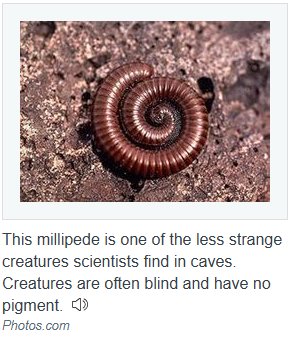
"There are usually more creatures at the cave’s entrance because there is more food there," scientist Rob Myers of Zara Environmental told Weekly Reader. "The farther back in a cave, the more you find creatures have adapted to cave life. What you find is more and more strange. The creatures are often blind and have no pigment." Pigment is a substance that gives color.
A creature such as the pill bug, for example, doesn’t need pigment in its skin, because it doesn’t have to protect itself from the sun. And the daddy-longlegs probably developed such big jaws to quickly grab prey, which is scarce inside caves.
Whenever a new species is discovered, the next task is to name the species. Specialists called taxonomists work to classify and name newly discovered creatures.
Certain scientists also study the new species to determine whether their populations are healthy. Cave animals can teach scientists a lot about the environment because the creatures are sensitive to changes in the ecosystem. An ecosystem is a community of plants and animals that interacts with the environment. If cave creatures decline, it could signal problems or changes in the environment.
The discoveries in the early 2000s led park officials to plan to protect the caves and the newly found species. "Now that we know the species are there, we can use them to learn more about cave ecosystems and life on this planet," said Myers.
What do you call someone who explores and studies caves? A spelunker!
"Caves are absolutely dark," Rob Myers of Zara Environmental told Weekly Reader. "They are darker than your bedroom gets at night. There is zero light in a cave, so you can’t see a hand in front of your face."
When spelunkers head into caves, they wear a helmet with a headlamp and carry an extra flashlight. Cave explorers also wear elbow pads and kneepads to crawl along the rocky floor. Many caves are underground, so the explorers slide down on ropes connected to special harnesses.
While there, a spelunker might see the magnificent cone-shaped formations of stalagmites (stuh-LAG-mights) and stalactites (stuh-LAK-tights). They form when water with calcium drips, and the mineral hardens and builds up over time.
Stalagmites rise from the ground. Stalactites resemble icicles and hang from a cave’s ceiling. When they meet, they form a column. What is an easy way to remember the difference between the words? Stalactite has a c for ceiling, and stalagmite has a g for ground.
According to the text, how many known caves in Sequoia and Kings Canyon national parks did scientists explore between 2002 and 2005?
What does the author describe in the section titled “Cool Cave Mysteries”?
Read these sentences from the text.
Inside the dark, damp underground caves of two national parks in central California, scientists made an amazing discovery. They found 27 previously unknown species of spiders, centipedes, millipedes, and scorpion-like creatures. The scientists explored 34 of 238 known caves in Sequoia and Kings Canyon national parks between 2002 and 2005.
[. . .]
"We thought we might find a handful of new species," said Joel Despain, a cave expert for the parks. "It was amazing to find 27."
What can you conclude based on this evidence?
Based on the text, why might spelunkers, or cave explorers, wear so much gear and equipment?
What is the main idea of the text?
Read these sentences from the text.
Whenever a new species is discovered, the next task is to name the species. Specialists called taxonomists work to classify and name newly discovered creatures.
As used in these sentences, what does the word “task” mean?
How do bats “see” their environment?
Some bats eat nectar from plants. What effect does this diet have on the environment?
Read these sentences from the text.
“A special group called the Bats for the Future Fund is collecting money to treat bats with white-nose syndrome. They are also trying to find ways to prevent the spread of the disease. One group of scientists plans to test environmental treatments for white-nose syndrome. This means they will treat the places where bats live, not the bats themselves.”
What can you conclude about efforts to save bats from white-nose syndrome, based on this information?
What are some things that could happen if bats disappeared entirely from white-nose syndrome?
What is the main idea of this text?
Why are bats important for farmers?