Twa kɔ nsɛm atitiriw so
Log in
Sign up for FREE
arrow_back
Laabri

Week 3.1: Body Systems

star
star
star
star
star
Last updated about 1 hour ago
30 Nsɛmmisa
Move Your Muscles!
Running Like a Pro
Now Hear This! Care for Your Ears
Body Buddies: The Microbes that Live In and On Us

Make sure you have answered all the questions, click submit when finished with all questions and check your answers. You may not be able to make corrections at this time.

1
1
1
1
1
1
1
Asemmisa {{asɛmmisaAhyɛnsode}}
7.

Choose the answer that best completes the sentences.

To avoid hurting your muscles, warm them up before exercising, says David Waymann, an exercise physiologist at the University of Michigan Health System. , their shoes are the same color and brand.

1
1
1
1
1
1
1
1

Body Buddies: The Microbes that Live In and On Us

Try to count all the living things you can see. You might spot people, trees, a squirrel, grass, birds, or insects. But did you know that most of the life around you can’t be seen? That’s because most living things are microbes: tiny organisms that are invisible without a microscope.

Microbes live everywhere. They’re in the water you drink, the food you eat, and the air you breathe. Right now, there are trillions of microbes in your belly and on your skin! These microbes live, feed, and reproduce in and on your body. But don’t worry! Most of these microbes aren’t “germs.” They don’t make you sick. Some of them actually help keep you healthy.

Many Homes for Many Microbes

Many kinds of microbes live in your body: there are fungi and viruses, but most are bacteria. And different types live on different parts of your body. Take your skin as an example. You can think of your skin as a landscape with mountains, valleys, cracks, and forests. Some parts are cool and dry, and others are warm and moist. Other parts might be smooth or rough, oily, or covered with hair.

In every part, different types of microbes find the shelter, moisture, and other nutrients they need to grow. This is happening all over your body: a unique group of microbes lives in each part of your gut, your mouth, and even your brain.

Body Buddies

When you shake someone’s hand or grab a doorknob, harmful microbes, called pathogens, might grab onto you. Fortunately, the helpful bacteria that live on your hands can usually fight them off. But using hand sanitizer can wipe out enough of the helpful bacteria that the harmful have a better chance of taking over. So it’s better to wash your hands with soap and water, which will sweep away most pathogens. Some of your helpful bacteria will be swept away too, but will soon grow back where they belong in the palm of your hand.

Microbes are hard at work in other parts of your body too. They help protect you from pathogens, and also help you digest food, make vitamins, and even help your brain work! That’s why we need to be careful when we use antibiotics. Antibiotics are important medicines because they can kill dangerous pathogens. But they can also kill the helpful microbes in our bodies.

You are an Ecosystem!

You’ve probably heard of ecosystems like forests and prairies. An ecosystem is a community of living things (such as plants and animals) that interact with one another as well as with non-living things (such as air and water) in their environment. Ecosystems don’t have to be large. In fact, together, your body and your microbiome make up an amazing ecosystem. Your body provides the environment for the trillions of microbes living inside you. And in return, they keep your body’s systems working like they should.

Now you have a new way to think of yourself: You’re more than an individual, you’re a “superorganism,” a community of trillions of microbes plus one human! You might feel funny about all those microbes living on you and inside of you. But remember, they’re an important part of our bodies and our health.
1
1
1
1
1
1
1

Move Your Muscles!

Muscles keep you on the go. Here’s how they work and why you need to keep them in tip-top shape.

Picture this: You’re out shooting hoops with your friends. As you take a jump shot, you suddenly feel your leg twist beneath you. Ouch! You might have sprained your ankle. But why did you sprain it? How can you keep from hurting it again? What is a sprain, anyway?

It all has to do with your muscles (more on that sprain later). When you walk down the street, ride your bike, or even yell hello to a friend, you are using muscles. Here’s the good news: everyone can have stronger muscles and prevent injuries.

Muscles: A Lot of Work!

The human body has three types of muscle. There are skeletal, smooth, and cardiac muscles. Smooth and cardiac muscles work without you having to control them. This means they are involuntary. Some body parts that have smooth muscle include the stomach, intestines, and eyes. Cardiac muscle can only be found in the heart.

Skeletal muscle is the most common type of muscle in the body. Skeletal muscles are responsible for almost all of the body’s movements. These muscles are usually attached to bones by strong tissue called tendons. Your body has more than 650 skeletal muscles. They make up about 40 percent of your body weight. Skeletal muscles are generally voluntary, which means you can control them. These muscles help you run, jump, and do all kinds of activities. And they can be injured if you don’t take proper care of them.

Skeletal muscles are different sizes and shapes, depending on their job. Back muscles are some of the biggest and strongest muscles in your body because they help hold you upright. Smaller muscles in your hands let you bend your fingers.

Skeletal muscles work in a simple way. They react when they receive electrical signals from your nerves. The signals are like messages from your brain. For example, when you swing a bat to whack a baseball, a nerve signal travels from your brain to your arm muscles, making them move. Nerve signals also let your brain know whether a muscle has been hurt, like if you twist your arm while swinging that bat.

What Pain Means

Taking good care of your muscles can help prevent you from sitting on the sidelines. This happened to Anita R., a 10-year-old soccer player from New York City. Anita felt pain under her right kneecap. "If I put pressure on it or went up and down the stairs a lot, it would sting and throb," Anita says. Her doctor thought that she "was kicking more [with] one leg and had more muscle in that leg than in the other." Anita had to go to physical therapy, where she did exercises to help her knee heal.

Your body moves by using muscles, bones, tendons, and ligaments. Ligaments usually connect bones together. Muscles, ligaments, and tendons can be injured if you push them too hard. For example, a tough run or a fall might lead to a pain in your leg. How do you know what’s happening when you feel pain? Here’s what might be going on.

  • Muscle aches may be caused by tension, overuse, or muscle injury from hard physical activities.

  • Sprains and strains can also result from being active. A sprain is a stretched or torn ligament. Such an injury might happen if you trip or fall. A strain is a torn or pulled muscle or tendon. It can happen when you pick up something heavy. Sprains and strains are common injuries in sports.

  • A repetitive motion disorder (RMD) is a damaged muscle, tendon, or ligament caused by making the same motion again and again. RMDs are common in the hands, wrists, and shoulders. Teens who spend a lot of time playing musical instruments or video games are at risk for RMDs. Two RMDs are tendonitis, a swollen tendon, and carpal tunnel syndrome, which can be caused by swelling in a tunnel-shaped area formed by bone and ligaments in the wrist.

To avoid hurting your muscles, warm them up before exercising, says David Waymann, an exercise physiologist at the University of Michigan Health System. Walk or jog in place for at least five minutes to get blood to your muscles. "Don’t use stretching as a substitute for a warm-up," Waymann says. After exercising, cool down by walking slowly. Finally, stretch for a few minutes to keep joints and muscles from getting stiff.

Keeping your weight at a healthy level can keep your joints safe from extra strain, advises Dr. Letha Griffin, an orthopedist in Atlanta.

When you aren’t active, muscles can get weak and shrink. Exercise regularly to strengthen muscles. Don’t play when you’re tired, sick, or in pain, and don’t overdo it. Take care of your muscles, and they’ll keep you on the go!

Fun Facts About Muscles

  • Where are the busiest muscles in your body? In your eyes! Scientists estimate that the eye muscles move about 100,000 times a day.

  • Your muscles are always partly contracted. That maintains muscle tone, keeping muscles firm and healthy. It is the only skeletal muscle activity that you cannot control.

  • The body’s largest muscle is the gluteus maximus muscle in the buttocks.

  • Growing pains can cause intense muscle pains in your legs. They usually start before bedtime and sometimes continue through the night. They usually stop when kids stop growing.

Muscles On the Move

Skeletal muscles, along with bones, joints, tendons, ligaments, and cartilage, make up the musculoskeletal system. Here’s what they do:

  • Joints are connections where two or more bones meet, making the skeleton flexible. Two examples of joints are elbows and knees. Bones are held together by strong straps of tissue called ligaments.

  • Skeletal muscles are attached to bones by tough cords called tendons. Tendons and bones move along with your muscles, such as when you wave your hand or tilt your head.

  • Slippery, rubbery cartilage covers the ends of bones at joints. It makes the connections between the bones flexible. Cartilage also protects bones from wear and tear at joints.

  • Muscles contain fibers. Slow-twitch muscle fibers can work hard for a long time without getting tired on a long run or bike ride. Fast-twitch fibers help with quick movements, such as jumping to catch a ball or sprinting. Most muscles are a mixture of slow- and fast-twitch fibers.

Asemmisa {{asɛmmisaAhyɛnsode}}
1.

According to the text, what are the three types of muscle in the human body?

Asemmisa {{asɛmmisaAhyɛnsode}}
2.

The author divides the text into sections with subheadings. What does the author describe in the section with the subheading "Muscles: A Lot of Work!"?

Asemmisa {{asɛmmisaAhyɛnsode}}
3.

Muscles can be injured if you don't take proper care of them.

What evidence from the text supports this statement?

Asemmisa {{asɛmmisaAhyɛnsode}}
4.

What is an example from the text of a way that people can strengthen muscles and prevent injuries?

Asemmisa {{asɛmmisaAhyɛnsode}}
5.

What is the main idea of this text?

Asemmisa {{asɛmmisaAhyɛnsode}}
6.


Read this sentence from the text.

Sprains and strains can also result from being active. A sprain is a stretched or torn ligament. Such an injury might happen if you trip or fall. A strain is a torn or pulled muscle or tendon. It can happen when you pick up something heavy.

Based on these sentences, what does the word "active" mean?

Asemmisa {{asɛmmisaAhyɛnsode}}
8.

Where can you find information about tendons?

Running Like a Pro

Everyone told Julien he looked just like his father. The same steady hazel eyes, the same big ears sticking out on either side of his face. “Oh my goodness!” people would say with a gasp. “Aren’t you a spitting image of your dad!” When his cello teacher met his father, he said, “What a bold lineage you share.” Julien liked that way of putting it, that he didn’t just look like his father, but that he and his father shared something more special.

So when Julien’s father began training for a marathon, Julien found himself wanting to run as well. He was in sixth grade, and the cross-country team was holding tryouts in a few weeks. He wanted to give it his best shot. His father said, “That’s a great idea, son. Running is not only great exercise for the body but for the mind too. When I go for a run, I feel free from all the things I have to do for the rest of the day. I don’t think about work or chores. Any worries I have, I leave at the start line, and they only climb back into my head when I’ve finished my run, by which time I’m so pumped that they no longer feel like worries.”

“Is that how you’re able to run such long races, Dad?” Julien asked. He was becoming nervous about having to run for so long without stopping.

“It’s not a race,” his father explained. “It’s about starting strong and finishing strong. Here, why don’t you and I go for a run every morning before school? Just around the neighborhood. We’ll build up your stamina, and we’ll also build up your mental energy to get through a run without feeling anxious about it.”

Julien approved of his father’s idea, and the next morning he was up bright and early to go for a run, wearing Converses that laced all the way from his toes to his ankle. His father shook his head. “You need shoes that you’ve tested out, not just any old shoes!” he explained. “Today after school, we’ll go to the running store and get you a great pair of sneakers. It’s really important to listen to your body, test it out, and get the perfect pair of shoes to complement your running form.”

All through the school day, Julien couldn’t stop thinking about shoes and running form. His father took great pride in those things, and he would too.

At the store, Julien was amazed to see what all he had to do before he could buy a pair of shoes. It wasn’t as simple as knowing his shoe size. No, the sales representative ran Julien through a battery of tests. Her name was Zoe. First, she made him walk up and down the store, barefoot, and observed him carefully. Then, she had Julien step onto a treadmill. It was the first time Julien had stood on a treadmill before. He looked at his father, big hazel eyes meeting big hazel eyes.

“Don’t worry about a thing, champ,” Zoe said. “This is the easy part.”

She turned on the treadmill and told Julien to walk on it as if he were walking down the street. Zoe was right, Julien thought, this is easy. Zoe sped up the treadmill a little, and Julien had to walk more quickly to keep up. She sped it up even more and added an uphill climb, and Julien began jogging. It was still easy; he wasn’t breathing hard yet, and knew he could go faster.

“Wow,” Zoe said to Julien and his father. “We’ve got a marathon runner here.”

“My dad’s the marathon runner,” Julien said in between breaths.

“Well, I can tell that you’re going to be great at long distance too,” Zoe said with a smile. “You pronate, which means that you put more stress on the insides of your feet when you run. It’s totally normal, don’t worry. And now we can find you the perfect pair of shoes to keep your feet strong and your arches supported while you run.”

“My son, the pro,” Julien’s father said, patting him on the back when Julien got off the treadmill.

Father, son, and Zoe spent thirty minutes trying on different pairs of shoes, a rainbow of colors, a series of brands, and settled on a pair of blue sneakers.

“We’ve done the research,” Julien’s father said on the drive back home. “Now you’re ready to train!”

And Julien agreed, wiggling his toes inside his brand new shoes—the same color and brand as his father’s.

Asemmisa {{asɛmmisaAhyɛnsode}}
9.

What do Julien and his father start doing together?

Asemmisa {{asɛmmisaAhyɛnsode}}
10.

Julien and his father solve a problem by getting a pair of blue sneakers. What is the problem?

Asemmisa {{asɛmmisaAhyɛnsode}}
11.

Julien and his father have a lot in common.

What evidence from the story supports this statement?

Asemmisa {{asɛmmisaAhyɛnsode}}
12.

Why does Zoe say, “We’ve got a marathon runner here” when Julien is on the treadmill?

Asemmisa {{asɛmmisaAhyɛnsode}}
13.

What is a theme of this story?

Asemmisa {{asɛmmisaAhyɛnsode}}
14.


Read the following sentences: “So when Julien’s father began training for a marathon, Julien found himself wanting to run as well.”

What does marathon mean in the sentence above?

Asemmisa {{asɛmmisaAhyɛnsode}}
16.

Read the following paragraph

At the store, Julien was amazed to see what all he had to do before he could buy a pair of shoes. It wasn’t as simple as knowing his shoe size. No, the sales representative ran Julien through a battery of tests. Her name was Zoe. First, she made him walk up and down the store, barefoot, and observed him carefully. Then, she had Julien step onto a treadmill. It was the first time Julien had stood on a treadmill before. He looked at his father, big hazel eyes meeting big hazel eyes.

How does the author connect the sentences in this paragraph?

Now Hear This! Care for Your Ears

Everyone in the pet store heard it. It was a young child's voice, but very, very loud. "HELLO, MR. TURTLE!" it said. "HELLO! HELLO!"

"Sh-h-h," said the voice's mother. "Why are you yelling so loudly at the turtle?"

"He doesn't have any ears!" the child wailed. "He can't hear me unless I talk loud."

"Yes, he does," the mother explained. "You just can't see them. They aren't on the outside of his head like ours."

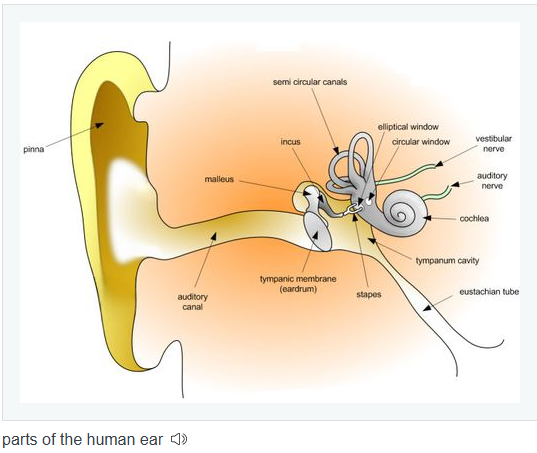
The child in the pet store was looking for the turtle's outer ears. Turtles don't have them, but humans do. The outer ear does several jobs. It gathers sound waves and produces earwax. It even allows you to identify where sounds come from.

The outer ear is called the pinna (PIN-uh) or auricle (OR-ric-le). It is made up of cartilage and skin. There are no bones in your outer ears, but read on! The outer ear gathers in sound waves moving through the air because of its shell shape.

Next the sound waves go down the funnel-shaped ear canal. Special glands in the skin of the outer ear canal produce earwax. This sticky, gummy wax prevents the skin of the outer ear canal from becoming dry and scaly. Earwax also traps dirt and discourages insects from entering the ear. When the wax becomes dry, it flakes off, carrying dust and dirt with it. Then these glands make new earwax.

Ears working as a pair help tell you where a sound is coming from. If a sound comes from your left, then the sound waves entering your left ear will arrive at your brain slightly before the sound waves entering your right ear. Your brain then tells you that the sound is coming from your left. Your brain also uses how loud a sound is to decide where it came from. This process is called sound localization (low-kul-ih-ZAY-shun).

The Middle Ear

The eardrum is made up of three layers. The outer layer is a thin part of the skin of the ear canal. The center layer of the eardrum vibrates with the sound collected by the outer ear. It is protected by the other layers because it continues to grow. It can heal itself if it becomes torn or punctured. The inside layer is a membrane that continues in the middle ear.

The middle ear begins at the eardrum, which is like the head of a drum. It vibrates with sound. Here is where your "ear bones" come into play. Three tiny bones, called ossicles (OS-ik-ulz), are behind the eardrum. They help carry the sound. The malleus (MAL-le-us), or hammer, which looks something like a hammer, is the first bone. It attaches to the eardrum. The second bone is the incus (IN-kus), or anvil. It attaches to the hammer. The third bone is the stapes (STAY-peez), or stirrup. It attaches to the anvil. When the eardrum vibrates with sound, it sets first the hammer, then the anvil, and then the stirrup into motion.

The middle ear also helps balance the pressure on the inside of the eardrum. This helps protect it from injury. The Eustachian (you-STAY-shun) tube connects to the back of the throat and acts like a pressure valve.

The tube decreases pressure when you cough or swallow, creating a popping sound. Sometimes when you are in an airplane, your ears "pop" several times. That's your Eustachian tube opening and reducing the pressure behind your eardrum.

The Inner Ear

The inner ear has two jobs: It changes sound into nerve signals, and it helps you keep your balance. A round structure called the cochlea (COKE-lee-uh) is filled with liquid and lined with tiny hairs. These change as sound vibrations pass through the liquid and set various hairs in motion. They change sound into nerve signals, which your brain can understand.

Different pitches of sound and different volumes will vibrate various hairs and different numbers of hairs. The nerve signals are then taken by the auditory (AUD-uh-tore-ee) nerve to your brain.

Three small loops located behind the cochlea are called semicircular canals. They, too, are filled with liquid and lined with hairs. They help you to keep your balance. Each time you move, the moving liquid and the movement of the hairs tell your brain what position your head is in.

Your brain tells your body which muscles to move to help keep you upright. But sometimes your brain gets tricked. Your eyes tell your brain that you have stopped twirling around, but the liquid in your ears keeps moving. One message says you are still moving. The other message says you have stopped. You feel dizzy until your brain gets only one message.

Protect Your Ears

You now know that your ears do some important jobs. For them to be their healthiest, you must help protect them from infection and injury. Follow these simple steps:

  1. Keep your outer ears clean and dry. A little soap and warm water on a clean washcloth are all you need. Dry your ears carefully with a soft towel.

  2. Do not put anything in your ears. Period. Objects can injure the canal or even the eardrum. This can lead to infection.

  3. Cover your ears in cold weather to prevent frostbite.

  4. Protect your hearing from very loud noise. Turn down the volume on your headphones. Wear earplugs in noisy places.

  5. Using a sunscreen? Don't forget to rub some on and behind your ears.

With proper care, your ears will give you a lifetime of hearing enjoyment. Take time to notice all the sounds you can hear when you are inside and outside. Close your eyes. Now identify all the sounds you can hear. Appreciate your sense of hearing.

Asemmisa {{asɛmmisaAhyɛnsode}}
17.

What part of the ear gathers sound waves and produces earwax?

Asemmisa {{asɛmmisaAhyɛnsode}}
18.

What does the last section of this article list?

Asemmisa {{asɛmmisaAhyɛnsode}}
19.

Read this sentence from the text.

"The outer ear does several jobs."

What evidence in the text supports this statement?

Asemmisa {{asɛmmisaAhyɛnsode}}
20.

Read these sentences from the text.

"Three small loops located behind the cochlea are called semicircular canals. They, too, are filled with liquid and lined with hairs. They help you to keep your balance. Each time you move, the moving liquid and the movement of the hairs tell your brain what position your head is in.

Your brain tells your body which muscles to move to help keep you upright. But sometimes your brain gets tricked. Your eyes tell your brain that you have stopped twirling around, but the liquid in your ears keeps moving. One message says you are still moving. The other message says you have stopped. You feel dizzy until your brain gets only one message."

If the liquid in a person's ears is not moving, what can you infer about that person?

Asemmisa {{asɛmmisaAhyɛnsode}}
21.

What is the main idea of this text?

Asemmisa {{asɛmmisaAhyɛnsode}}
22.

Read these sentences from the text.

"The middle ear begins at the eardrum, which is like the head of a drum. It vibrates with sound. Here is where your 'ear bones' come into play. Three tiny bones, called ossicles (OS-ik-ulz), are behind the eardrum. They help carry the sound. The malleus (MAL-le-us), or hammer, which looks something like a hammer, is the first bone. It attaches to the eardrum. The second bone is the incus (IN-kus), or anvil. It attaches to the hammer. The third bone is the stapes (STAY-peez), or stirrup. It attaches to the anvil. When the eardrum vibrates with sound, it sets first the hammer, then the anvil, and then the stirrup into motion."

What does the phrase "come into play" mean here?

Asemmisa {{asɛmmisaAhyɛnsode}}
23.

Read these sentences from the text.

"The outer ear is called the pinna (PIN-uh) or auricle (OR-ric-le). It is made up of cartilage and skin. There are no bones in your outer ears, but read on! The outer ear gathers in sound waves moving through the air because of its shell shape.

Next the sound waves go down the funnel-shaped ear canal."

What word could replace "Next" in the last sentence without changing the sentence's meaning?

Asemmisa {{asɛmmisaAhyɛnsode}}
24.

What is a microbe?

Asemmisa {{asɛmmisaAhyɛnsode}}
25.

What does the author describe in the section with the heading “Many Homes for Many Microbes”?

Asemmisa {{asɛmmisaAhyɛnsode}}
26.

Read these sentences from the text.

“[A] unique group of microbes lives in each part of your gut, your mouth, and even your brain. […] [Microbes] help protect you from pathogens, and also help you digest food, make vitamins, and even help your brain work!”

What conclusion can you draw about microbes in your body, based on this evidence?

Asemmisa {{asɛmmisaAhyɛnsode}}
27.

Based on the text, how could the relationship between your body and the microbes in it be described?

Asemmisa {{asɛmmisaAhyɛnsode}}
28.

What is the main idea of this text?

Asemmisa {{asɛmmisaAhyɛnsode}}
29.

Why might the author have used the phrase “Body Buddies” to describe microbes in the title and in one of the headings in this text?

Asemmisa {{asɛmmisaAhyɛnsode}}
30.

Choose the answer that best completes the sentence below.

Microbes keep your body’s systems working like they should,