Twa kɔ nsɛm atitiriw so
Log in
Sign up for FREE
arrow_back
Laabri

Week 3.6: Small Creatures

star
star
star
star
star
Last updated about 2 hours ago
36 Nsɛmmisa
Making Space for Bunnies
Tracking Birds Using Tiny Tags
Portrait of an Animal Rescue Expert
Shawn the Speedy Snail
Frogs at Risk

Make sure you have answered all the questions, click submit when finished with all questions and check your answers. You may not be able to make corrections at this time.

Making Space for Bunnies

Did you know there are 20 different types of cottontail rabbit? All of the bunnies share one thing in common: their fluffy white tail.

Their other characteristics depend on where they live. The desert cottontail has adapted to living in the desert, while the swamp rabbit prefers—you guessed it—living in swamps and marshes. The swamp rabbit even enjoys swimming! Other cottontails include the mountain cottontail, the Eastern cottontail, which is the most common, and the New England cottontail, which is actually declining in numbers.

The most common rabbit in the New England states used to be the New England cottontail. These rabbits prefer living in forested areas with lots of young trees. New forests have lots of bushes and plants near the ground, called underbrush or thickets, where the New England cottontail likes to hide. They don’t like open areas. The Eastern cottontail doesn’t mind snacking on grasses in open fields, but the New England cottontail stays close to the underbrush and watches for predators.

Over the past 100 years or so, most of the forests in New England have grown older and have larger, more mature trees. As trees get taller, the tree canopy (the branches and leaves of the treetops) block the sunlight from reaching the forest floor. Small shrubs and plants can’t survive without sunlight, and they die. Without those shrubs and plants, there is nowhere for the New England cottontail to hide.

Over the past 50 years, the population of the New England cottontail has dropped by 80 percent in Connecticut, Massachusetts, New Hampshire, and New York. At the same time, the population of Eastern cottontails has increased in those states. The populations of predators have also increased. Coyotes, foxes, bobcats, fishers, weasels, hawks, and owls all eat rabbits.

Fortunately for the New England cottontail, conservation groups want to help the bunny survive the changing environment. The Wells National Estuarine Research Reserve is creating 400 acres of young forest habitat in southern Maine. In addition to helping the New England cottontail, this young forest area will also help a bird called the American woodcock and pollinators such as butterflies. The American woodcock is a short, plump bird that lives in young forests. Its spotted brown color helps it blend with leaves as it walks on its short legs across the forest floor. As it walks, it searches for worms with its long bill.

In addition to creating young forest areas, the Wells Reserve is also teaching landowners in the area how to help the New England cottontail. The program is a partnership with several other organizations, companies, and groups, including the National Fish and Wildlife Foundation, the American Forest Foundation, Avangrid Foundation, Eversource, and the U.S. Department of Agriculture Natural Resources Conservation Service.

When groups who care work together, they can make a difference for animals such as the little New England cottontail.

1
1
1
1
1
1
1

Tracking Birds Using Tiny Tags

Have you ever taken a long trip with your family? If so, you know how it must feel to be a red knot.

The red knot is a type of small shorebird with a cinnamon-orange belly, gray, black, and orange wings, and an amazing travel schedule. These birds spend winters in Argentina, Chile, or Brazil, in South America. Then, they fly thousands of miles north to the eastern United States, where they hang out on the beach for a big snack. After that, they head even farther north through Canada and spend the summer near the Arctic Circle, where they nest and raise their babies.

Scientists who study these birds are worried about them. Red knots are disappearing, and scientists don’t understand all of the reasons why. How can we help these birds? Where are the birds getting in trouble? Since they travel such great distances, they could have trouble where they nest, along the route where they fly, or even where they live during the winter. Biologists and bird watchers have studied the migration of shorebirds such as the red knot for many years, and there is still a lot we don’t know. But now, a new technology can help. Scientists are using tiny devices called nanotags that work with radio signals to study the red knot’s long journey.

Nanotags are about the size and weight of a button. They have a thread-like antenna and a battery. Scientists attach them to the birds. As each bird flies, the nanotag gives off a signal that is heard by a special network of antenna towers. The towers collect the signal and store the information for scientists to read. Each nanotag has a unique code, so scientists can tell which bird is flying past the tower. The towers can detect birds up to 10 miles away!

An organization called Bird Studies Canada is tagging about 100 rufa red knots in Chile. (Rufa red knots are one of six types of red knots in the world.) Bird Studies Canada will study the birds’ behavior in Chile and then follow the red knots’ trip north to the Arctic Circle. These birds spend most of their time in large flocks with other birds, so tagging just 100 birds gives scientists information on the entire flock.

The scientists from Bird Studies Canada added more antenna towers in Chile to better understand how the birds live in South America. As the red knots fly north, the scientists will collect information from the network of antennae called the Motus Wildlife Tracking System. Many researchers use this system to study the behavior and movements of birds.

All of this information will help them understand where the birds might have trouble on their journey. Scientists and bird watchers can then develop the best plans to help the birds in the future.

1
1
1
1
1
1
1
1
1
1
1
1
1
1
Asemmisa {{asɛmmisaAhyɛnsode}}
21.

Choose the answer that best completes the sentence below.

Justin Matthews has many nicknames, he uses his speed to help get food for others.

Frogs at Risk

South America's frog populations are on the decline. That spells trouble for the environment.
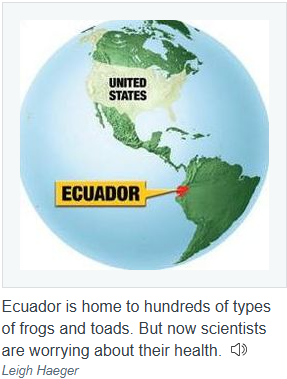
The mountains and thick forests of Ecuador, in South America, are home to 417 types of frogs and toads. Tiny red-eyed tree frogs hide inside flowers. Bumpy-skinned toads use their sticky tongues to catch mosquitoes and other prey. Colorful poison dart frogs rest on tree branches. These brightly colored frogs are packed with poison, which protects them from their enemies.

Now, many species, or types, of frogs and toads in Ecuador are at risk of dying out. According to a report in 2005 by the group NatureServe, eight frogs had become extinct, or died out, in North and South America by 2005. "It's the same magnitude event as the extinction of the dinosaurs," says scientist Luis Coloma.

What Are Amphibians?

Salamanders, frogs, and toads are all amphibians. Amphibians are animals with backbones that spend part of their life in water and part on land. Frogs and toads lay jellylike eggs in water. The eggs hatch into tadpoles, which breathe through gills. As the tadpoles grow into frogs or toads, they develop lungs and live on land.

Like reptiles, such as lizards and snakes, amphibians are cold-blooded. That means their body temperature depends on the environment. Unlike reptiles, amphibians lack protective scales. Amphibians must live near water so that their skin stays moist.

Vanishing Species

Over the last several decades, many amphibian species have become extinct. In the early 2000s, two of every five of the 3,046 species that live in North and South America were at risk of vanishing.

Why are these creatures in trouble? Much of their habitat has been destroyed as loggers have cut down trees to make room for farms and roads. A habitat is a place in nature where a plant or an animal makes its home. Disease, weather changes, and pollution are other causes of the decline in amphibian populations.

Scientists are concerned about the decrease in the number of frogs. The health of frogs is closely linked to the health of the environment. "Amphibian extinction is an indicator of [a problem with the environment]," scientist Jonathan Campbell told Weekly Reader.

Because amphibians breathe through their skin, they easily absorb pollution. They are usually the first to disappear when the environment is under threat. As a result, some frogs are born with deformed, or wrongly shaped, body parts, such as extra legs and eyes. When frogs with strange body parts are found in an area, it is a clue that the environment is polluted or suffering.

What Can Be Done?

Scientists are fighting to save amphibians. Some scientists believe that South America's poison dart frogs have chemicals in their body that can be used to treat diseases, such as cancer. The scientists want governments to pass laws that will reduce pollution and to create parks that protect the amphibians' habitat.

"Almost half of the extinctions are happening for unknown reasons," scientist Robert Kaplan told Weekly Reader. "Scientists have a lot of work to do, and quickly."

Examples of Amphibians in Ecuador

Here are some of Ecuador's frogs and toads.

  • Splendid leaf frogs live in top layers of trees and come down to the ground only once a year, on a moonless night, to lay eggs.

  • Giant glass frogs live in trees and have translucent, or almost see-through, skin. The creature's red heart is visible from the outside.

  • Harlequin toads have colorful, smooth skin, often with spots or streaks of orange, red, yellow, blue, or green. By 2020, some species of harlequin toads had become critically endangered. This means these species had become especially in danger of being extinct.

1
1
1
1
1
1
1
Asemmisa {{asɛmmisaAhyɛnsode}}
1.

Where do New England cottontails prefer to live?

Asemmisa {{asɛmmisaAhyɛnsode}}
2.

What caused the population of the New England cottontail to drop by 80% over the past 50 years?

Asemmisa {{asɛmmisaAhyɛnsode}}
3.

Many different types of animals benefit from young forest areas.

What evidence from the text supports this conclusion?

Asemmisa {{asɛmmisaAhyɛnsode}}
4.

How might you describe the situation that led the New England cottontail’s numbers to drop so quickly?

Asemmisa {{asɛmmisaAhyɛnsode}}
5.

What is the main idea of this text?

Asemmisa {{asɛmmisaAhyɛnsode}}
6.

What is a common feature of all cottontail rabbits?

Asemmisa {{asɛmmisaAhyɛnsode}}
7.

What do conservation groups want to help the New England cottontail do?

Asemmisa {{asɛmmisaAhyɛnsode}}
8.

What is a red knot?

Asemmisa {{asɛmmisaAhyɛnsode}}
9.

The author says that scientists still don’t know a lot about the red knot’s migration route. What solution are scientists using to solve this problem?

Asemmisa {{asɛmmisaAhyɛnsode}}
10.

Read the following sentences from the passage.

“Scientists who study these birds are worried about them. Red knots are disappearing, and scientists don’t understand all of the reasons why. How can we help these birds? Where are the birds getting in trouble? Since they travel such great distances, they could have trouble where they nest, along the route where they fly, or even where they live during the winter.”

What conclusion can you draw based on this information?

Asemmisa {{asɛmmisaAhyɛnsode}}
11.

What information can scientists gather from the nanotags that will help them protect red knots?

Asemmisa {{asɛmmisaAhyɛnsode}}
12.

What is the main idea of this passage?

Asemmisa {{asɛmmisaAhyɛnsode}}
13.

What do scientists use to study red knots?

Asemmisa {{asɛmmisaAhyɛnsode}}
14.

Why are scientists worried about red knots?

Portrait of an Animal Rescue Expert

Justin Matthews has always loved animals. As a boy, he collected turtles and lizards from the pond behind his house in Bradenton, Florida. He terrified his younger sister by slipping the reptiles into her bed at night. By the time he was 12, his bedroom looked like an exhibit at the zoo. Matthews’s love of animals has lasted into his adulthood.

“At my house, we’ve got an iguana, a 10-foot alligator, three constrictor snakes, a hybrid wolf, a giant tortoise, a possum,” Matthews says. “Every time someone comes by the house, they say it’s like a visit to the Florida Zoo!”

Matthews makes his living as a wildlife rescue expert. Each day he takes between 10 and 20 phone calls from people experiencing some kind of trouble with animals. Sometimes a squirrel has gotten loose in someone’s living room. Other times an alligator is sunning itself on someone’s front lawn, preventing kids from going out to play. On rare occasions, a caller reports an animal attack. In such cases Matthews suggests the caller call 911. Then he jumps in his truck to see if he can help.

Fortunately, animal attacks are rare. Matthews spends most of his time educating the public about animal behavior. He believes that if people understood animals better, they would not be so afraid of them.

“When I was young, I tried to get to know every type of animal I could,” he says. “People are scared of animals like snakes and sharks and alligators because they don’t understand them. And they don’t understand them because they haven’t spent any time with them. But when you get to know a python, for example, you start to realize they are actually very nice creatures. People keep them as pets for a reason. They can be fun to have around!”

That may seem like a stretch. But what Matthews says is backed up by science. Burmese pythons are in fact quite calm creatures. Unless you attack them, they will remain peaceful. The problem is that Burmese pythons can grow to lengths of 20 or even 25 feet. Keeping a 20-foot snake in your house is not the easiest thing to do.

“Those snakes can get awfully long,” says Matthews. “And what happens is, after a while, the family can’t care for a snake that big. Instead of selling them, they release them into the wild. All of a sudden, you’ve got 20-foot snakes slithering through people’s backyards!”

Matthews says that at least 10 percent of his rescue calls come from people who see snakes on their properties. When he gets snake calls, he brings a cooler to put them in. Then he drives them to the local Florida Fish and Wildlife office.

Matthews does not only deal with snakes. People call with all sorts of stories. Once, someone called to say there were three wolves running through the local state park. He knew that wolves were not allowed to be in the park, so he drove out to see what he could do. Within an hour, he had captured all three of the wolves in his van. He relocated them to a large cage in his backyard. One of the wolves, Nakia, still lives with him and his wife.

I asked how he managed to tame these wild wolves.

“Simple,” he says. “I threw some chicken into the back of my van, and drove through the park until all three wolves jumped in. I figured they would be hungry. When I got back home, I put them into a cage and lay down beside them for a few hours. After a while they realized I was not their enemy. They started acting nicely toward me. We’ve been friends ever since.”

Matthews is something of a local celebrity in Bradenton. People know him as “the wildlife guy.” Some people call him “alligator man.” His popularity got a boost when he competed in the Python Challenge 2013. The Everglades, a large state park in Florida, is full of Burmese pythons. So Matthews and others agreed to help park employees catch them. As a competitor, he appeared on national news shows with his best friend, Roy, who helped him search. They didn’t catch any. But they did tell officials where the snakes were not hiding out.

“It was a thrill,” Matthews says of the contest. “I was happy to help the Florida Fish and Wildlife folks search for those snakes. They’re a real problem for the state of Florida. People want to be able to enjoy the natural beauty of the Everglades, with its grasses and lagoons. But how can they relax when they know the place is full of big, scary-looking snakes?”

Due to Matthews’s high profile during the contest, television stations expressed interest in giving him his own show.

“TV show or not, I’m happy doing what I’m doing,” he says. “For me, it’s all about the animals.”

Asemmisa {{asɛmmisaAhyɛnsode}}
15.

What is Justin Matthews’s job?

Asemmisa {{asɛmmisaAhyɛnsode}}
16.

The author describes what happens when people can no longer care for their pet Burmese pythons. How does the author describe this?

Asemmisa {{asɛmmisaAhyɛnsode}}
17.

Matthews thinks it is important to help people understand animals better so that people would not be so afraid of them. Which evidence from the text supports this conclusion?

Asemmisa {{asɛmmisaAhyɛnsode}}
18.

According to the passage, Matthews caught three wild wolves and put them in his van. He says, “When I got back home, I put them into a cage and lay down beside them for a few hours. After a while they realized I was not their enemy.”

Based on this information, how can Justin Matthews best be described?

Asemmisa {{asɛmmisaAhyɛnsode}}
19.

What is the main idea of this passage?

Asemmisa {{asɛmmisaAhyɛnsode}}
20.

Read the following sentences from the passage:

“Matthews is something of a local celebrity in Bradenton. People know him as ‘the wildlife guy.’ Some people call him ‘alligator man.’ His popularity got a boost when he competed in the Python Challenge 2013.”

As used in the text, what does the word “celebrity” mean?

Asemmisa {{asɛmmisaAhyɛnsode}}
22.

What does Matthews encourage people to understand?

Shawn the Speedy Snail

Shawn was a snail unlike any other snail in the ditch. All of the snails that Shawn knew were slow. They were slow to get food, slow to get water, slow to get anywhere. The snails of Shawn’s ditch were so slow because they each had huge shells on their backs that they had to carry around. The shells were heavy, but they had to be because the shells were the snails’ homes! Certainly, Shawn had a shell on his back too, just like all the others. He even named it “Shawn’s Place.” He was funny like that, and the snails enjoyed his sense of humor. What made Shawn so fast was that he was stronger than everyone else. Having his home on his back didn’t bother him like it did the others in Shawn’s ditch. The others would complain and sigh, so depressed that they had such a weight to carry on their shoulders and backs. Because Shawn was the strongest, and could carry his home with ease, he was also the fastest, making Shawn the speediest snail around.

From the time Shawn was a baby snail, he could beat any of the snails he knew in the ditch in a race. He grew up challenging each snail to a race, and he was undefeated. Shawn started using his speed for his benefit and his benefit only, though, which was something he would later regret. Anytime there was a leaf that fell to the ground, Shawn would race to it and eat until he got full before anyone else would get the chance. Shawn was always quicker to the roots, too, and he’d eat them right up. If it rained, and puddles of water formed at the bottom of the ditch, Shawn drank and drank all he needed, right in front of all his friends and family, who were slowly gathering at the pools. It was almost as if Shawn was showing off how strong and fast he was all the time. The other snails liked Shawn, but the way he used his speed was making them angry.

After some time, when the other snails became particularly hungry because Shawn was beating them to all the food, the snails in the ditch decided that enough was enough.

“Shawn! Stop eating so much before we can have our helping,” cried Blaine.

“Yeah, Shawn! We know you’re big and strong and fast,” agreed Susan. “You don’t have to keep reminding us about how slow we are,” she added.

Shawn was a little upset about their remarks. “Well, maybe if you would exercise a little bit more, you could beat me to the food and the water!” he said.

“How can we become stronger if you keep beating us to our food?” replied Harvey.

“We all think it’s about time you found another ditch, one that you can have all to yourself,” said Blaine.

That hurt Shawn. He felt a knot in his heart. Slowly, as slowly as he’d ever crawled before, he left the ditch for another place to find food and water.

He knew that there was another ditch across the road that was completely empty of other snails. Shawn was the only one who knew that because he was the only one capable of getting across the road safely, with his speed and all.

A couple of weeks went by. Shawn missed his friends across the road, and he realized that his ditch had even more food than the other, much more than he’d ever need. He decided he’d pay them a visit. He waited by the side of the road for the closest car to pass. Once it did, he speedily crossed back over to his old ditch. What he found made him more upset than anything ever before.

“Shawn!” cried Blaine. “We need your help. There isn’t enough food in this ditch anymore. We’re too weak and too slow to find enough for all of us to eat.”

Shawn’s friends were starving. Even though they had asked him to leave the ditch, it was only because of his selfish actions. Shawn knew what the right thing to do would be.

One-by-one, Shawn lifted each of his snail friends up on top of Shawn’s Place and as fast as he could, which, for Shawn, was pretty fast, brought them over to the ditch on the other side of the road. They were all safe and sound, especially after Shawn raced around the ditch getting food and bringing it straight to his weaker friends. Shawn would never use his speed to show off again.

Asemmisa {{asɛmmisaAhyɛnsode}}
23.

Why is Shawn able to beat the other snails to the food and water?

Asemmisa {{asɛmmisaAhyɛnsode}}
24.

After Shawn returns to the first ditch, he discovers a problem. There is not enough food for the snails in the ditch. How does Shawn solve this problem?

Asemmisa {{asɛmmisaAhyɛnsode}}
25.

Shawn uses his speed for his own benefit.

What evidence from the story supports this statement?

Asemmisa {{asɛmmisaAhyɛnsode}}
26.

Why do the other snails tell Shawn to find another ditch?

Asemmisa {{asɛmmisaAhyɛnsode}}
27.

What is a theme of this story?

Asemmisa {{asɛmmisaAhyɛnsode}}
28.

Read the following sentence:

“If it rained, and puddles of water formed at the bottom of the ditch, Shawn drank and drank all he needed, right in front of all his friends and family, who were slowly gathering at the pools.”

What does the word ditch mean in the sentence above?

Asemmisa {{asɛmmisaAhyɛnsode}}
30.

According to the text, Ecuador is home to many types of frogs and toads. How many?

Asemmisa {{asɛmmisaAhyɛnsode}}
31.

How does the author organize the information in this text?

Asemmisa {{asɛmmisaAhyɛnsode}}
32.

Read the section titled “Vanishing Species.”

Based on the evidence from the section, what can you conclude about why amphibians are at risk?

Asemmisa {{asɛmmisaAhyɛnsode}}
33.

Based on the text, how are the environment and its frog population connected?

Asemmisa {{asɛmmisaAhyɛnsode}}
34.

What is the main idea of the text?

Asemmisa {{asɛmmisaAhyɛnsode}}
35.


Read these sentences from the text.

Why are these creatures in trouble? Much of their habitat has been destroyed as loggers have cut down trees to make room for farms and roads. A habitat is a place in nature where a plant or an animal makes its home. Disease, weather changes, and pollution are other causes of the decline in amphibian populations.

As used in these sentences, what does the word “destroyed” mean?

Asemmisa {{asɛmmisaAhyɛnsode}}
36.

Choose the answer that best completes the sentence.

By 2005, many amphibian species had become extinct,