Choose the answer that best completes the sentence below.
While the earth’s plates move very slowly, some changes in the earth happen very quickly, earthquakes.
Once upon a time all of the colors started to argue. Green, blue, yellow, orange, red, indigo, and violet fought over who was the most beautiful. Each color wanted to be everyone’s favorite.
Green spoke first. "Look around you. See the grass and the trees. I am the color of Earth. Without me, no animal could live. Look at the farms in the countryside. Look at the forests. I am more places on Earth than any of you."
Blue broke in with a joke. "You are only Green with envy.” All of the colors laughed. Blue was the friendliest of the colors. He continued, “You may be on land, but think of me! I am the color of the ocean and the sky. I am the water people drink and the air they breathe. I am the rain that makes trees and flowers grow. I bring kindness and serenity.”
Yellow danced around and said, “Yes! You may be the color of the sky, but the sky would never be blue without me! I splash the world with puddles of sunlight, not rain! I bring happiness. Without me, Green, your grass would never grow. I am sunflowers, sunshine, and smiles!”
Orange came next. In a very serious voice, Orange said, “Yellow, you play too much. I am the most beautiful. Who has never paused to see a beautiful sunset? I bring happiness at the end of the day. I am rare, but precious, like a great gem.”
Then Red interrupted with a yell, “Listen to me! I am strength! I am power in battle. I am the color of blood that pumps in the heart and brings life. I am fire and passion. Who could ever fall in love without red? Who could ever smell the beautiful rose?”
Purple spoke and everyone listened. Purple was very respected among the colors. “Colors, I am the color of royalty. My depth is great. I combine the power of Red with the kindness of Blue. Through the ages, I have been the color of wisdom.”
Finally, the timid voice of Indigo joined the conversation. Indigo was quiet, but determined. "I, too, am important. I am the color that fills the sky before blackness. I am the color in the depths of the sea. The deepest thoughts are shaded Indigo. I bring philosophy."
The colors kept quarreling. They all started speaking at once. Rain heard the noise and became angry. He made lightning crash from the sky. All the colors huddled together in fear. Rain scolded the colors: “What are you fighting about? You are all special. You are all different. None of you is the best. Without all of the colors, the world would be sad.”
Rain told the colors to hold hands as a sign that they were friends again. But Rain would not let the colors forget his lesson. From then on, after big storms, Rain made the colors join hands in the sky. In the rainbow, all the colors are together as a symbol of peace and hope.
Matt Nelsen is a Mechanical Engineer for PG&E, which stands for Pacific Gas & Electric. PG&E is a company in Northern California that provides electricity and natural gas. Matt, as an engineer, designs the pipes that carry natural gas.
Natural gas is found underground, trapped in rocks. It can be captured by drilling and pulling it out of the rocks. Once it is captured, it is refined so that people can use it. This gas can then be burned to do lots of different things.
This natural gas is provided by PG&E to people in Northern California. It is used in houses and individual buildings like schools. This gas is used for heating, water heating, and cooking. Also, PG&E provides gas to factories and other big companies. This gas is used for power generation, equipment sanitation, and product development. Natural gas is used for many things, such as making electricity, recycling, and making most items in stores.
This gas is moved in pipes. Underground there are a lot of pipes that carry many different things in and out of buildings. There are pipes that carry water into a house and then there are pipes that carry the dirty water out. There are also pipes that move natural gas. Matt designs these pipe systems for PG&E, figuring out where the pipes need to be so that the gas gets where it needs to go.
This is called designing “high-pressure transmission pipeline systems.” This means that Matt figures out how many gas pipes are needed, how big they need to be, and how much gas needs to go through them. Matt needs to make sure that on any day, everyone who needs gas has it.
To do so, Matt first figures out how much gas is used throughout the year. In Northern California, gas usage peaks in the winter, “as customers use more gas when it's cold out,” says Matt. People need more gas in the winter to keep their houses warm and to heat their water for showers and baths. He designs pipes to be able to provide the necessary amount of gas.
Matt likes being an engineer because of the problem solving he gets to do. He likes thinking about “how to approach complex issues and develop intelligent…solutions.” Matt has to be able to be flexible and solve problems. If something goes wrong, he is one of the people whom PG&E asks to fix the issue.
Matt also likes getting to see the pipe systems that he designs built in the real world. He says it is a little scary because his pipe designs affect “so many people: construction workers, maintenance crews, customers.” There are a lot of people depending on Matt getting the pipes right! But Matt says it's worth it when his pipe systems are built. When Matt's designs are built and work like he expects them to, he says he feels like he's “really adding something to help people. It's a good feeling.”
Matt says the hardest thing is being worried that his solutions won't work. It's hard to know what will actually happen. Will there be enough gas? Will the pipes work correctly? Matt says that he can't “have every piece of information [he] need[s] to solve a problem.” This means that Matt and other engineers have to assume some things. Matt can guess how the pipes will work and how many people will need gas, but he can't know for sure. Not knowing for sure is the hard part of being an engineer.
There is a lot of work that goes into making gas pipes work. Matt works very hard to make sure that they work properly. So next time you wash your hands with warm water or you use a gas stove, think of Matt and all the engineers who made sure your home is getting the gas it needs!
The sun is a wonderful thing for Earth. It is a star that heats the planet and makes life on Earth possible. In addition, its light shines onto the planet. It is Earth’s ultimate source of energy.
Summer days may be longer than winter days, but for most people, the sun seems to do the same thing each day: it appears to come up in the east for the day, and it appears to go down in the west for the night. The sun looks like it rises in the east and sets in the west because of how the earth spins in space. It spins toward the east, or counterclockwise. This means that when most people look at the sky in the morning, the sun will first appear in the east.
The earth takes 24 hours to complete one turn. For most places on Earth, there is a daytime and nighttime every 24 hours. But in some places for many days at a time, the sun might stay up in the sky, or it might not even come up above the horizon.
In some parts of the world, the sun can be up in the sky for months. During part of the spring and summer in Earth’s Northern Hemisphere, the Northern Hemisphere is tilted towards the sun so much that the sun in northern Alaska, which is located in the Arctic Circle, never goes below the horizon. The Arctic Circle is an area at the top of the earth. In Barrow, Alaska, the sun doesn’t set for almost three months! This phenomenon is called the midnight sun, when the sun has not set at midnight. Try sleeping through that!
During parts of the fall and winter in Earth’s Northern Hemisphere, the Northern Hemisphere is tilted in such a way that the sun doesn’t come over the horizon in northern Alaska for a little over two months. Therefore, nights last more than 24 hours. This phenomenon is called the polar night. Although the sun never rises above the horizon during parts of the fall and winter in the Arctic Circle, enough light often shines so that people who live there don’t need flashlights to walk around outside.
It may be hard for many people to get through these times of very little or prolonged sunlight. But arctic plants and wildlife have adapted to these seasons of long days and long nights. In the arctic winter, some animals hibernate, and others travel south to where there is more sunlight.
In the arctic summer, there are pools of still water from melted ice, and the 24-hour sunlight warms the Arctic Circle. These conditions are favorable for mosquitoes, which lay their eggs on the surface of water, to thrive. The birds that eat these insects now have plenty of food in the arctic summer. For animals like caribou that mainly eat plants, they can easily find food during the long days of summer.
Most animals, including humans, are used to a period of sunlight and a period of no sunlight every 24 hours. In places where there are months when the sun continuously stays above the horizon or below the horizon, living things have had to adapt to survive.
Please choose the answer that best completes the sentence below.
Earth's atmosphere bends certain colors of sunlight and absorbs others, the moon looks reddish during a lunar eclipse.
David and Charlie were setting off on a hiking trip with their uncle Max.
They had packed all of the essential items they would need for their day of hiking. Inside their backpacks were sandwiches, water, sunscreen, bug spray, a long sleeve shirt for the cold, and sunglasses for the sun.
Before they started on their trip, they gathered around a picnic table with their uncle. He showed them what was inside his own backpack. His bag was heavier. He had all the same things David and Charlie had in their bags, except he also had a first aid kit, extra water bottles, a flashlight and a bunch of folded papers.
“What is with all the papers, Uncle Max?” asked David. “Are you going to be doing some homework at the top of the mountain?”
Uncle Max and the boys laughed.
“No,” said Uncle Max, spreading out the folded papers. “These are all maps. They will show us where we are headed.”
“Why don’t you just look up the map on your phone?” asked Charlie.
“Well, we can do that too,” said Uncle Max. “But just in case the phone battery dies or we lose service, we will have these maps on paper. Plus a few of these maps show specific trails for the park that may not be listed on your phone.” Uncle Max opened one of the maps even wider and pointed to a spot with his finger. “This is where we are,” he said. “See all of the trees around us? And this is the trail we are going to take up the mountain and then back.” Uncle Max pointed at a mountain to the right. Sure enough, it was on the map in the same spot.
The boys adjusted their bags, tied their shoes tight, and started off down the trail following behind Uncle Max.
“How do the people who make the maps know where everything is?” asked Charlie.
“Well, there is something called cartography,” said Uncle Max. “Cartography is the study and making of maps. Cartographers use science and exploration to establish where certain parts of the earth are.”
Uncle Max and the boys hiked around a bunch of trees and followed a path over a small river.
“Do maps tell you about what is under the water too?” asked David.
“Some of them do,” said Uncle Max. “Not all maps show all bodies of water. But bigger bodies of water like oceans and lakes are often mapped out. If you are exploring in the ocean and you want to find a coral reef or a sunken ship, then that would be included on a map.”
The three walked for another hour. As they went, they looked at all the trees and plants. They also saw a deer and a few frogs.
After a few more minutes, the boys stopped and had some water, while Uncle Max showed them where they were on the map. They were almost at the bottom of the mountain—they could see it right up in front of them.
“In school we learned that the earth’s surface moves,” said David, as they started walking again. “Because the earth is made up of plates.”
“Plates?” asked Charlie. “Like the plates we use to eat lunch?”
Uncle Max laughed. “Sort of,” he said. “More like puzzle pieces that fit together. And yes, they do move, but usually they move very slowly. If you look at maps that scientists have created of what the earth looked like many, many years ago, you can see that countries and islands on the earth were in different places. Land masses broke apart and floated.”
“So then maps change,” said Charlie.
“Yes, they have to be updated to reflect any changes,” said Uncle Max. “Not that those changes happen very fast.”
“Earthquakes happen fast, though,” said David.
“Definitely,” said Uncle Max. “Very fast. An earthquake is the result of a sudden release of energy in the earth’s crust that creates something called seismic waves. That is why the machine used to measure an earthquake is called a seismometer. This machine helps scientists figure out what is going on in the earth and helps predict any future earthquakes, since they sometimes come in patterns.”
“That’s scary,” said Charlie.
“It is. But that shows you how powerful the earth’s movements can be,” said Uncle Max.
The three hikers reached the mountain.
David looked up. “We are going all the way up there?” he asked. He was tired from his first hike and was not looking forward to heading up the mountain.
Uncle Max laughed. “How about we have our sandwiches down here instead?” he suggested. “Then we can go back and swim in the lake.”
The boys agreed. So Uncle Max laid a blanket on a big flat rock, and the three had their sandwiches in the sun. Then they took a photo in front of the mountain, so they could show their mom. Maybe next time they came back, they could use the map to climb the mountain.
What is the name of the study and creation of maps?
In the passage, Uncle Max describes a number of things to the boys. How does he describe earthquakes?
The movement of the earth’s plates has changed the way that the earth looks over many years. What evidence from the text supports this conclusion?
Based on the information Uncle Max explains, what can be concluded about the impact of the movement of the earth’s plates?
What is the main idea of this story?
Uncle Max compares the earth’s plates to puzzle pieces. Why does Mr. Max compare the earth’s plates to puzzle pieces?
According to the legend, what were the colors fighting over?
In this legend, what is the cause of rainbows?
Read this paragraph from the text.
Green spoke first. “Look around you. See the grass and the trees. I am the color of Earth. Without me, no animal could live. Look at the farms in the countryside. Look at the forests. I am more places on Earth than any of you.”
Based on this evidence, what does Green mean by saying, “Without me, no animals could live”?
Based on this legend, how might some Native people of North America view colors?
What is this text mostly about?
Read these sentences from the text.
The colors kept quarreling. They all started speaking at once. Rain heard the noise and became angry. He made lightning crash from the sky. All the colors huddled together in fear. Rain scolded the colors: “What are you fighting about? . . .”
As used in these sentences, what does the word “quarreling” mean?
Choose the answer that best completes the sentence.
Rain made all of the colors form a rainbow they were arguing.
Which color is described as the most friendly?
Where is natural gas found?
What does the author describe in the passage?
Read the following sentences:
“Matt designs these pipes for PG&E, figuring out where the pipes need to be so that the gas gets where it needs to go… This means that Matt figures out how many gas pipes are needed, how big they need to be, and how much gas needs to go through them.”
Based on this evidence, what conclusion can be made?
Based on the text, what does Matt need to do when designing the natural gas pipes for PG&E?
What is this passage mostly about?
Read the following sentences: “Matt says that he can't ‘have every piece of information [he] need[s] to solve a problem.’ This means that Matt and other engineers have to assume some things.”
What does “assume” mean?
Choose the answer that best completes the sentence below.
Natural gas is used for many domestic and commercial purposes, heating, cooking, power generation, and product development.
What is the sun?
Midnight sun in northern Alaska is an effect described in the passage. What is its cause?
Read the following sentences:
“During part of the spring and summer in Earth’s Northern Hemisphere, the Northern Hemisphere is tilted towards the sun so much that the sun in northern Alaska, which is located in the Arctic Circle, never goes below the horizon. . . . During parts of the fall and winter in Earth’s Northern Hemisphere, the Northern Hemisphere is tilted in such a way that the sun doesn’t come over the horizon in northern Alaska for a little over two months."
What conclusion about the impact of the tilt of the earth does this information support?
Based on the text, how does the Northern Hemisphere tilt during the Northern Hemisphere's winter months?
What is this passage mostly about?
Read the following sentences: “During some of the spring and summer in Earth’s Northern Hemisphere, the Northern Hemisphere is tilted towards the sun so much that the sun in northern Alaska, which is located in the Arctic Circle, never goes below the horizon. In Barrow, Alaska, the sun doesn’t set for almost three months! This phenomenon is called the midnight sun, when the sun has not set at midnight.”
What does the word “phenomenon” mean above?
Choose the answer that best completes the sentence below.
The midnight sun is when the sun never sets; , the polar night is when the sun never rises.
Why do some animals hibernate in the Arctic winter?
An eclipse happens when a planet or a moon gets in the way of the sun’s light. Here on Earth, we can experience two kinds of eclipses: solar eclipses and lunar eclipses.
What’s the difference?
A solar eclipse happens when the moon gets in the way of the sun’s light and casts its shadow on Earth. That means during the day, the moon moves over the sun and it gets dark. Isn’t it strange that it gets dark in the middle of the day?
This total eclipse happens about every year and a half somewhere on Earth. A partial eclipse, when the moon doesn’t completely cover the sun, happens at least twice a year somewhere on Earth.
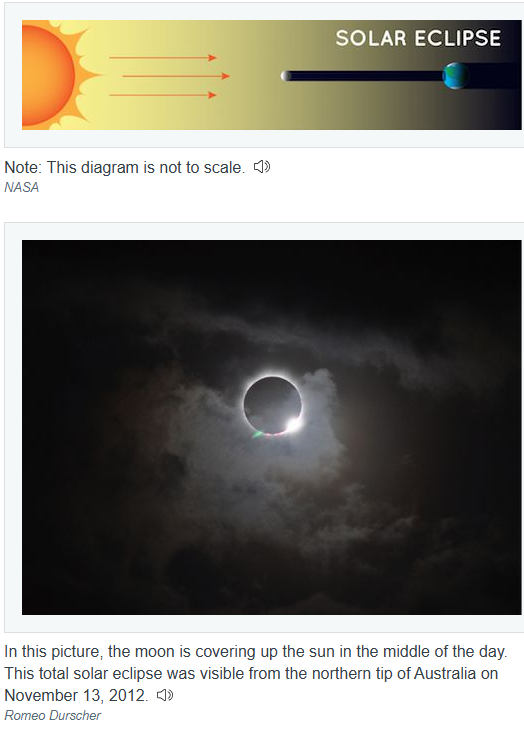
But not everyone experiences every solar eclipse. Getting a chance to see a total solar eclipse is rare. The moon’s shadow on Earth isn’t very big, so only a small portion of places on Earth will see it. You have to be on the sunny side of the planet when it happens. You also have to be in the path of the moon’s shadow.
On average, the same spot on Earth only gets to see a solar eclipse for a few minutes about every 375 years!
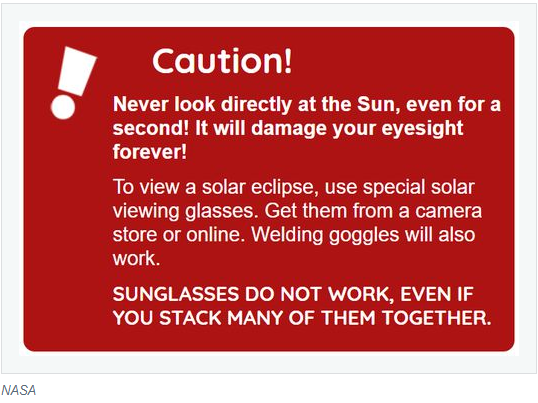
During a lunar eclipse, Earth gets in the way of the sun’s light hitting the moon. That means that during the night, a full moon fades away as Earth’s shadow covers it up.
The moon can also look reddish because Earth’s atmosphere absorbs the other colors while it bends some sunlight toward the moon. Sunlight bending through the atmosphere and absorbing other colors is also why sunsets are orange and red.
During a total lunar eclipse, the moon is shining from all the sunrises and sunsets occurring on Earth!
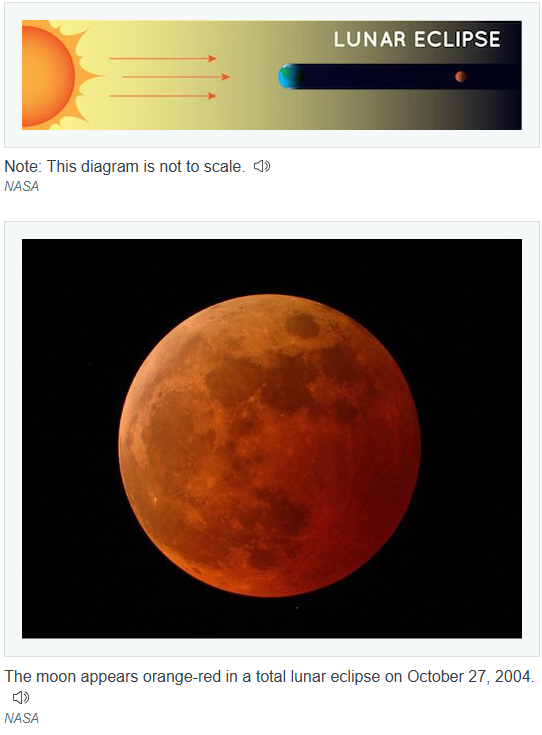
You might be wondering why we don’t have a lunar eclipse every month as the moon orbits Earth. It’s true that the moon goes around Earth every month, but it doesn’t always get in Earth’s shadow. The moon’s path around Earth is tilted compared to Earth’s orbit around the sun. The moon can be behind Earth but still get hit by light from the sun.
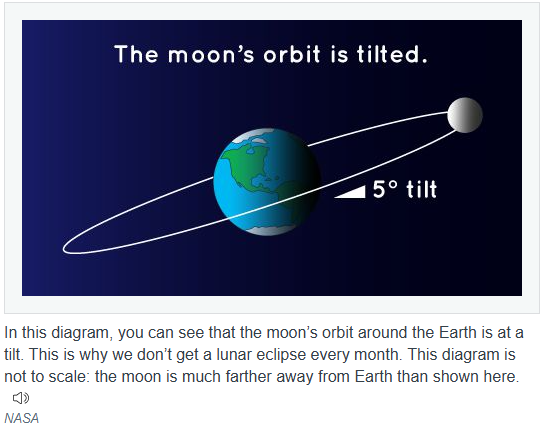
Because they don’t happen every month, a lunar eclipse is a special event. Unlike solar eclipses, lots of people get to see each lunar eclipse. If you live on the nighttime half of Earth when the eclipse happens, you’ll be able to see it.
It’s easy to get these two types of eclipses mixed up. An easy way to remember the difference is in the name. The name tells you what gets darker when the eclipse happens. In a solar eclipse, the sun gets darker. In a lunar eclipse, the moon gets darker.
What is an eclipse?
The text compares and contrasts solar and lunar eclipses. What is one difference between them?
The text states, “During a lunar eclipse, Earth gets in the way of the sun’s light hitting the moon. That means that during the night, a full moon fades away as Earth’s shadow covers it up.” What conclusion can you draw based on this evidence?
What is one thing that must happen in order for either a solar or a lunar eclipse to occur?
What is the main idea of this passage?
Please read these sentences from the text. "Getting a chance to see a total eclipse is rare. The moon's shadow on Earth isn't very big, so only a small portion of places on Earth will see it."
Based on these sentences, what does the word rare mean?
Which section would you find information about the moon's orbit around Earth?