From Kangaroos: Amazing Jumpers
By Lisa M. Herrington
 The late afternoon sun casts a warm glow over Australia's planes. A group of kangaroos hop about, nibbling on grass. A baby kangaroo peeks its head out of its mother's cozy pouch. Then it quickly ducks back in. For now, the baby is content to enjoy the ride.
 Suddenly, a strange noise nearby startles the kangaroos. Their tall ears pierced up perk up. The sound may be from a pack of wild dogs, but the kangaroos aren't sticking around to find out. Springing into action, the kangaroos begin to bounce - faster and faster - scattering in different directions. They can leap the length of a school bus in one bound. leaving danger in their dust.
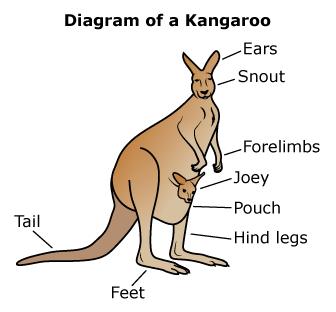
 Kangaroos are the only large animals that hop to move, and they are among the world's best jumpers. Their remarkable leaping ability, unusual body shape, and adorable pouch babies make them some of the most fascinating animals on Earth.
Meet These Hoppers
 When we think of kangaroos, the four largest species typically come to mind. They are the red kangaroo, the eastern gray kangaroo, the western gray kangaroo, and the antilopine kangaroo...
 However, the family to which these kangaroos belong includes many smaller species such as wallaroos, wallabies, and quokkas. There are more than 50 species in the family!
 The red kangaroo is the biggest species. It can grow about 6 ft tall and weigh up to 200 pounds. Eastern and western gray kangaroos are almost as tall but are not as heavy. They all have big feet that can grow to 18 inches long.
 All these large kangaroos belong to a group of mammals called marsupials. Most female marsupials have pouches on their bellies to carry and feed their young. Baby marsupials do most of their developing inside their mother's pouch.
Home, Sweet Home
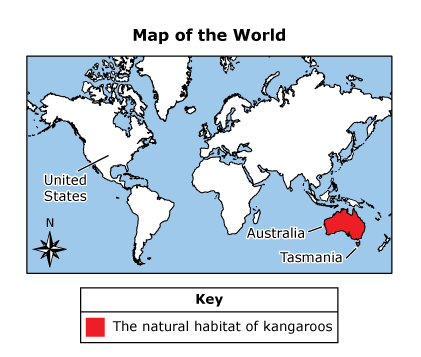
 Large kangaroos live in mainland Australia and Tasmania. They are found in a wide variety of environments, from grasslands to deserts to sandy shores. Different species of large kangaroos live in different habitats. Red kangaroos make their home in remote wilderness areas of central Australia known as the outback. They most likely like to bounce across its hot, dry open planes and deserts. Few trees grow in these inland areas, and there is little water.
 Gray kangaroos prefer the woodlands and bushlands of eastern, western, and southern Australia. These areas get more rain. The kangaroos that live there are nicknamed “foresters” because they are found with their armor trees. They moved to areas of open grasslands when they raise. Antilopine kangaroos can be found in Australia's northern woodlands.
Hopping to It
 You might already know that kangaroos are jumping machines, but would you believe that they can travel as fast as a car? Large kangaroos can leap at speeds of 30 mph. If they need to escape danger, they can exceed 40 mph.
 As they move, kangaroos tuck in their forelimbs and bounce on both of their strong hind legs at the same time. Their legs are made up of tough, flexible tendons that attach muscles to bones. They work like springs. A kangaroo's legs tighten when the animal lands and expand when it jumps. As a kangaroo hops forward, its long tail swings up and down. This super jumper can leap more than 30 ft in a single hop!
 When kangaroos move slowly to graze, they arch their bodies and crawl-walk on all fours. To do this, they lean over so that their front legs and their tail are on the ground. Then they swing their back legs forward.
 Kangaroos tend to be social animals. Most large kangaroos live in groups… These groups can make up anywhere from three to 50 or more kangaroos.
 Male kangaroos are called bucks or boomers... females are called does or flyers. Since they are much lighter and smaller than males, they can hop faster. They move quickly and spend so much time in the air that they look like they are flying!
 Kangaroos make noises to communicate. They may bark, cough, or growl if they feel threatened. Mothers make clicking or clucking sounds - usually several times in a row - to call their young. Kangaroos also touch noses to say hello…
Chew on this!
 Kangaroos are herbivores. That means they mainly feed on plants. different species much on different kinds of grasses, leaves, and flowers.
 A kangaroo's sharp front teeth, called incisors, work like scissors, snipping grasses and leaves. Broad, flat back teeth called molars crush and grind the tough food. Because kangaroos chew so much, their molars often wear down completely. In some species, the worn-down teeth are replaced with new molars that move forward…
 While eating, kangaroos may rest on their back legs. as a mother grazes, her baby, called a joey, may also lean out of the pouch to eat.
 Kangaroos need water, but they can go long stretches without it. They can live on almost as little water as camels do. They get a lot of their water from the plants they eat.
Keeping Cool
 Many kangaroos eat when it is cooler. The animals start moving around in the early evening and stay active until dawn. During the day kangaroos try to rest in shady spots to avoid overheating out in the open Plains and grasslands. but it can be hard to find shade in areas with few trees. So red kangaroos, for example, dig holes in the ground to make cool places where they can rest and seek refuge from the sun. They scrape away the hot top soil to get to the cooler ground below.
 Licking their forearms is another way that kangaroos keep cool. They have less hair on this part of their body. As the wet saliva drives, it cools the kangaroos’ blood and lowers their body temperature…
Pouch Babies
 The mother kangaroo gives birth to a very tiny baby…
 Despite its miniature size, the newborn kangaroo grips its mother's fur with its short front limbs and crawls its way into her pouch…
 The pouch offers food, shelter, and protection for the baby so it can grow and finish developing.
Roo Rider
 It takes a while for the baby to get fur and begin to look like a kangaroo. By four or five months old, the joey pops its head out for the first time. It's about the size of a cat…
 When it's time to bounce, the mother kangaroo buckles her Joey in for the ride. She does this by tightening the muscles at the top of her pouch so the baby can't fall out.
 The joey will remain in the pouch until it is about eight months old. Then it climbs out to explore the world for short periods of time. A joey's early hops are wobbly, but they eventually become stronger.
 When the joey becomes frightened or tired and wants to return to the pouch, the mother relaxes the opening. The joey will dive back into the pouch - head first. Inside the pouch, the baby kangaroo does a somersault to turn itself around so its head is near the opening.
Growing Up and Out
 As it grows, the baby kangaroo spends more time outside its mother's pouch. Before long it becomes too big for the pouch. At nine to 12 months, depending on the species, the joey leaves the pouch for good. It is also called a young-at-foot now.
 The young-at-foot still relies on its mother. It may even try to get back into its mother's pouch, but she won't let it. She licks her pouch clean and prepares it for a new brother or sister to arrive…
Off into the World
 Young kangaroos like to playfully box. Mothers also practice boxing with their joeys to teach them how to defend themselves. By the time they are two to three years old, young kangaroos have become independent.
 The kangaroo is Australia's most well known animal and is one of the country's national symbols.