Bell work 8/3-8/7
star
star
star
star
star
Last updated about 1 month ago
10 Nsɛmmisa
adapted from A Beginner’s History
by William Harrison Mace
Before telephones connected people across the globe, telegraphs were used to transmit messages between remote locations. Until the late 1800s, Europe and North America could only communicate through messages sent by ship. Cyrus West Field changed history when he ran a telegraph cable along the Atlantic Ocean floor, connecting the two continents.
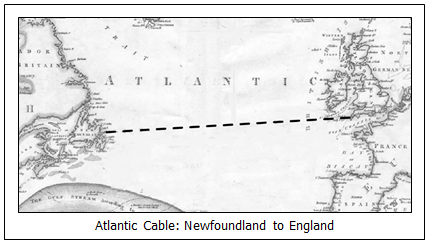
Atlantic Cable: Newfoundland to England
Cyrus W. Field was born in Massachusetts in 1819. His grandfather was a Revolutionary soldier. Cyrus went to school in his native town of Stockbridge, and at fifteen was given a place in a New York dry goods store at fifty dollars a year. Before he was twenty-one he went into business for himself. At the end of a dozen years he was the head of a prosperous paper firm. In 1853 he retired from active business.
Field became interested in a man who was joining Newfoundland with the mainland by means of a telegraph line. “Why not make a telegraph line to span the Atlantic?” thought Field. He went to work, and proposed his schemes before Peter Cooper and other generous men. They believed in them.
Field next went to England and laid his plan before a number of English businessmen. He pleaded so eloquently that they, too, were convinced. He returned to America to lay the matter before Congress and ask them to vote him a sum of money.
Field returned to England to supervise the making of his “cable.” In August 1857, everything was ready. The cable lay coiled on the ship, ready to be let out in the Atlantic Ocean. The great ship started the journey, and everything went well until three hundred thirty-five miles of the cable had been let out into the ocean, when the cable broke in two. It was the same as losing half a million dollars.
Field went back to England and began promptly to prepare for a second attempt. He then came to America and made arrangements to use the Niagara, a large vessel. The British ship, Agamemnon, was also taken to help in this second trial. The ships started in mid-ocean, one going one way and one going the other way. This time only one hundred eleven miles were laid, when the cable again snapped.
6. Field hastened to London to meet the men who had invested in him initially. It was a council of war after a terrible defeat! But Mr. Field did not believe in surrender, even to the sea.
7. On the seventeenth of July 1858, the ships again set sail for mid-ocean. They “spliced” the cable, and the Niagara with Mr. Field on board sailed away for Newfoundland. The British ship went the other way. This time they were successful. Both countries were excited. Queen Victoria sent a telegraph message through the sea to United States President James Buchanan.
8. Great was the rejoicing in New York, the home of Mr. Field. A religious service was held in Trinity Church; national salutes were fired, a great procession was formed, an address was made by the mayor of the city and, at a very late hour, a grand banquet was held. While the party was going on, the cable gave its last throb, and parted.
9. The very day that a whole city rose up to do honor to the Atlantic telegraph and its author, it gave its last flash and then went to sleep forever in its ocean grave.
10. After five years of slow and toilsome work, caused by the fact that the Civil War was raging in the United States, Cyrus W. Field was again ready. When the vessel, bearing the cable, was within six hundred miles of land, the cable broke again.
The Final Success
11. An Anglo-American Telegraph Company was now formed. Mr. Field invested $50,000, Daniel Gooch $100,000, and another person promised to bear a part of the expense. On a Friday they set out and on another Friday they reached America with the cable safely laid. Mr. Field sent this message to England:
12. “Hearts Content, July 27, 1866. We arrived here at nine o’clock this morning. All well...the cable is laid, and is in perfect working order.”
13. The success of this undertaking, after so many years of failure, produced a great effect throughout the civilized world. Mr. Field was the center of all rejoicing. Congress voted him a gold medal. England did honor to his name. The Paris Exposition of 1867 gave him the highest medal it had to bestow. States and chambers of commerce in all parts of the nation passed resolutions in praise of his great work.
14. Finally he took a trip around the world and received honors from many nations. Mr. Field lived at Tarrytown, New York. He died in New York City in 1892, at the age of seventy-three.
Part A: Which choice provides the best objective summary of the passage?
Part B: Which two details from the passage support the answer to Part A?
Which detail from the passage supports the inference that Cyrus W. Field was persistent and strong-willed?
How does the author elaborate on the fact that laying the Atlantic cable was a difficult task?
What is the author’s purpose for writing this passage?
Which choice is a claim made by the author in the passage?
Part A: Which choice is a claim made by the author in the passage?
What does the personification in paragraph 9 mean?
Based on the context, what does the phrase “It was a council of war” in paragraph 6 mean?
How does the author use structure to support the idea that Cyrus West Field was determined to lay the Atlantic cable?