Spring til hovedindhold
Log ind
Sign up for FREE
arrow_back
Bibliotek

Day 8: Body System Interactions

star
star
star
star
star
Sidst opdateret 20 days ago
15 Spørgsmål
Nødvendig
1
Nødvendig
1
Nødvendig
1
Nødvendig
1
Nødvendig
1
Nødvendig
1
1
Nødvendig
1
Nødvendig
1
Nødvendig
1
Nødvendig
1
Nødvendig
1
Nødvendig
1
Nødvendig
1
1
Spørgsmål 1
1.

Match the body system to their funcition

Draggable emnearrow_right_altKorresponderende emne

Digestive

arrow_right_alt

Gets rids of metabolic water - urine, sweat, and carbon dioxide

Endocrine

arrow_right_alt

Breaks down food and absorbs it into the blood

Skeletal

arrow_right_alt

Regulates body functions and metabolic activity with hormones

Excretory

arrow_right_alt

Supports and protects the body and blood cell production

Spørgsmål 2
2.

Match the body system to their funcition

Draggable emnearrow_right_altKorresponderende emne

Respiratory

arrow_right_alt

Produces and releases gametes and takes care of the embryo

Integumentary

arrow_right_alt

Exchanges gas between the air and the body

Reproductive

arrow_right_alt

Protects and covers the outside of the body

Spørgsmål 3
3.

Match the body system to their funcition

Draggable emnearrow_right_altKorresponderende emne

Circulatory

arrow_right_alt

Contracts for motion (movement)

Nervous

arrow_right_alt

Transports oxygen and nutrients

Muscular

arrow_right_alt

Sends and receives impulses and regulates body activities

Spørgsmål 4
4.

Biting flies can transmit diseases and cause loss of blood for animals in nature. Horses have developed behaviors to repel biting flies such as ear twitching, head tossing, leg stomping, and tail swishing.

Which statement best describes the interaction between body systems that allows horses to repel biting flies?

Spørgsmål 5
5.

Both the respiratory system and the digestive system involve the uptake of necessary molecules from an animal's surroundings. Alveoli are tiny sacs that aid in the exchange of carbon dioxide and oxygen in the lungs. Intestinal villi are tiny projections along the lining of the intestines used to take in nutrients from food passing through.
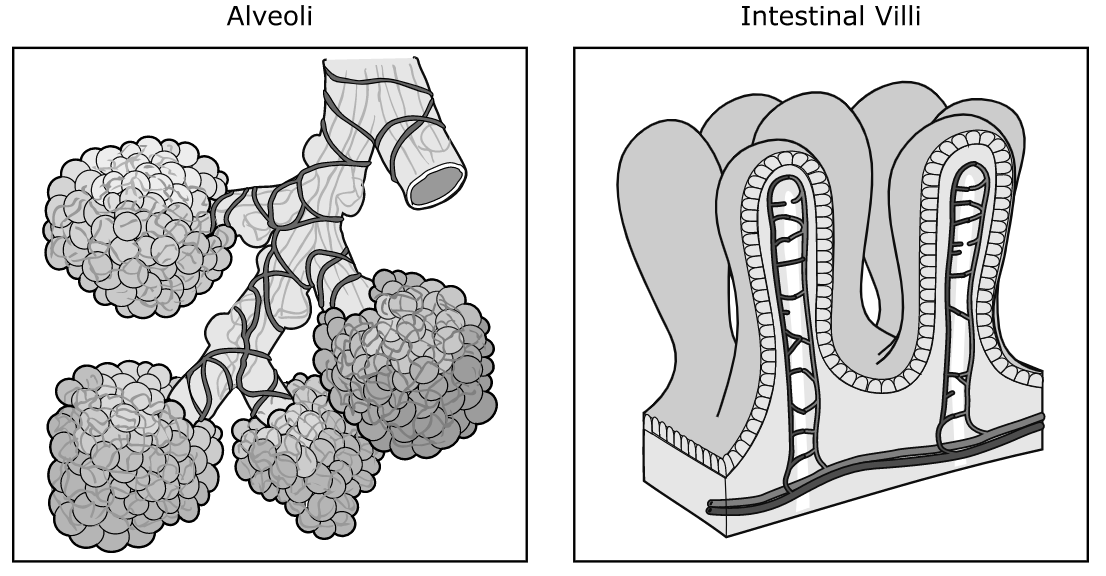
Which system must interact with the respiratory and digestive systems to transport gases and nutrients throughout the body?
Spørgsmål 6
6.

The female reproductive and endocrine systems work interactively for which main purpose?

Spørgsmål 7
7.

Which statement best describes an interaction between the muscular system and the respiratory system?

Spørgsmål 8
8.

How do the circulatory system and immune system work together to respond to an injury?

Spørgsmål 9
9.

When the skin comes in contact with an irritant, receptors in the skin send signals to the spinal cord. The signal is then sent to the brain for processing, and the individual begins to scratch the affected area.

Which two systems are most likely interacting when a person experiences itching caused by a skin irritant?

Spørgsmål 10
10.

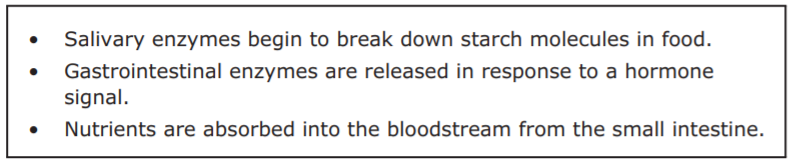
Breaking down food for nutrients involves many body systems. A student made a partial list of the processes that occur.

Which body systems interact most directly in the three listed processes?

Spørgsmål 11
11.

Which four body systems interact to allow a person to sneeze?

Spørgsmål 12
12.

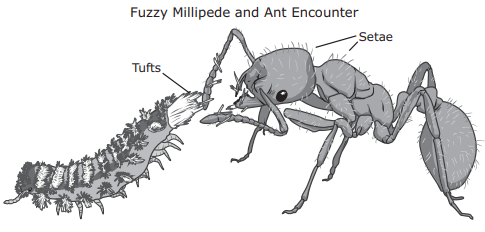
The fuzzy millipede, Polyxenus fasciculatus, is found in Texas and is preyed upon by most species of ants. To protect itself against the ants, it ejects fibers from a tuft located at the tail end of its body. The tufts have hooks at the tips and barbs along their length that lock and interlink with the ant’s setae, small hairs that cover the body of the ant.

When an ant attacks, the millipede flexes its back end toward the ant and wipes the tufts against it. As the ant attempts to remove the tufts, it entangles itself more, becoming immobilized.

Which two systems most directly interact in the fuzzy millipede’s defense against ants?

Spørgsmål 13
13.

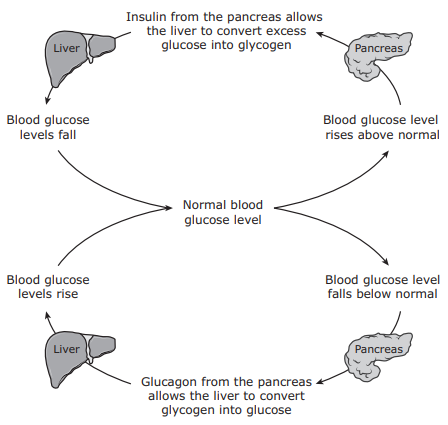
A feedback mechanism in the human body is shown.

Based on this diagram, which two systems interact to maintain homeostasis?

Spørgsmål 14
14.

Spørgsmål 15
15.

Regulation is the process of body systems working together to maintain homeostasis despite variation in external conditions. Two major systems help detect and coordinate the response to changes in the environment.

Negative feedback is one example of regulation. If blood sugar gets too high, a signal is sent and the hormone insulin is secreted by the endocrine system. In response, the liver removes glucose from the blood and stores it as glycogen.

WHAT OTHER SYSTEM, BESIDES THE ENDOCRINE, IS INVOLVED IN THE DETECTION AND RESPONSE TO THE EXTERNAL CONDITIONS?