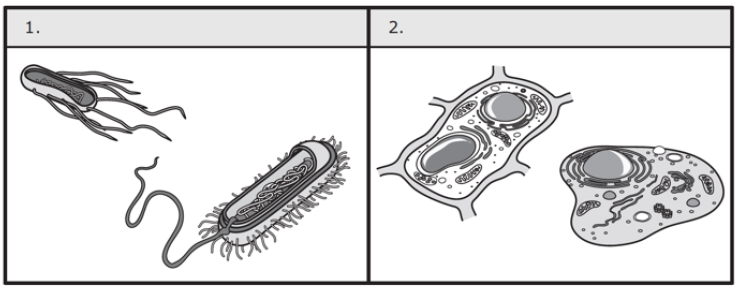
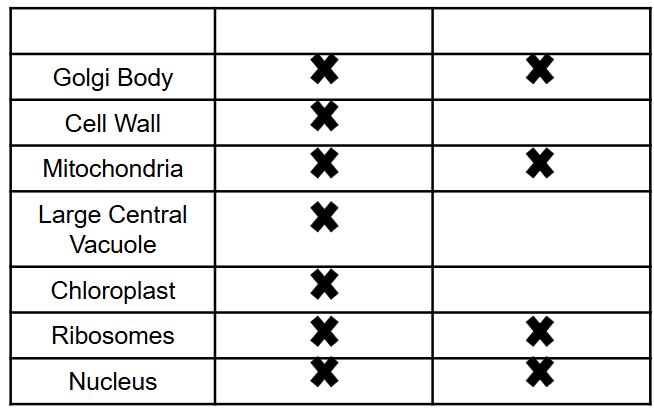
The table below indicates which structures are present in two types cells. The X indicates structures that are present in each cell.
Identify the cells below based on their structures.
Andre svarmuligheder:
Bacterial Cell
Animal Cell
Plant Cell
For each row, select if the structure is observed in prokaryotes, eukaryotes, OR select both boxes if the structure is found in both type of cell.
Prokaryote | Eukaryote | |
|---|---|---|
Nucleus | ||
No nucleus | ||
Cell membrane | ||
Ribosomes | ||
DNA | ||
Cytoplasm | ||
Simple | ||
Complex |
Correctly match the cell organelle to its function (job).
| Draggable emne | arrow_right_alt | Korresponderende emne |
|---|---|---|
Mitochondria | arrow_right_alt | Provides Instructions for Making Proteins |
DNA | arrow_right_alt | Responsible for making the proteins that build our physical traits. |
Chloroplast | arrow_right_alt | Creates ATP (energy) by breaking down glucose (food) for both plant and animal cells. |
Cell Membrane | arrow_right_alt | Uses solar (sun) energy to make glucose (food) for plant cells. |
Ribosome | arrow_right_alt | Maintains homeostasis by controlling what can enter and leave the cell. |
Which cell components could be observed in a prepared slide of leaf cells but not in prepared slides of human cheek cells?
The table below indicates which structures are present in two types cells. The X indicates structures that are present in each cell.
Identify the cells below based on their structures.
Bacterial Cell
Animal Cell
Plant Cell
A student groups different types of cells as shown below.
Identify the groups the student created by moving the correct answer to the boxes provided.
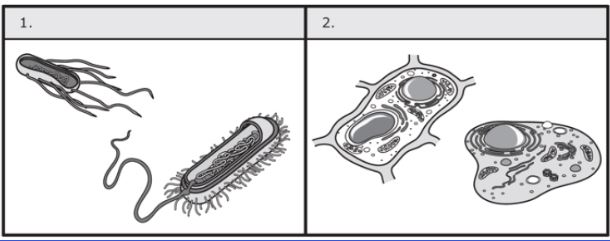
A student groups different types of cells as shown below.
Complete the sentence below with the provided options.
The cells in Section 1 are because they .
Below are different types of cells. Select which organelle(s) can be found in each type of cell. (Some organelles can be found in multiple cells)
Prokaryotic Cells | Animal Cell | Plant Cell | |
|---|---|---|---|
Nucleus | |||
DNA | |||
Cell Wall | |||
Cell Membrane | |||
Ribosomes | |||
Mitochondria | |||
Chloroplasts |
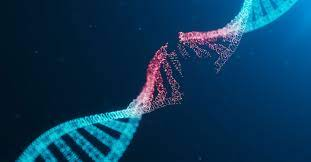
A scientist has discovered a new toxin to use in biological warfare. This newly synthesized poison crosses all cellular membranes and attacks the cell by breaking down its genetic material (DNA). This stops all cellular activity and kills the cell.
Based on this information, the new toxin could be used to kill which type of cell?
Antibiotics are medicines that treat infections by killing bacteria. Some antibiotics work by targeting and shutting down bacterial ribosomes.
What effect would shutting down the RIBOSOMES of a bacteria have?
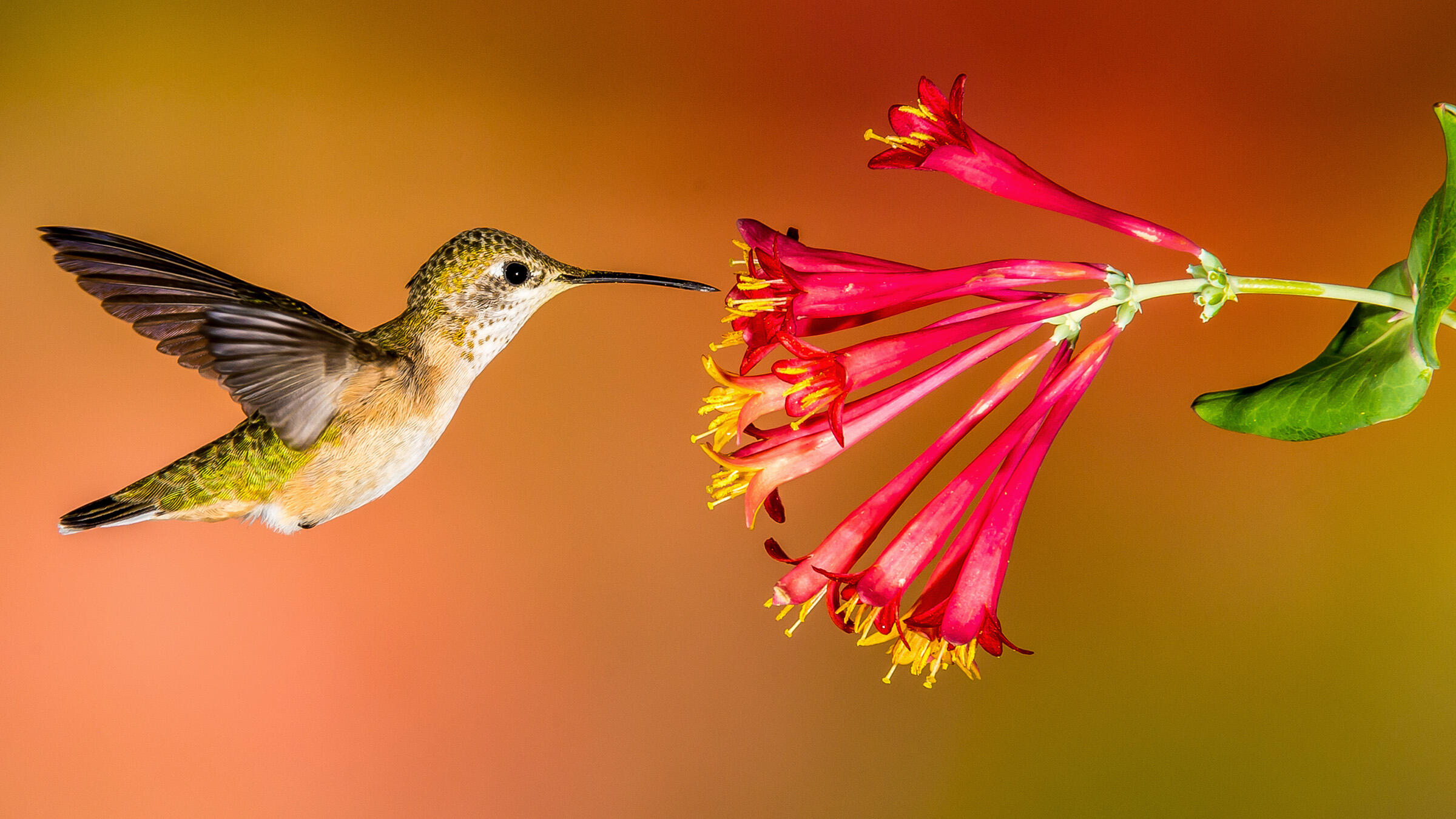
Hummingbirds must eat almost continuously to maintain their high energy needs. For example, their wings beat more than 3,000 times per minute.
Therefore, hummingbird muscle cells must have a large number of in order to provide them with the energy they need.
When mammals get an infection, their body temperature often rises 2-3 degrees. The body gets the energy it needs to react to an infection by –
Classify the following descriptions into their correct categories below.
Smaller (1-5um)
Ribosomes
Plant Cells
Bacteria Cells
DNA
Animal Cells
Larger (10-100um)
Prokaryotes (2 Items)
Eukaryotes (3 items)
BOTH (2 items)
Students created note cards comparing characteristics of eukaryotic and prokaryotic cells.
Which set of note cards most accurately compares these cells?
The endosymbiotic theory explains how certain organelles in eukaryotic cells originated. Which evidence best supports this theory?
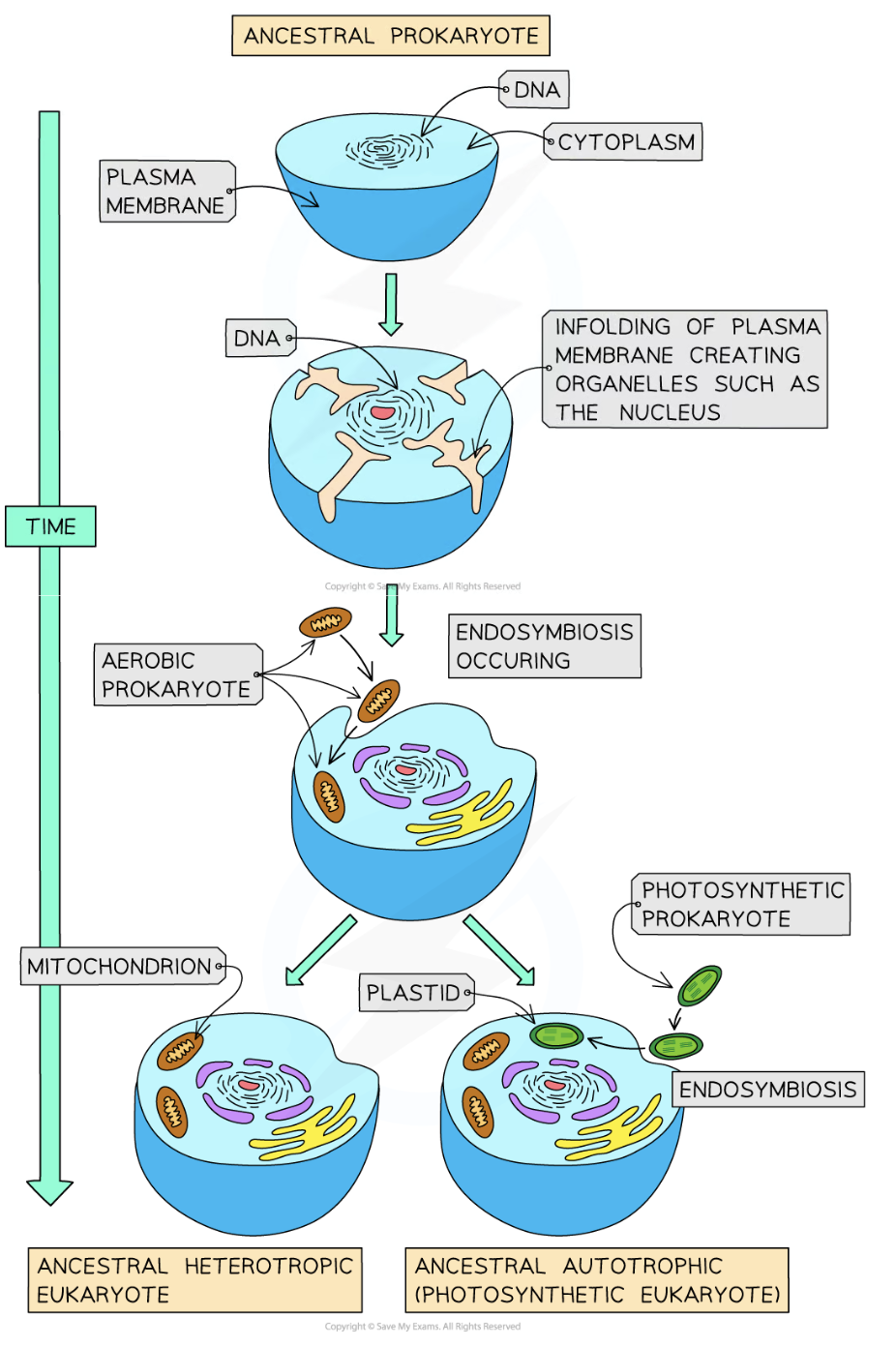
Based on the diagram, which organism evolved first?
The autogenous theory is another explanation for the origin of eukaryotic cells. What does this theory suggest?
Which statement is part of the cell theory? (Select all that apply).
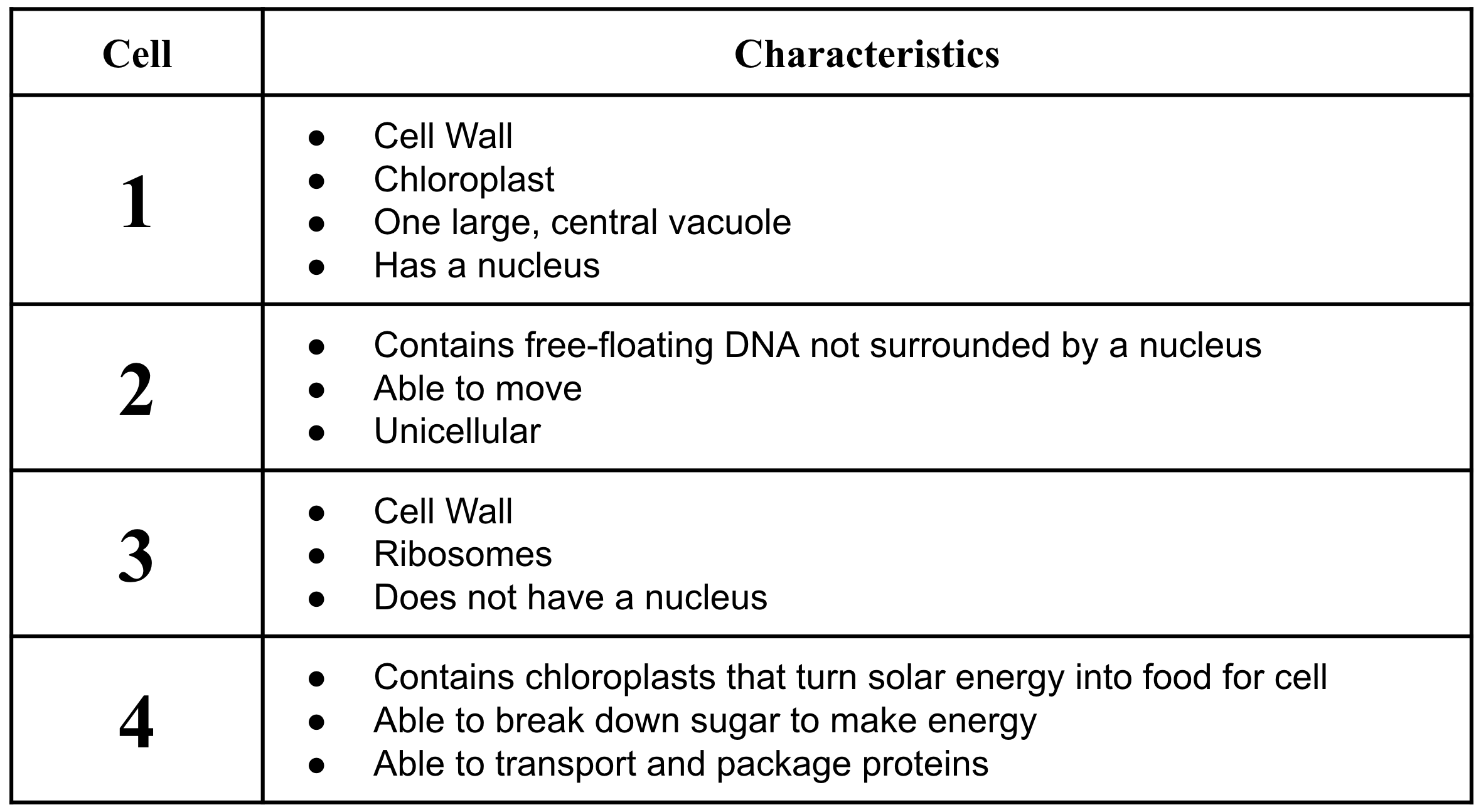
Based on the information in the table below, which of the cell(s) would be classified as EUKARYOTIC?
Select TWO correct answers.
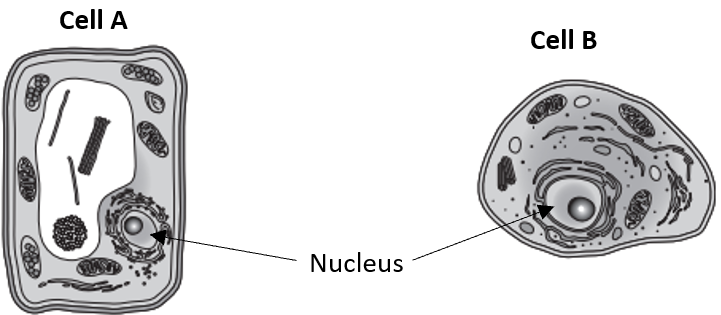
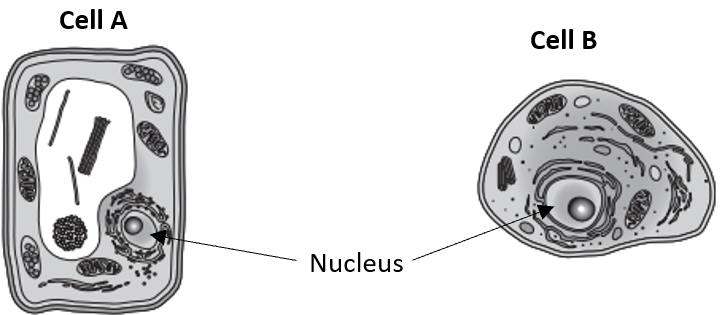
Below are two cells observed under a microscope.
What do Cell A and Cell B have in common? (What similarities do they share?)
A similarity shared by Cell A and Cell B is that , and a difference between Cell A and Cell B is that .
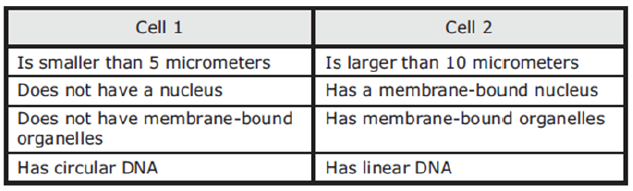
Some students used information they gathered from lab investigations to prepare a table. They entered the table in their lab notebooks.
Which of these correctly identifies the two cells described in the table above?
Explain why you chose your answer on number 23.
STEM:
Cell 1 is a(n)______________________ because___________________, and Cell 2 is a(n) _____________________ because__________________________.


Which statement is best supported by the diagram?
A researcher examines two organisms under a microscope and records observations in the table.

Read the sentences and choose the options that identifies the missing term.
Based on this data, Organism X is a , and will have cells that are. Organism Y is a , and will have cells that are .