Speciation is driven by natural selection, which gradually accumulates changes in allele frequencies of populations over time.
In order for organisms to be considered a species, which conditions must be met?
Select TWO correct answers.
A population of lizards lives on a large island. Over time, a severe storm washes some lizards onto a nearby smaller island, where the environment is very different.
The smaller island has rocky terrain, fewer trees, and different food sources. The lizards on the new island begin to develop different traits, such as shorter legs for climbing rocks and darker skin for better camouflage.
After thousands of years, when lizards from the two islands are brought together, they no longer recognize each other as mates and do not interbreed.
What is the most likely explanation for why the lizards from the two islands no longer interbreed?
A population of fish lives in the same large freshwater lake. Some fish prefer to stay near the rocky shoreline, where they feed on small crustaceans, while others prefer the open water, where they feed on plankton.
Over time, the fish in these two groups develop different body shapes and jaw structures suited for their specific diets. Even though they live in the same lake, they rarely interact or breed with each other.
After many generations, the two groups of fish have become so genetically different that they can no longer interbreed.
What is the most likely explanation for why these two fish populations have become separate species despite living in the same lake?
In a population of insects living in the same forest, some individuals develop a preference for laying their eggs on a newly introduced fruit tree, while others continue to lay their eggs on the original native tree.
Over time, the insects that hatch on the new tree mate mostly with others that also prefer that tree, while those on the native tree do the same.
Over many generations, genetic differences accumulate, and the two groups of insects can no longer interbreed, even though they still live in the same forest.
What is the most likely explanation for why these two insect populations have become separate species?
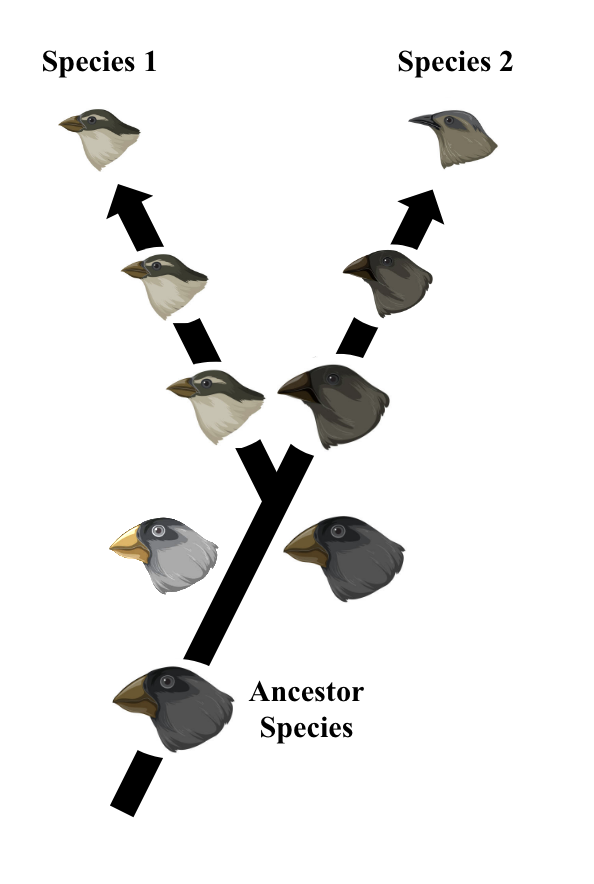
The diagram below shows the morphological change in beaks of two species of finches.
Which statement explains why species 1 and species 2 are different?
The Texas tortoise is native Memorial Park is a large natural recreation area that has been preserved in Houston. After the construction of Katy Freeway the Texas tortoise population was divided to individuals north of the freeway and tortoises south of the freeway in Memorial Park. See the map below.
Given the separation of the tortoise population into two distinct breeding populations. Given enough time one could propose that they could become different enough to no longer . This would be considered an example of speciation.