| Draggable item | arrow_right_alt | Corresponding Item |
|---|---|---|
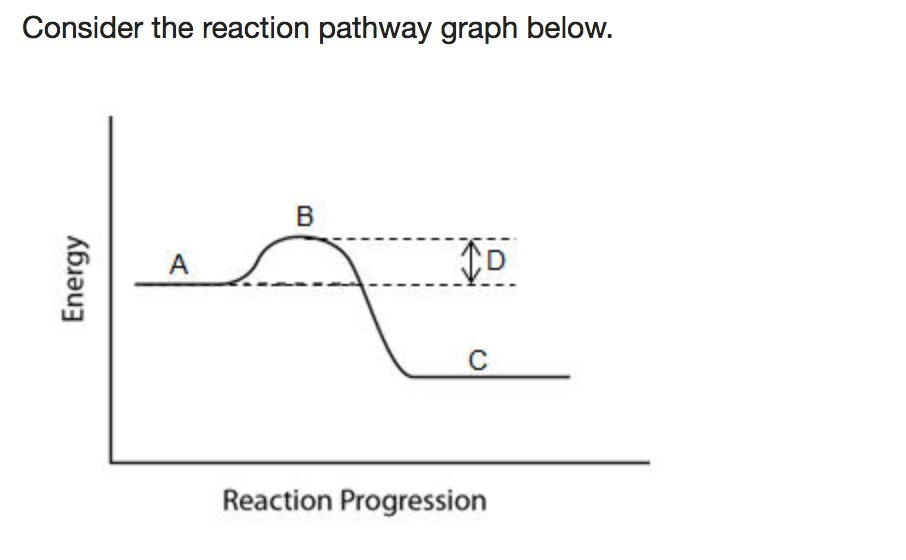
activation energy | arrow_right_alt | A |
reactants | arrow_right_alt | C |
products | arrow_right_alt | D |
Nucleotide
last place the body goes for energy
C, H, O, N
C, H, O
DNA & RNA
Slow energy, 2nd place the body goes for energy
Glycogen and fatty acids
C, H, O (1:2:1 ratio)
C, H, O, N, P
monosaccharides
Quick energy, 1st place the body goes for energy
Amino acids
Carbohydrates
Lipids
Proteins
Nucleic Acids
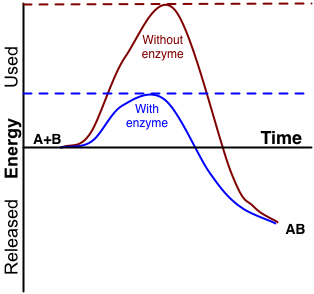
Enzymes the activation energy in order to a chemical reaction. Enzymes are also known as .
| Draggable item | arrow_right_alt | Corresponding Item |
|---|---|---|
activation energy | arrow_right_alt | A |
reactants | arrow_right_alt | C |
products | arrow_right_alt | D |
| Draggable item | arrow_right_alt | Corresponding Item |
|---|---|---|
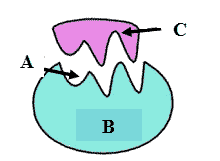
B | arrow_right_alt | active site |
C | arrow_right_alt | enzyme |
A | arrow_right_alt | substrate |
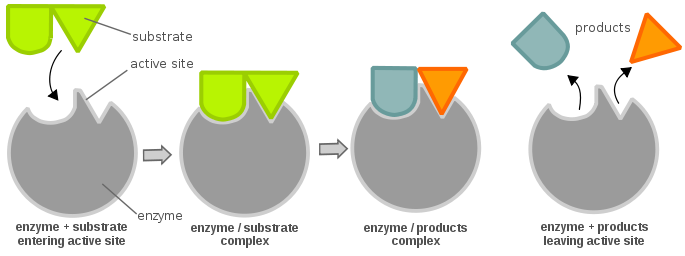
In the enzyme-substrate complex pictured below, what is happening during the third picture?
If the activation energy of a biochemical reaction is lowered with the help of enzymes, then
Reactants bind to enzymes at the . Reactants is another name for the . When the enzyme finishes the reaction with the subtract, the is released.
Another name for enzyme is which a reaction by the activation energy required for the reaction to take place.
Locate the optimal pH for the enzyme alkaline phosphatase by clicking on the correct pH number at the bottom of the graph.
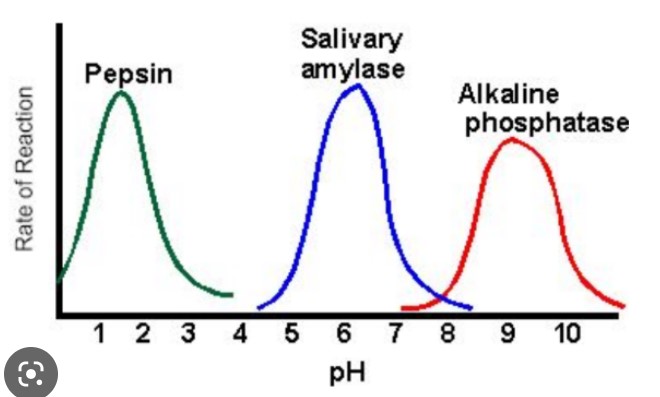
Locate the optimal pH for the enzyme salivary amylase by clicking on the correct pH number at the bottom of the graph.
Match the monomer on the left with the macromolecule that it is makes on the right.
| Draggable item | arrow_right_alt | Corresponding Item |
|---|---|---|
Nucleotide | arrow_right_alt | Protein |
Fatty acid/hydrocarbon chain | arrow_right_alt | Nucleic acid |
Monosaccharide | arrow_right_alt | Lipid |
Amino acid | arrow_right_alt | Carbohydrate |
Match each funtion AND example to the its corresponding macromolecule.
Example: DNA
Stores exccess energy
Example: Enzyme
Example: Glucose
Immediate source of energy
Example: Unsaturated Fat
Creates proteins and passses on genetic information to offspring
Structural (building structures in our bodies) and Functional (facitilitating cell processes essential for survival)
Nucleic Acids
Protein
Lipid
Carbohydrate
Use each of the descriptions below to match the macromolecule.
trying to build more muscle
if your next meal will be in a week (long term energy)
provides a quick boost of energy
eat this type if you are planning to participate in a physically demanding event, such as running in a 10K race
helps grow strong nails
bear consume as it prepares to go into hibernation for the winter
carbohydrates (2)
lipids (2)
proteins (2)
Match each molecule group based on the macromolecule it is classified as.
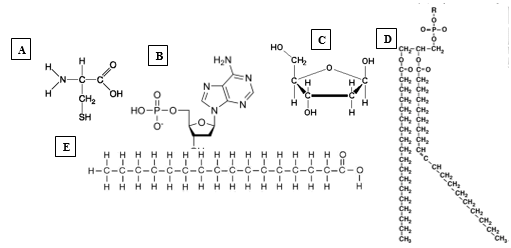
Match the correct macromolecule to its identifying characteristic.
| Draggable item | arrow_right_alt | Corresponding Item |
|---|---|---|
nucleotide | arrow_right_alt | it contains CHON |
fat or lipid | arrow_right_alt | it contains CHO and has a 2:1 of hydrogens to oxygens |
monosaccharide or simple sugar. | arrow_right_alt | it contains CHONP |
amino acid | arrow_right_alt | it contains CHO and has at least one long chain of carbons surrounded by hydrogens |
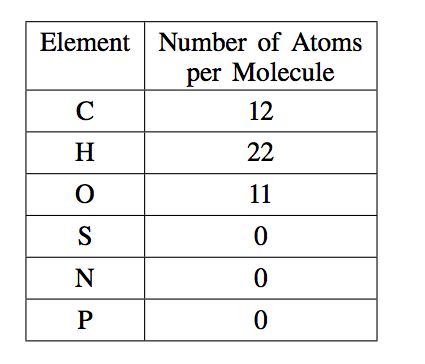
A biochemist was given a sample of an unknown organic compound and asked to determine the class of organic compounds to which it belonged. The chart shown represents the result of the biochemist's analysis of the sample. Based on these results, to which class of organic compounds did this sample belong?
Which TWO structural formulas of organic compounds shown represent carbohydrates?
The diagram below represents a process that occurs in organisms. Which statements indicates what A and B in the boxes could represent?

There are over 2000 kinds of edible insects in the world, and they are becoming an increasingly popular source of protein. One cup of cricket flour contains over 28 grams of protein.
The building blocks of the protein in the cricket flour are:
Hormones are proteins that regulate many functions in the body, such as growth and cell differentiation. Which of the following does NOT describe a function of proteins in living organisms?
Carbohydrates are a type of biological macromolecules required to carry out life functions. Which of the following statements regarding carbohydrates is true?
is a nucleic acid. It stores in cells and, like all nucleic acids, is composed chains of .
| Draggable item | arrow_right_alt | Corresponding Item |
|---|---|---|
Denaturation | arrow_right_alt | substances that are changed during a chemical reaction |
Reactant (substrate) | arrow_right_alt | the minimum amount of energy required to start a chemical reaction |
Catalyst | arrow_right_alt | loss of normal shape of a protein due to heat or other factors |
Product | arrow_right_alt | a region on an enzyme that binds to a protein or other substance during a reaction. |
Enzyme | arrow_right_alt | substance that speeds up the rate of a chemical reaction |
Active Site | arrow_right_alt | A type of protein that speeds up a chemical reaction in a living thing |
activation energy | arrow_right_alt | a substance that forms in a chemical reaction |
A catalyzed reaction will have a activation energy, and this leads to a(n) in the reaction rate.
Graph I shows the relationship between the relative rates of activity of enzymes A and B and temperature. Graph II shows the relationship between the relative rates of activity of enzymes A and B and pH.
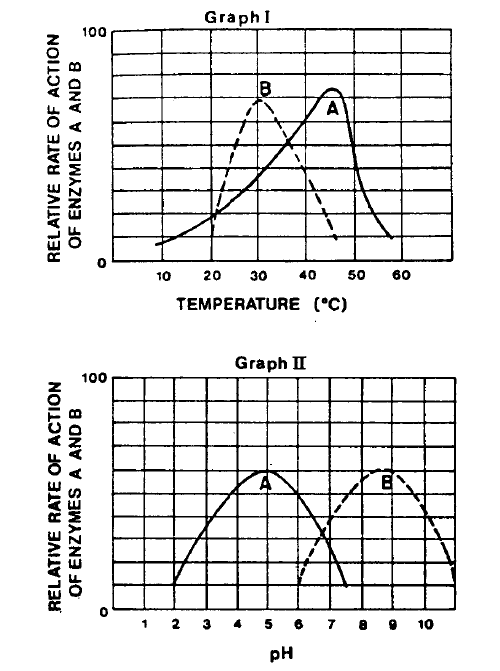
The conditions where enzyme A is most effective is a temperature of
Graph I shows the relationship between the relative rates of activity of enzymes A and B and temperature. Graph II shows the relationship between the relative rates of activity of enzymes A and B and pH.
The conditions where enzyme B is most effective is a temperature of
| Draggable item | arrow_right_alt | Corresponding Item |
|---|---|---|
Polymer | arrow_right_alt | single building block |
Monomer | arrow_right_alt | large molecule with many smaller building blocks bonded together |
Starch is a monomer of carbohydrates
The monomer of protein is while the polymer is called
The video uses the phrase polynucleotides to describe the polymer of nucleic acids. What is another term for this polymer?