Match the monomer on the left with the macromolecule that it is makes on the right.
| Draggable item | arrow_right_alt | Corresponding Item |
|---|---|---|
Nucleotides create | arrow_right_alt | Protein |
Fatty acid/hydrocarbon chains synthesize | arrow_right_alt | Nucleic acid |
Monosaccharides join to form | arrow_right_alt | Lipid |
Amino acids make | arrow_right_alt | Carbohydrates |
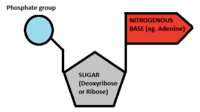
Which macromolecule is shown?
![]()
This macromolecule stores genetic information and is made up of the monomer nucleotide. The two examples for this macromolecule is DNA and RNA.
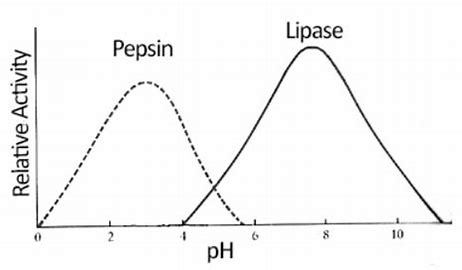
Pepsin's optimal pH is while lipase performs better at . If the Pepsin experiences a pH above 6, then it will become which means it is destroyed and cannot be used again. Note: If an enzyme remains within the preferred range, it can be reused unlimited times as new substrates appear.
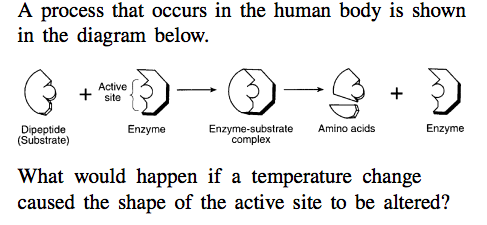
If the activation energy of a biochemical reaction is lowered (less energy is required) with the help of enzymes, then
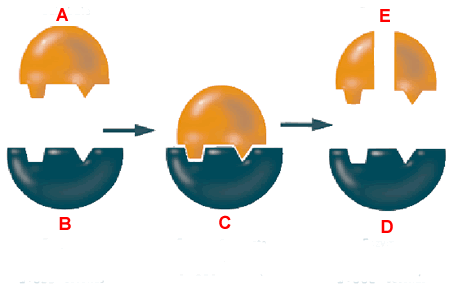
Match the correct name to each letter shown in the picture above.
| Draggable item | arrow_right_alt | Corresponding Item |
|---|---|---|
E | arrow_right_alt | substrate |
A | arrow_right_alt | enzyme |
B | arrow_right_alt | enzyme-substrate complex |
C | arrow_right_alt | product |
Scenario:
Imagine you are a scientist studying a new organism found in a deep ocean trench. This organism needs to survive extreme conditions, like intense pressure and freezing temperatures. After studying its cells, you discover that it has a special protein that helps it survive these harsh conditions.
Question: How do proteins, as macromolecules, help this organism survive in extreme conditions?