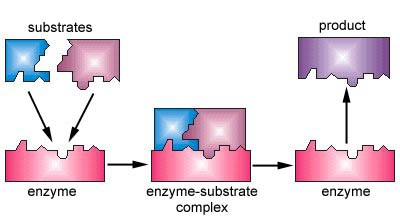
Label the diagram with the options below.
Mmuae Afoforo a Wobɛpaw:
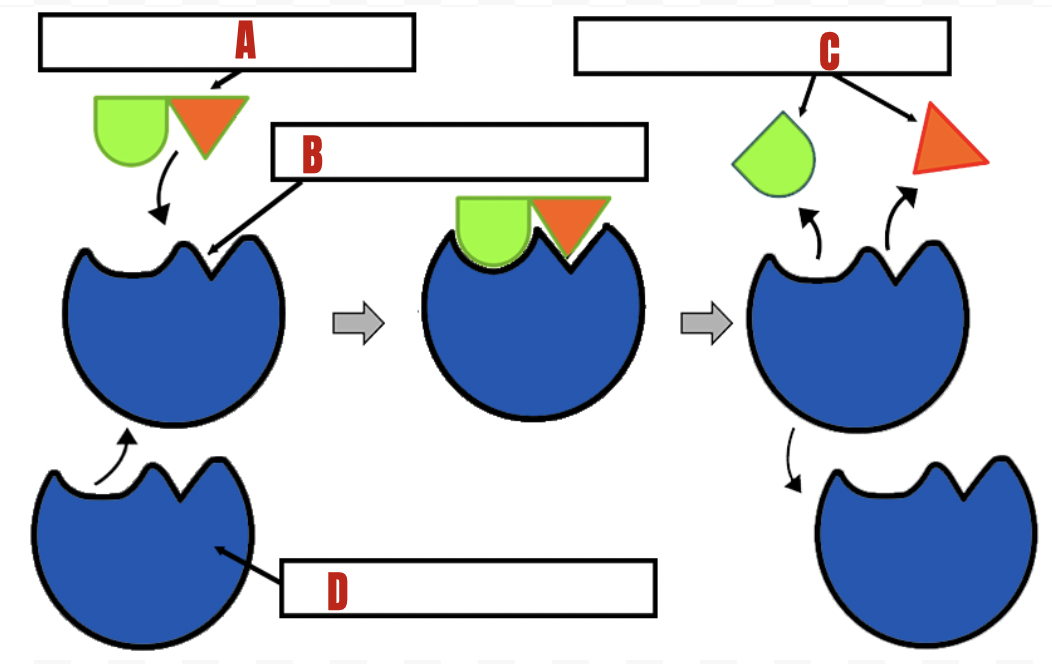
Enzyme
substrate(s)
Product(s)
Active Site
Directions: Watch the video below to fill in your Enzyme Amoeba Sisters worksheet that is in your Unit 1 packet (extras are hanging up by the door). Then answer all the questions.
Directions: Watch the video below to fill in your Enzyme Amoeba Sisters worksheet that is in your Unit 1 packet (extras are hanging up by the door). Then answer all the questions.
Read the following article on Enzymes using the following link: https://www.ducksters.com/science/biology/enzymes.php
Then take the quiz at the end of the article and upload a screenshot of your results.
How to upload a screenshot:
1. Press the print screen (Fn & PrtScr) button near the top row of your keyboard
2. Paste it into the box using "Ctrl" and "v" buttons simultaneously
I will not accept the picture unless I see TITLE and SCORE
Here are some things that can affect enzyme activity:
1. Temperature - The temperature can affect the reaction rate. The higher the temperature, the the reaction will occur. However, at some point, the temperature will become so high that the enzyme will and stop working.
2. pH - An extreme pH (high or low) will typically slow the reaction or even the reaction altogether.
3. Concentration - A concentration of substrate or enzyme can increase the reaction rate.
4. Inhibitors - Inhibitors are molecules that are specially made to stop the activity of enzymes. They may just slow down the reaction or stop it altogether. Some inhibitors bond with the enzyme causing it to change shape and not work correctly. The opposite of an inhibitor is an which can help to speed up the reaction.
Match the enzyme terms to their definitions.
| Draggable item | arrow_right_alt | Corresponding Item |
|---|---|---|
Denaturation | arrow_right_alt | Location on the enzyme where the substrate binds |
Inhibitor | arrow_right_alt | Protein that acts as a biological catalyst |
Active site | arrow_right_alt | Substance that speeds up a chemical reaction |
Enzyme | arrow_right_alt | Change in enzyme structure, usually caused by extreme heat or pH |
Catalyst | arrow_right_alt | Substance that slows down or stops enzyme activity |
Label the diagram with the options below.
Enzymes only work with specific substrates because each enzyme:
Enzymes _____________ the activation energy in order to ________________ a chemical reaction.
The best analogy for an enzyme and its substrate would be which of the following?
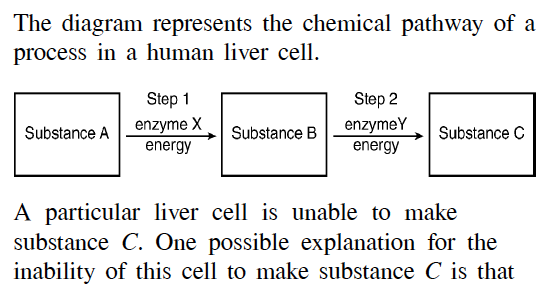
What reference does she make toward the enzymes?
Most enzymes are a
The site where the binding occurs on the enzyme is called
When the enzyme and substrate lock together (induced fit), the enzyme can:
Enzymes are not necessary for chemical reactions, but they can ______________ chemical reactions
Enzymes are known as _________ and they can be used over and over and over again
Match the correct enzyme to the macromolecule it breaks down.
| Draggable item | arrow_right_alt | Corresponding Item |
|---|---|---|
protease | arrow_right_alt | sugars (lactose) |
amylase | arrow_right_alt | lipids |
lactase | arrow_right_alt | starch |
lipase | arrow_right_alt | proteins |
Which of the following can bind to active sites/substrates to help enzymes do their jobs?
Structural changes in an enzyme can affect its ability to function correctly. This denaturation can occur as a result of _______________.
| Draggable item | arrow_right_alt | Corresponding Item |
|---|---|---|
-ose | arrow_right_alt | ending for enzymes |
-ase | arrow_right_alt | ending for sugars |