Use the video below to fill in your amoeba sisters worksheet.
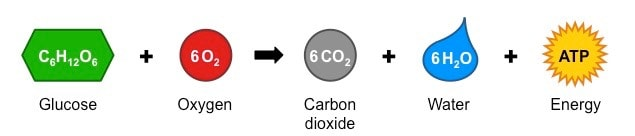
1. What raw materials (Reactants) are needed for respiration?
The energy produced during respiration is placed into what energy-carrying molecule?
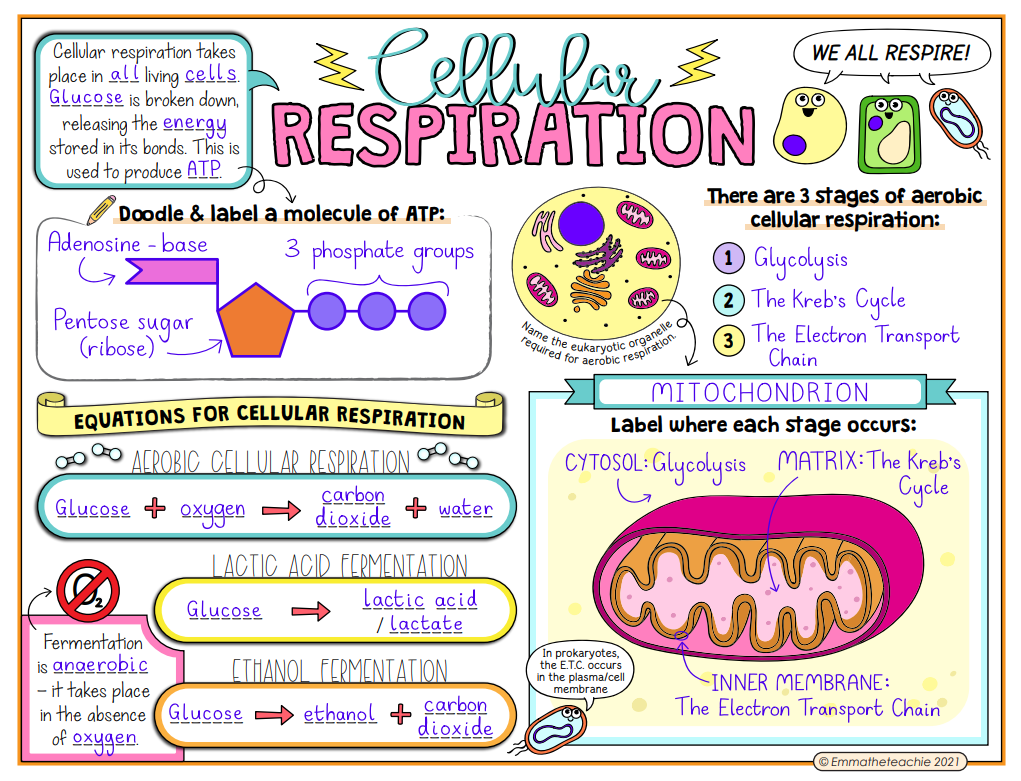
Most of cellular respiration occurs inside of which organelle?
In cellular respiration, six molecules of oxygen have been produced, as well as a single molecule of C6H12O6, otherwise known as
How do glucose and other sugars get into your body?
Cellular respiration is the process our bodies use to break down molecules and turn it into stored as ATP . ATP is like the "battery" that powers many processes in our cells. The glucose molecule is eventually turned into carbon dioxide and . There are three main stages: Glycolysis, Krebs Cycle, and Electron Transport Chain. The one stage that does not require oxygen and occurs in all organisms is: .
Use the Video Notes to match each step of the cellular respiration process with the correct location and product.
produces: CO2, 2 ATP, 2 FADH2, 6 NADH
occurs in inner mitochondrial membrane
produces: H20 and about 26-34 ATP
occurs in mitochondrial matrix
produces: 2 pyruvate, 2 ATP, 2 NADH
occurs in cytoplasm
Glycolysis - 1st step
Krebs Cycle - 2nd step
Electron Transport Chain - 3rd step
In the Electron Transport Chain, what is the final acceptor of the electrons that NADH and FADH2 carry?
Cellular Respiration generates about how much ATP in total?
What is the name of the protein molecule (an enzyme) that generates the ATP at the end of the Electron Transport Chain?
Glycolysis Function: Glycolysis is the initial stage of cellular respiration and occurs in the cytoplasm. Its primary function is to break down one molecule of glucose (a sugar) into two molecules of pyruvate (a simpler compound). This process generates a small amount of ATP and NADH.
Krebs Cycle (Citric Acid Cycle) Function: Taking place in the mitochondria, the Krebs cycle completes the breakdown of glucose initiated by glycolysis. This step helps to release carbon dioxide and the production of NADH and FADH2. The main function is to harvest high-energy electrons that will be used in the next stage, the electron transport chain.
Electron Transport Chain (ETC) Function: The electron transport chain is located in the inner mitochondrial membrane. It is the final stage of cellular respiration and involves the transfer of electrons from NADH and FADH2 to oxygen. As electrons move through the chain, LOTS of energy is released and used to pump protons across the membrane, creating an electrochemical gradient. ---------------------------------------------------------------------------------------------------------------
Light Reactions (in Photosynthesis) Function: Light reactions take place in the thylakoid membrane of the chloroplasts. Their main function is to capture and convert light energy into chemical energy stored in ATP and NADPH. Water is also split during these reactions, releasing oxygen as a byproduct.
Calvin Cycle (Dark Reactions, in Photosynthesis) Function: The Calvin cycle occurs in the stroma of chloroplasts and is part of the process of photosynthesis. Its primary function is to use the ATP and NADPH generated during the light reactions to convert carbon dioxide into glucose.
| Draggable item | arrow_right_alt | Corresponding Item |
|---|---|---|
the krebs cycle | arrow_right_alt | first step - happens in cytoplasm - involved in the breakdown of glucose (cellular respiration) |
light reactions | arrow_right_alt | produces A LOT of ATP by utilizing the high-energy electrons generated in the previous stages (cellular respiration) |
Glycolysis | arrow_right_alt | convert light energy into chemical energy - oxygen is released as a product (photosynthesis) |
electron transport chain | arrow_right_alt | utilizes this energy to convert carbon dioxide and produce glucose (photosynthesis) |
the Calvin cycle | arrow_right_alt | second step - happens in mitochondria - involved in breakdown of glucose (cellular respiraiton) |
What products are formed during respiration?