1
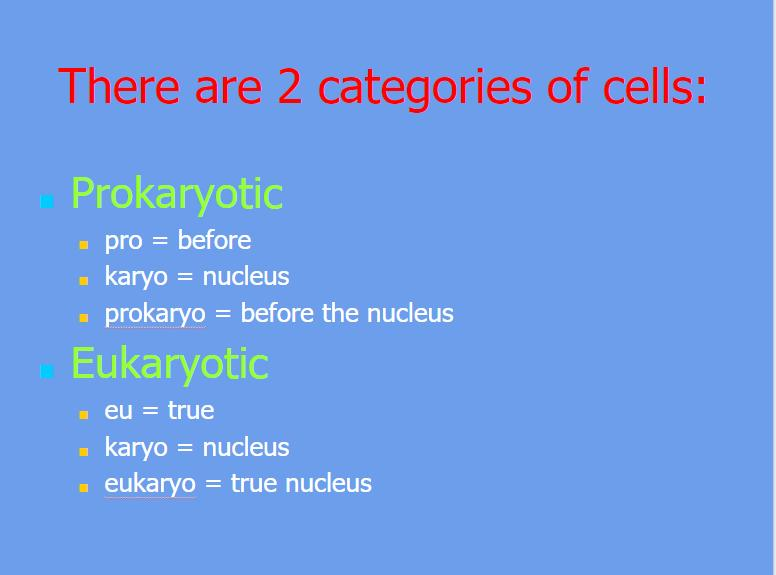
Use the picture that includes morphemes.
Eukaryote literally means
Use the picture that includes morphemes.
Eukaryote literally means
Being small and simple can be an advantage because prokaryotic cells can reproduce quickly and efficiently. This allows these simple organisms to adapt to environmental changes easier than eukaryotic cells. This increases "fitness" - their ability to survive and reproduce in spite of changes in environmental conditions.
Use the picture that includes morphemes.
Eukaryote literally means
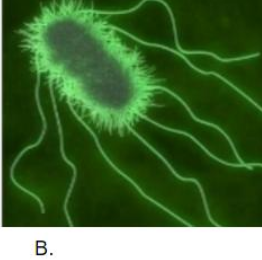
Figure B is a picture of the bacterium E. coli. It is a
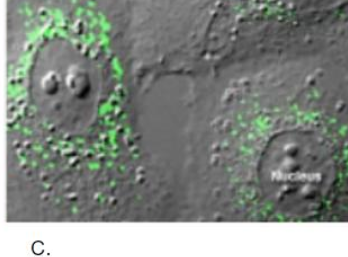
Figure C is a picture of epithelial cells (cells that line the surface of organs and tissues in humans). It is a(n) ___________________
There are 3 items in each category.
has a nucleus
no nucleus
smaller in size
the evolved cell
can be single-celled or multi-celled
very simple in structure
Prokaryote
Eukaryote
Now that you know a little about prokaryotic cells and eukaryotic cells. Try this question:
Suppose a certain poison kills human cells by blocking pores in the membrane that surrounds the nucleus. Explain why the poison (would or wouldn't) work on prokaryotic bacterial cells.
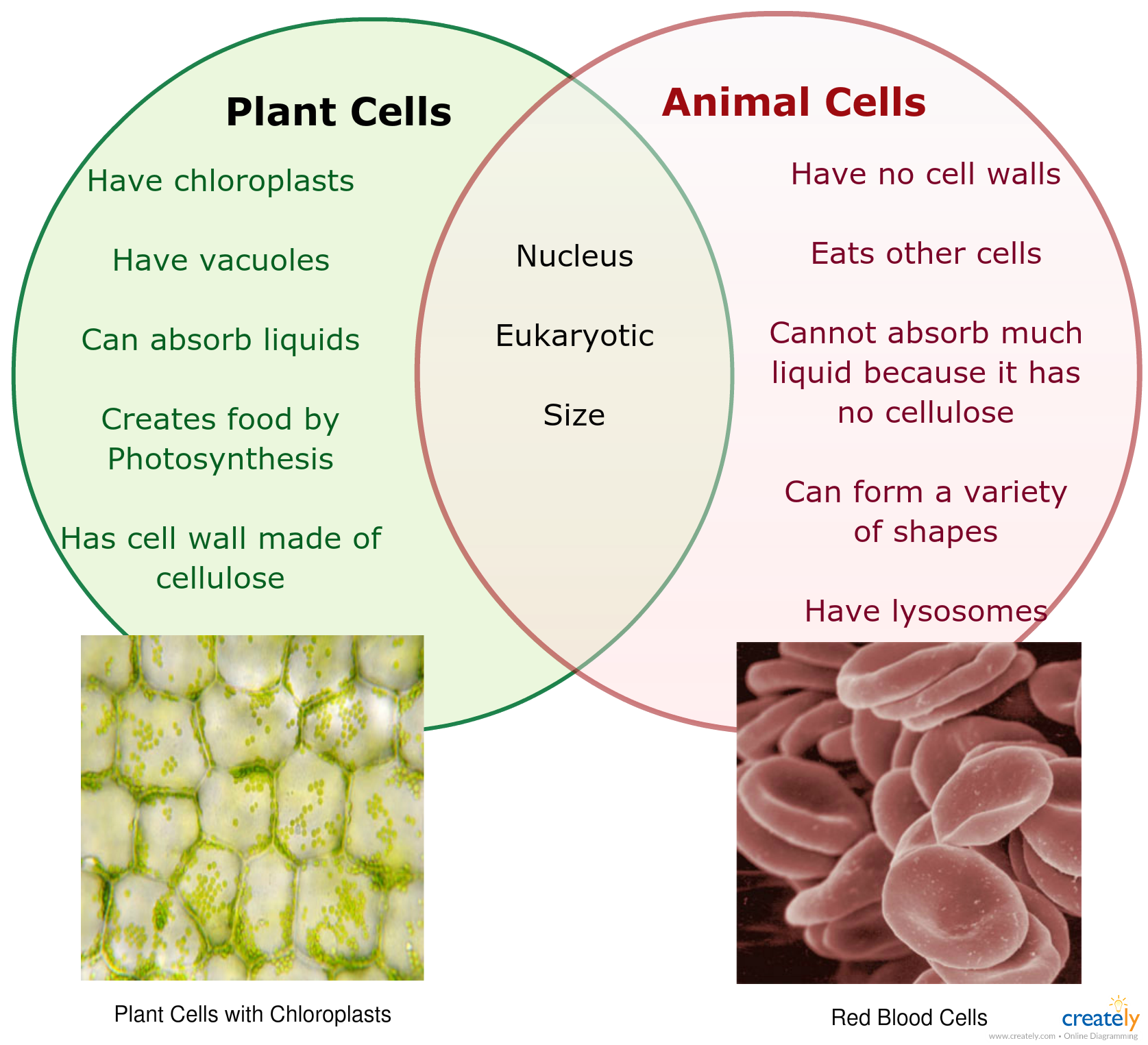
Plant cells and animal cells are both the basic building blocks of life, but they have some important differences:
Shape:
Plant Cells: Typically have a rigid, rectangular shape because of the cell wall. Animal Cells: Have a more irregular or round shape as they lack a cell wall.
2. Cell Wall:
Plant Cells: Have a strong outer cell wall made of cellulose that gives the cell structure and protection. Animal Cells: Do not have a cell wall, only a flexible cell membrane.
3. Chloroplasts:
Plant Cells: Contain chloroplasts, which allow them to make their own food through photosynthesis. Animal Cells: Do not have chloroplasts and cannot make their own food.
4. Vacuoles:
Plant Cells: Have large central vacuoles that store water, nutrients, and waste, helping maintain cell structure. Animal Cells: Have smaller vacuoles, which are more involved in storing food and waste.
5. Energy:
Plant Cells: Make energy through photosynthesis, using sunlight, water, and carbon dioxide. Animal Cells: Get energy from food through cellular respiration.
6. Lysosomes:
Plant Cells: Usually do not have lysosomes, as their central vacuole serves a similar role. Animal Cells: Contain lysosomes that break down waste and foreign substances.
In short, plant cells have more specialized structures to make food from sunlight and support plant growth, while animal cells are more flexible and rely on eating to get energy.
Sort the organelles into the correct category. There are 3 items in each category.
Chlorplast
Cell Membrane
LARGE central vacuole
Cell Wall
Nucleus
Mitochondria
Plants Only
Animals and Plants
Which type of cell is simpler?
Prokaryote literally means
Prokaryotes have a nucleus.
Which cell is more complex because it's organized with membrane bound organelles?
OPTIONAL - The venn diagram did not print into your packet. It's up to you to write it or not :)
What is the main difference in shape between plant and animal cells?
Which of the following structures is found in plant cells but not in animal cells?
What is the primary function of the large central vacuole in plant cells?