1
Water is a compound formed when two hydrogen atoms and one oxygen atom ______ bond.
Water is a compound formed when two hydrogen atoms and one oxygen atom ______ bond.
1
1
Match the term to the correct definition.
| Draggable item | arrow_right_alt | Corresponding Item |
|---|---|---|
adhesion | arrow_right_alt | the amount of heat needed to raise the temperature of 1 Kg of a substance 1degree Celcius |
capillary action | arrow_right_alt | the force of attraction between water molecules and other water molecules |
slightly negative | arrow_right_alt | a property of water that exists because ice is less dense than liquid water |
hydrogen bond | arrow_right_alt | tightness across the surface of water. |
universal solvent | arrow_right_alt | the force of attraction between water molecules and other substances like glass. |
Ice floats | arrow_right_alt | the property of water that is due to the combined force of attraction - both cohesion and adhesion. (how water enters roots of a plant) |
cohesion | arrow_right_alt | water is often called this because it dissolves so many substances. |
slightly positive | arrow_right_alt | the bond created between water molecules |
surface tension | arrow_right_alt | the oxygen end of a water molecule |
Heat capacity or specific heat | arrow_right_alt | the hydrogen end of a water molecule |
Match the term to the correct definition
| Draggable item | arrow_right_alt | Corresponding Item |
|---|---|---|
solute | arrow_right_alt | A combination of two or more substances that are NOT chemically combined |
Polarity (polar) | arrow_right_alt | a pure substance made of only one kind of atom and cannot be broken down |
compound | arrow_right_alt | Anything that has mass and takes up space |
atom | arrow_right_alt | A substance that is made of two or more elements that are chemically combined |
mixture | arrow_right_alt | the smallest unit of most compounds |
solution | arrow_right_alt | The part of a solution that does the dissolving |
matter | arrow_right_alt | the part of a solution that is being dissolved |
molecule | arrow_right_alt | A mixture that forms when one substance dissolves another |
element | arrow_right_alt | The smallest part of an element |
solvent | arrow_right_alt | means that the overall charge of a molecule is neutral even though opposite ends of the molecule have small opposite charges |
Water is a compound formed when two hydrogen atoms and one oxygen atom ______ bond.
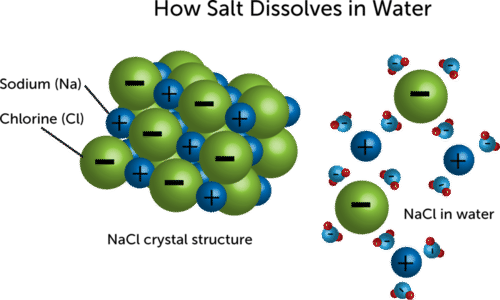
Water will dissolve salt because
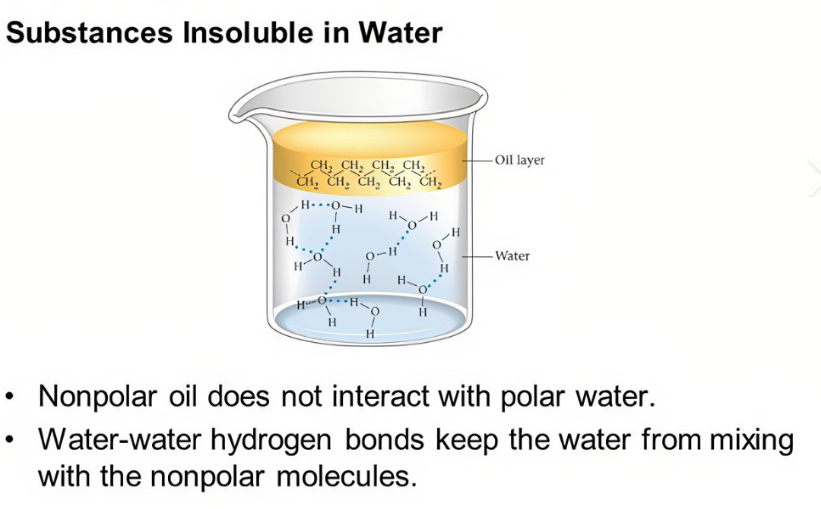
Water does not dissolve oil because
Which type of bonds do polar covalent bonds break down in chemical reactions?
Water molecules stick together through what type of bonding
Adhesion occurs when water molecules
Cohesion occurs when water molecules
Which of the following scenarios is an example of cohesion
Certain insects can "walk on water" due to the _______ of water, created by ______.
Water has a high latent (specific) heat; this means
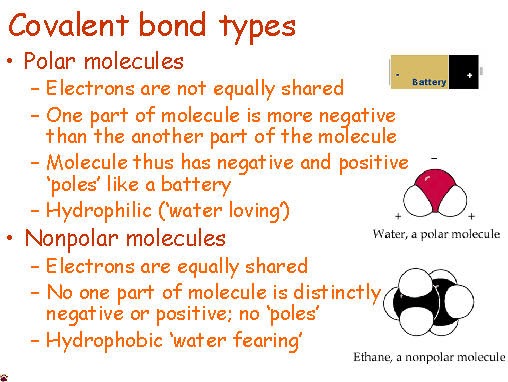
What is the definition of polar?
What type of covalent bonds do water molecules have?