For fun play this two minute game:
Play the game twice. Once in the light forest and once in the dark forest. It will allow you to play each game for 1 minute. When the game is over. It will tell you the percentage of light moths left in the population and the percentage of dark moths left in the population.
Case Study: Moths in the Industrial Revolution
RS Edleston was an English naturalist who studied insects in the 1800s. In 1848 he recorded an unusual discovery in his journal. “Today I caught an almost totally black form of Biston betularia (peppered moth) near the center of Manchester.” This is the first recorded sighting of a dark peppered moth.
What was rare in 1848 became common over the next fifty years. By 1900, the peppered moth populations in areas around English cities were as much as 98% dark moths. Scientists became curious why this was happening.
During that time, England was experiencing what is known as the Industrial Revolution. Factories were being built, and they ran by burning coal for fuel. The result was a dark smoke that covered the surrounding countryside. Trees that had been light and covered by lichens now were dark and bare. This clearly was having some impact on the moths. Scientists began to try to find out why.
Some thought the adults were changing their colors the same way the larvae could match the color of the twigs. Others thought the chemicals in the smoke darkened the moths.
Finally it was found that the color was genetic. Moths passed their color to the next generation. Eggs from light moths developed into light moths and dark moth eggs turned to dark adults. The dark color was caused by a mutation in the DNA of a single moth, and the mutated gene had been passed to all its offspring.
This explained why the moths were dark, but not why the dark moths were taking over. Did the dark moths have an advantage in the dark forests? If so, the change in the moths was a result of natural selection.
Natural selection was proposed by Charles Darwin to explain how new species evolve. All types of living things have small differences between the individuals in the species. If one of those differences allows the individual to live longer, they will likely have more offspring. As that trait is passed on, the population starts to look more like the successful individual. Over time, the species changes.
In 1896, J. W. Tutt suggested that the peppered moths were an example of natural selection. He recognized that the camouflage of the light moth no longer worked in the dark forest. Dark moths live longer in a dark forest, so they had more time to breed.
All living things respond to natural selection. Over 100 other species of moth were observed to darken over time in polluted forests. Scientists call this effect industrial melanism. Natural selection is still at work in the peppered moth. In the last 50 years, most industrial countries have significantly reduced their pollution. As predicted by the theory, the number of dark moths are dropping as the forests become cleaner.


Why did dark peppered moths become more common?
Why do frogs and other organisms reproduce soOOOO many eggs or offspring?
Do organisms "decide" to evolve and change?
Which organisms are most likely to survive?
What does "fitness" mean, in biology?
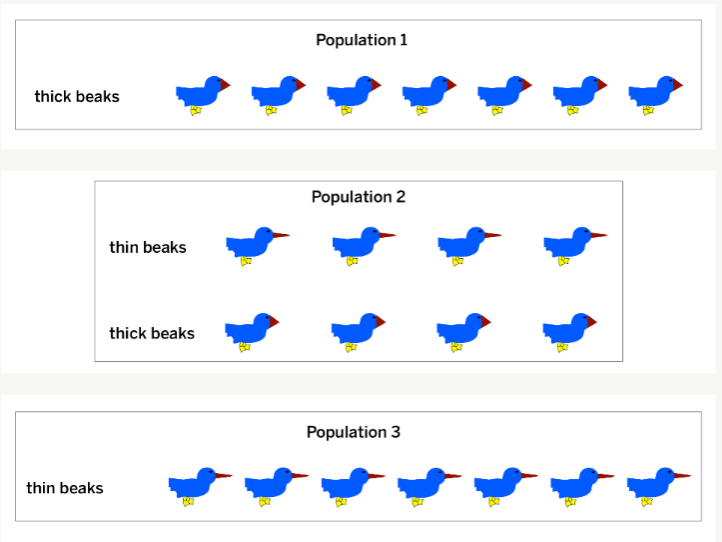
Blue jays are birds that live in the forest. They can have beaks of different thicknesses.
Blue jays use their beaks to get to the seeds they eat. Blue jays with thinner beaks can easily reach and eat the seeds inside pinecones. Blue jays with thicker beaks can easily open and eat seeds with hard shells.
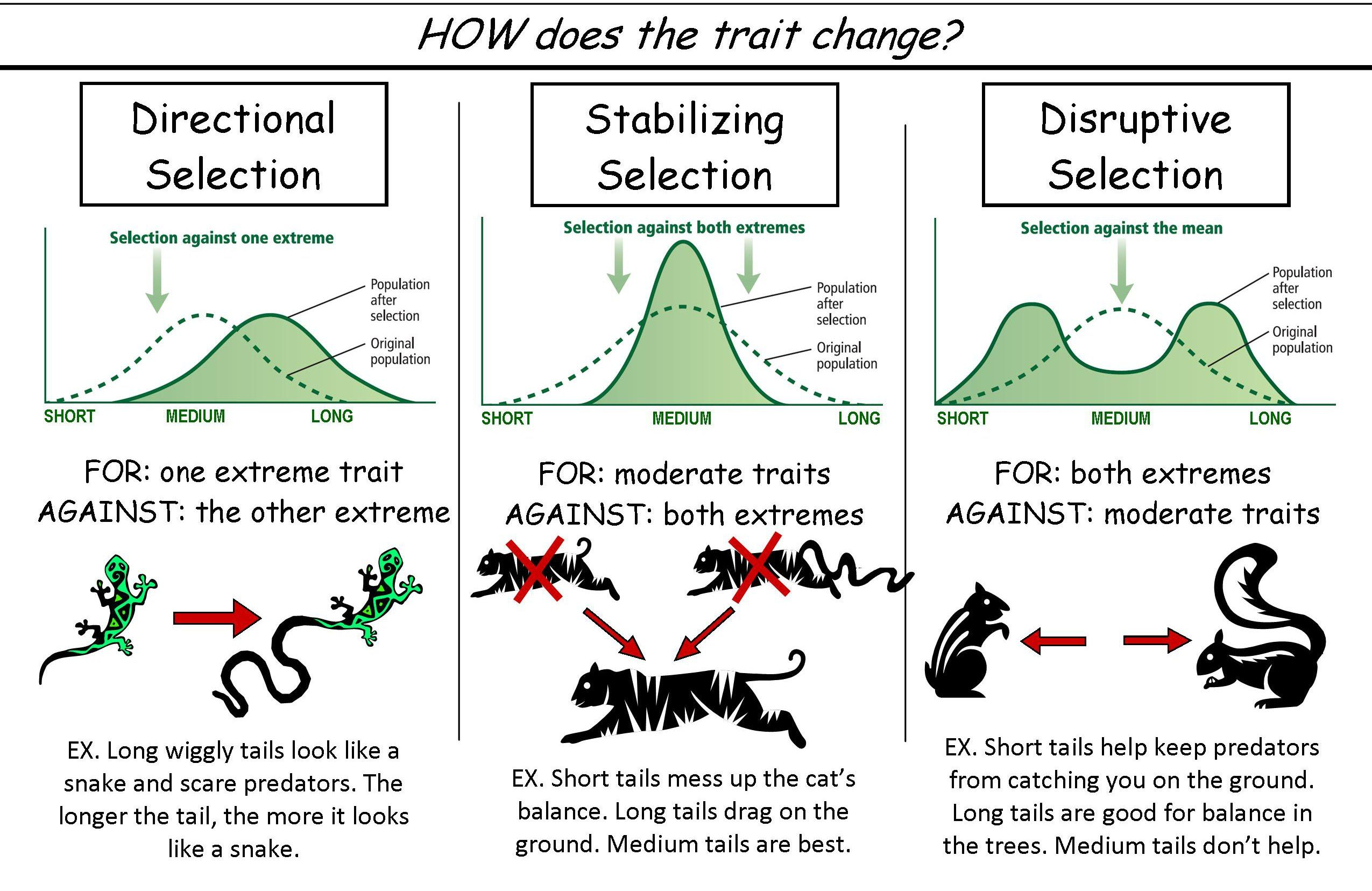
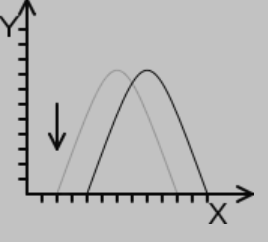
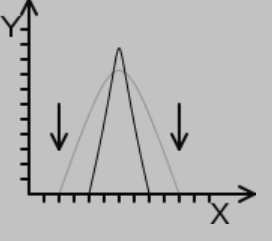
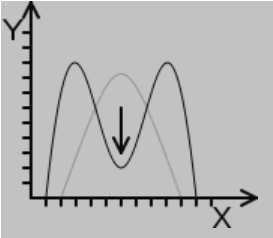
The image below shows three possible blue jay populations.
If the environment changes to have only seeds in pinecones, which of the following blue jay populations will most likely survive?
| Draggable item | arrow_right_alt | Corresponding Item |
|---|---|---|
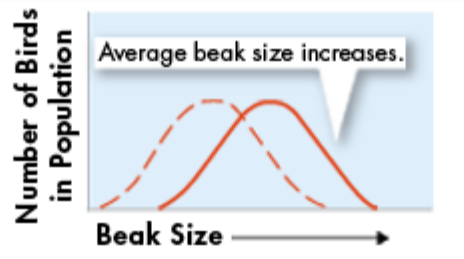
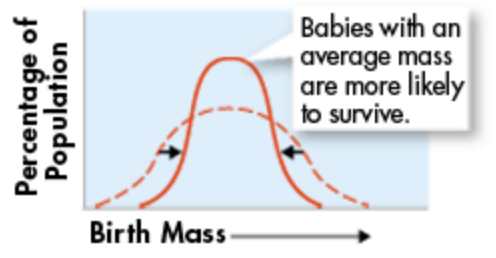
Stabilizing selection | arrow_right_alt | occurs when individuals at one end of the curve have higher fitness than individuals in the middle or at the other end. |
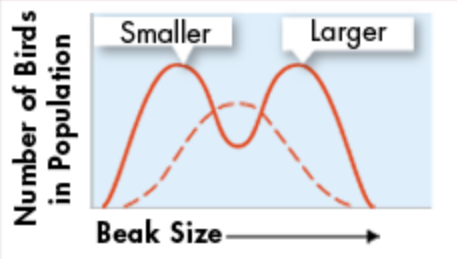
Disruptive selection | arrow_right_alt | occurs when individuals near the center of the curve have higher fitness than individuals at either end. |
Directional selection | arrow_right_alt | occurs when individuals at the upper and lower ends of the curve have higher fitness than individuals near the middle. |
| Draggable item | arrow_right_alt | Corresponding Item |
|---|---|---|
Stabilizing selection | arrow_right_alt | |
Disruptive selection | arrow_right_alt | |
Directional selection | arrow_right_alt |
If only large seeds were available, birds with larger beaks would have an easier time feeding and would be more successful in surviving and passing on genes.
Which type of natural selection is this an example of?
Very small and very large babies are less likely to survive than average-sized individuals. The fitness of these smaller or larger babies is therefore lower than that of more average-sized individuals.
Which type of natural selection is this an example of?
In an area where medium-sized seeds are less common, birds with unusually small or large beaks would have higher fitness. Therefore, the population might split into two groups—one with smaller beaks and one with larger beaks.
Which type of natural selection is this an example of?
| Draggable item | arrow_right_alt | Corresponding Item |
|---|---|---|
Stabilizing selection | arrow_right_alt | Giraffes with the longest necks are able to reach more leaves to each. Selective pressures will work in the advantage of the longer neck giraffes and therefore the distribution of the trait within the population will shift towards the longer neck trait. |
Disruptive selection | arrow_right_alt | For a plant, the plants that are very tall are exposed to more wind and are at risk of being blown over. The plants that are very short fail to get enough sunlight to prosper. Therefore, the plants that are a middle height between the two get both enough sunlight and protection from the wind. |
Directional selection | arrow_right_alt | An area that has black, white and grey bunnies contains both black and white rocks. Both the traits for white and black will be favored by natural selection since they both prove useful for camouflage. The intermediate trait of grey does not prove as useful and therefore selective pressures act against the trait. |
What did J.W. Tutt suggest about peppered moths?