Twa kɔ nsɛm atitiriw so
Log in
Sign up for FREE
arrow_back
Laabri

Unit 6 Practice Test

star
star
star
star
star
Last updated about 3 hours ago
4 Nsɛmmisa
Hyɛ no nsow a efi ɔkyerɛwfo no hɔ:

After watching the video on the different types/patterns of natural selection read each scenario and determine the pattern. Answer Directional, Disruptive, or Stabilizing.

After watching the video on the different types/patterns of natural selection read each scenario and determine the pattern. Answer Directional, Disruptive, or Stabilizing.

1
1
1
1
Asemmisa {{asɛmmisaAhyɛnsode}}
1.

Scientists noted that each of several anole lizard species in the Caribbean Islands has a body type that seems to be well suited for its own habitat. For example, the anole species that live mainly on tree trunks have stocky bodies and long legs. Anoles that live in grassy areas are slender and have very long legs. Scientists also noted that distinct anole species with the same body types can be found on several different islands. These findings are consistent with the mechanism of natural selection, which favors adaptations that allows a species to survive in its environment.

The scientists developed a few hypotheses for the finding that the twig-dwelling anole species found on several of the islands have thin bodies, large toe pads, and short legs and tails. They then performed DNA analysis on each of these twig dwelling species. This analysis revealed that the twig-dwelling species on different islands did not share a recent common ancestor.

Which of these hypotheses is supported by the findings?

Asemmisa {{asɛmmisaAhyɛnsode}}
2.

Scientists have found evidence that about 2.4 million years ago a gene regulating jaw muscles mutated and may have led to the more graceful human jaw we see today.

The diagram above shows the skulls of 3 hominid species (Gorilla, Homo erectus and Homo sapiens)
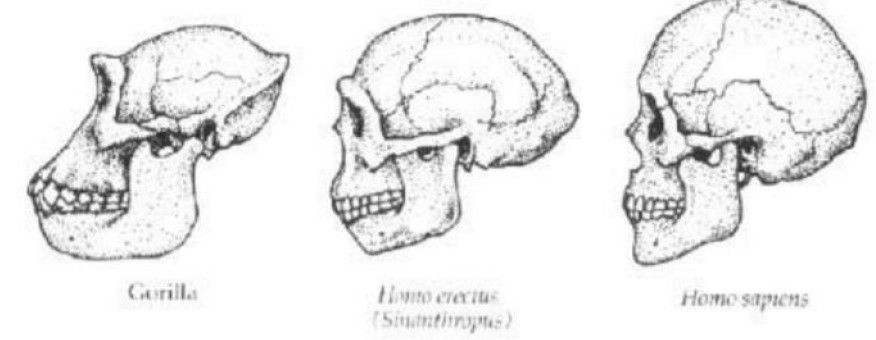
Which of the following could explain the change in jaw size according to the stated evidence .
Asemmisa {{asɛmmisaAhyɛnsode}}
3.

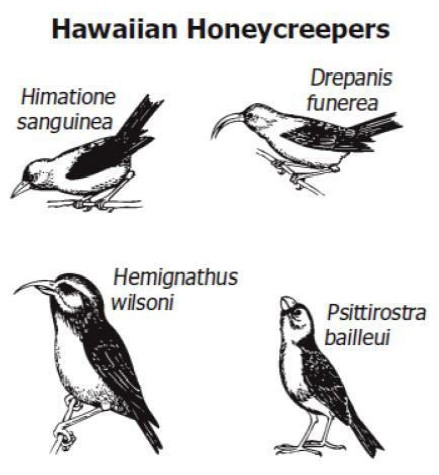
The different species of Hawaiian honeycreepers shown in the diagram below all descended from a single species of North American bird. They now have different beaks, eat different foods, sing different songs, and live in different environments on the islands.

Which factor probably contributed most to the development of these different species?

Asemmisa {{asɛmmisaAhyɛnsode}}
4.

Which graph below BEST illustrates the expected change in the finch population if the environment changes to favor small beaks?